
“Mindfulness means paying attention in a particular way, on purpose, in the present moment, and nonjudgmentally.” — Jon Kabat-Zinn, founder of the Mindfulness-Based Stress Reduction program at the University of Massachusetts Medical Center.
Over the past few years, I have been curious about why some people handle adversities and tragedies in such positive ways often showing remarkable inner strength and resiliency. Yet others seem to fall apart at the slightest bump in the road and have great difficulty bouncing back. I was drawn to the book written by Dr. Martin E.P. Seligman, entitled “Flourish” (A Visionary New Understanding of Happiness and Well-Being). Dr. Seligman is commonly known as the founder of Positive Psychology and has accomplished decades of research at the University of Pennsylvania. Flourish should be required reading for anyone interested in self-improvement and personal growth. What intrigued me most was the chapter on turning trauma into growth.
In spite of a very difficult childhood without much love, trust and security, both my brother and I are upbeat, positive people and we view the glass as half full most of the time. Although we have both faced a lot of adversities in marriages, jobs and tragic losses of loved ones, we are steadfast in optimism, kindness and respectfulness. Our deceased brother did not possess these traits and lived a troubled, unstable and addictive short life. What made the difference?
My strong desire for a greater understanding about what makes some people thrive while others get in their own way often thwarting personal happiness lead me to mindfulness.
Turns out that while striving to learn more so I could help others be more positive, I discovered I had a lot of my own personal improvement work to do.
Through mindfulness, I became aware of a lifetime of conditioned responses and buried emotions that often don’t feel very good. Mindfulness enables me to examine my feelings, my responses and my decisions in a non-judgmental way. It empowers me to live fully in the moment, create new healthy habits and strengthen my core attributes.
Being present in the moment takes practice. We have over 60,000 thoughts a day and a wide range of emotions that tag along. Our phones have become a source of constant interruption. Did you know that our daily social media consumption could span 300 feet if it were printed out? That’s the height of the Eiffel Tower.
Three of my favorite resources for cultivating more mindfulness are Dr. Ellen Langer’s Book – The Mindful Body, Dr. Lisa Feldman Barrett’s book – How Emotions are Made and Dr. Susan David’s book – Emotional Agility.
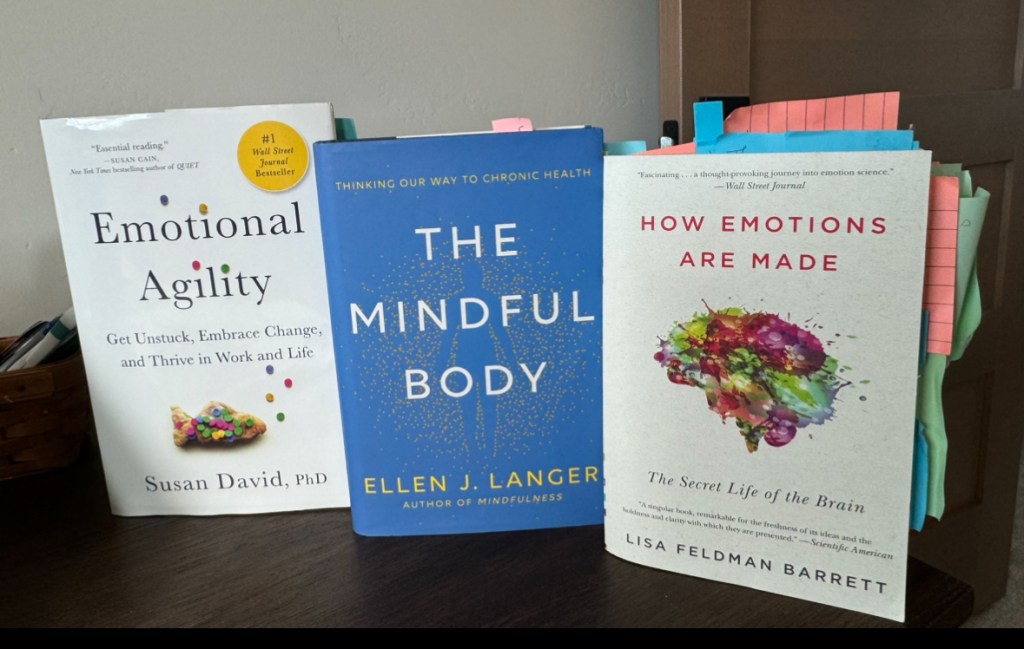
These remarkable books help us understand how our thoughts, emotions and preconceived notions keep us from being fully present and prevent us from taking in fresh perspectives, new data and meaningful updates to our human operating system – our brain.
If you prefer to watch or listen rather than read the insights from these three researchers, I will soon be providing links to podcasts and YouTube clips that will let you dip your toes into their game-changing work. — stay tuned!
- Build a Sophisticated Toolshed
- Digging in & Getting to Work
- A Coaching Tree & Board of Advisors
- Wherever You Go, There You Are
- Character Development
- Better Scripts, Better Stories
- The Stories We Tell Ourselves – Part 2
- The Stories We Tell Ourselves
- A Slice of Life
- Our Natural Resources

 Inspired New Horizons