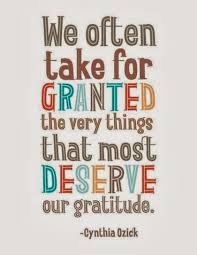
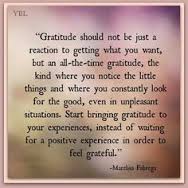
Put some Gratitude in your Attitude

Did you count your blessings as you gathered around your Thanksgiving feast recently?Wouldn’t it be great to have that appreciation for family and friends stick around for longer than one holiday?   Try putting some daily gratitude in your everyday attitude!

images-4

Good attitude is contagious….

A few days before Thanksgiving, I was wheeling a bulky shopping cart around a very congested grocery store.  My list was long and I was unfamiliar with the layout of this new store.   Since I was shopping for my pregnant daughter who is an awesome cook, there were a few items on that list that were also new to me.  It’s been quite a while since this single woman did a major family grocery shop just a few days before a big holiday.   In the midst of the produce section I took a few minutes to soak it all in — the colorful abundance of fresh food choices, the spicy scents of autumn treats, the hustle and bustle of customers filling their carts.    Taking the time to be grateful had a positive effect on my overall attitude about the daunting task ahead of me.

What impressed me the most was the calm, cheerful, helpful demeanor of the grocery store employees.  They were not acting like they were overwhelmed or exasperated by the many customers who approached them asking for help.  I witnessed the impact that this had on the customers.  Smiles were returned, people were more patient with each other in crowded aisles.   A young man in the cheese department articulated how grateful he was for his job and for the customers who made that possible.    He told me that this is how they distinguish themselves from other grocery stores — great service and gratitude.  His positive, appreciative attitude was infectious.

So I came home not only with the groceries — I came home with a generous and grateful attitude.

unknown-1


When the wheels fall off…..

We’ve had a lot of crazy things happening in our life over the past week that can put a strain on family — I tripped over the dog and injured my shoulder, my daughter lost her wallet, the baby bumped her head badly on the sidewalk, the house alarm went off in the middle of the night due to dead batteries, a flat tire on the car, the dog got an eye infection.  Well, you get it — Life!

There have been a few times recently where we all felt worn out, overwhelmed and cranky.  Admittedly it takes a little extra effort to stop and catch our breath, assess the situation and then find something to be thankful for — but it is so worth it.  Occasionally we can even laugh about the latest bump in the road.

images-7


What we learn from children…..

I’ve been trying to help my little 14-month old granddaughter cope with frustration as she is learning a new skill, is overly tired or not getting her way.   Distractions such as a favorite song or counting toes usually brings a smile to her face.  I can see the frustrations wash away as that smile breaks out and we make eye contact. When she is older, I will teach her about using gratitude and mindfulness when emotions bubble up.

images-8


Helping young children learn coping skills comes naturally to us.  As adults, we could benefit from a refresher course for ourselves.

Adopting a similar distraction technique when we are flooded with emotions can make a huge, positive difference in our lives. Instead of counting toes, we can count our blessings.

So pause to put a little gratitude in your attitude next time you find yourself frustrated, stressed out or angry.   You just might begin to smile and find a softer way to deal with problems.


Awareness = Empowerment

When life just isn’t going our way, do we react or respond?

Life throws stuff at us every day that makes us feel out of control. If we are exhausted from lack of sleep, stressed out about work, or overwhelmed with kids, laundry and housework, we are probably going to lose it! We yell at our spouse for being inconsiderate, honk the car horn repeatedly at the jerk who’s blocking traffic, send the kids to time out.

When life isn’t cooperating with us, we tend to try to control the situation to make it the way WE want it to be. We habitually activate our need for control and power when we feel discounted or insecure. Often when we try to control the situation, we do get some temporary cooperation, but overtime it undermines the long-term benefits of resolving an ongoing issue in a positive way.

Next thing you know, the same old problem keeps cropping up and we get more deeply invested in having things go OUR way, creating a chasm in our relationships and hurting people we love.

In my recent post “Patterns and Positivity” I shared insights that have been helping me become more aware of my habitual reactions and finding a fresh perspective to age-old behavioral patterns and conflicts.  It’s not surprising that a new attitude goes a long way when we try to work out our differences with others.

The hardest part is taking that deep breath and reminding yourself not to be so hasty to react when you are in the heat of the moment.

I have often been too quick to blurt out something and even it if was well-intentioned, the words I chose were not the right words and certainly my agitated tone contributed to a huge miscommunication.

It would be great to be given a mulligan in that moment so that I could reframe my response to match my true intentions. In hindsight, I often come up with a much better way to express myself. Coincidentally that usually happens when I’ve cooled off from the heated emotions and can see things from a bigger perspective.

Admittedly, I often get confused myself at how things get so crazy sometimes. I know in my heart that I really love someone and want nothing but the best for them. Yet in my efforts to help them while simultaneously respecting myself, it doesn’t feel like love and common ground at all.

At the heart of the matter is attitude and awareness — Being mindful of our attitude and being fully aware in the present moment.

Viktor Frankl (legendary psychiatrist and Holocaust survivor) observed this in the most profound way:

“We who lived in concentration camps can remember the men who walked through the huts comforting others, giving away their last piece of bread. They may have been few in number but they offered sufficient proof that everything can be taken from a man but one thing — the last of his human freedoms — to choose one’s attitude in any set of circumstances, to choose one’s own way.

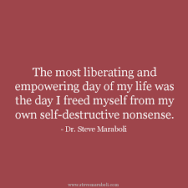
Having control of our attitude, awareness and responses is empowerment — and that is much more beneficial in resolving conflict than evoking power by being controlling or judgmental.

images

When we try to grasp control, we do damage to our relationships, often hurting someone we love. It’s really in direct conflict with what we want. We may “win” in the moment by being using intimidation, guilt or punishment. Over the long haul, we are getting further and further away from what we really need and want. Our reactive behaviors might be pushing away the love, respect and happiness we are really seeking.


If you find that there are constant battles with your child, a spouse or a friend, might there be a better long term resolution? A fresh perspective and an approachable demeanor just might open up a healthy dialogue. Try putting yourself in the other’s shoes and let go of personal attachment. You may be surprised at what you discover — about yourself and the other person too.

Look for patterns in your relationships and give yourself some time to sit with your own frustrations, angers and resentments. Bring mindfulness and compassion to where you get stuck. It’s human nature to feel the need to control when we feel disconnected and separate. We go on auto pilot wanting to defend ourselves to have less pain or gain more pleasure. Invest some quality time in getting to really know yourself and what sets you off.

images


We can’t change the flow of life yet we can change our attitude. If we can practice being less reactive and more responsive along with that new attitude, it is sure to yield a better result for everyone. Less conflict, more joy — sounds good to me.


“When we are no longer able to change a situation, we are challenged to change ourselves.                         

                                                                  — Viktor E. Frankl, Man’s Search for Meaning

Ahead of his time….

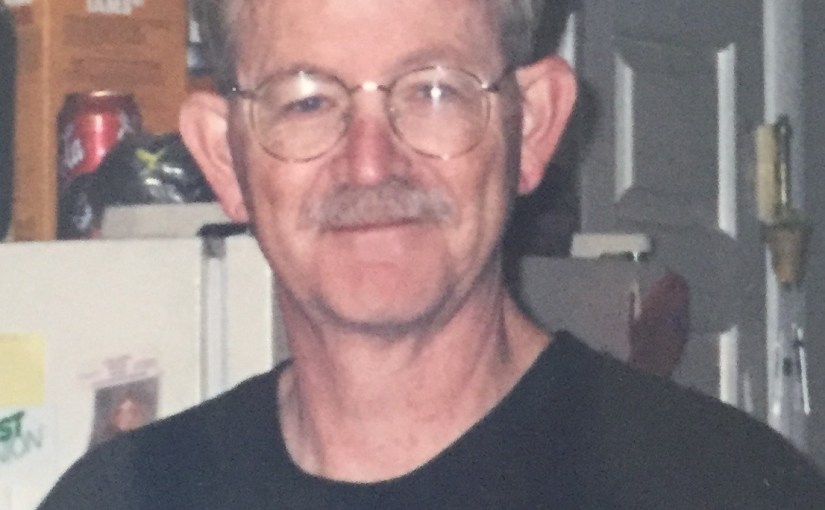
October has arrived with crispness in the air, rich autumn colors glowing in the sunrise, and an air of reflection for me.  Fourteen years ago, my beloved husband passed away very suddenly on October 9th.  I like to honor his memory by reflecting on our shared memories.  Skip Davis was ahead of his time — a mindful man with a deep appreciation for a joyful life.

Skip was generous with his heart and his wisdom.  He was kind and compassionate.  He would often say to us “Everyone has a story” — his gentle way of reminding us not to judge others.  He would take the time to ask questions and actively listen for the answers when he met someone.  He had a natural curiosity about people.  He wanted to get the backstory on a person so he could better understand them and their behaviors, attitudes and opinions.   He was mindful long before it became mainstream.

It was his innate interest in people that made him such a highly respected leader in the corporate financial world.   Even before Myers-Briggs was introduced in the workplace, Skip would take the time to get to know his employees and make a sound assessment as to where they would find the most success and be the happiest in the careers.  His attitude was “if you love your job and are given the right environment in which to excel, you will.” He was known to move employees from a technical job to a sales job and watch them flourish.  Skip had a gift for recognizing potential and talents in people that even they did not realize they possessed.  He’d take it one step further and ensure that they got the education, mentors and support system to be successful.   When someone he mentored got a big promotion, he was genuinely happy for them and proud.  He was not jealous of their success, but rather felt a strong sense of accomplishment in his contribution to their career advancement.

He conducted himself in the same caring manner at home with family and friends.  I’ve never known another person as empathic and compassionate as Skip.   It was almost as if he could walk in your shoes and feel your emotions just as you did.   He earned your trust quickly.  A man of high integrity, he never made a promise he couldn’t keep and he would go out of his way to demonstrate his love.  Even when he was angered, he kept his cool and found a gentle way to navigate a tense situation.  One of my favorite Skip quotes is this one:  “If you want someone’s attention, just whisper.”

Think about that for a few moments.  Rather than raising your voice and shouting a defensive remark that sparks a combative dialogue…….take a breath and lower your voice, calmly state your feelings and perspective.  When someone whispers, we instinctively lean forward to hear them fully and we do tend to actually “listen” rather than prepare a quick retort.  Calm is a powerful state of being.

Skip also used to say “the future belongs to those who prepare for it”.  He wasn’t one to “wing” it when it came to work, travel or at home projects.  He’d do his research, brainstorm with others (especially experts in their fields), review and rehearse — and always have a backup plan if something should go awry.

Little did I realize at that time that Skip was really giving me and others these mindfulness tools:

  • Don’t judge others.  Take the time to understand them.
  • Your words and your actions should match.  Have integrity.
  • Stay centered and calm.  Compromise is often the best option in conflict resolution.
  • Being prepared reduces anxiety and builds self-confidence.

Skip had a zest for life that was hard to contain — just ask anyone who knew him! He’d enter a room and the lights got brighter, the energy ramped up! He was always looking for the positives — in people, in circumstances, in life.

Perhaps the greatest attribute that Skip possessed was resiliency.  Skip experienced a lot of life’s adversities including the sudden loss of his mother in a tragic car accident, a brain aneurism requiring life-threatening surgery, serving in the CIA during the drug wars in Latin and South America, and a long career in international banking during the era of frequent mergers and acquisitions accompanied by massive job losses.

The greatest testament of his resiliency came on 9-11-2001.  We were at the Biltmore in Phoenix, Arizona, for an annual international banking conference.  Skip was a keynote speaker for several seminars being offered throughout the week and his sales team was in full force garner new business.  Banks from all over the globe were represented with hundreds of employees in attendance.

In the early morning of September 11th, we were awakened by a phone call in our room.  Skip’s colleague frantically told us to turn on the TV and remarked that “Amy won’t be flying home today.”  We were in shock as we watched the second plane hit the Twin Towers.

You can imagine the chaos that unfolded as all those conference attendees, the Biltmore employees and other hotel guests began to assimilate what was happening in our country. Phone lines were jammed as everyone reached out in a panicked effort to connect to loved ones across the globe, terrified as more attacks were reported.

I witnessed my husband recognizing the elements unfolding,  remaining calm yet taking action.

While other team leaders scrambled and called quick meetings in their hotel rooms to devise big schemes to hire private planes to escort their own teams back to their homes, Skip was pragmatic.

Skip knew that no one was going to be flying anywhere.  He called the local rental car agencies and reserved as many vehicles as possible.   He determined that a majority of attendees could drive across the country to their families.  It was in fact the only option they really had.  He also made multiple hotel reservations across the country, estimating travel times for major cities across the U. S.   He determined that it would take 3 days driving 800 miles a day to get home on the East Coast.  ( I should point out that this was long before iPhones, Siri and accessible GPS.)

Skip went to Biltmore management and arranged for large screen TV’s to be brought into the largest conference rooms so that attendees could gather together to watch the ongoing news coverage.

He and his team were scheduled to host a private dinner party at the Heard Museum that evening.   Instead, Skip arranged for the caterer to prepare additional food and bring it all to the  Biltmore where he provided dinner for all the conference attendees.

In the midst of all the shock, fear and helplessness, Skip remained calm and comforting to others.  He encouraged people to be together, to offer support and compassion to each other.  He gave a lot of hugs, looked people directly in their eyes and offered his soft, calming words of comfort and concern.

What resonated so deeply with me as I watched Skip’s resiliency was how he genuinely cared for all others.  His personal resiliency was contagious and a few others followed his example.  I believe that many of us found courage we didn’t know we had because of his leadership.

The definition of resiliency is the ability to bounce back quickly from adversity.  Skip took resiliency to a new level.  He not only personally recovered quickly, he reached out and offered support to others immediately.  He shared by example.

Each year at this time, I reflect on how blessed I was to have been married to such an incredible man.  Although our time together was much too short, the gifts he gave to me and our family stay with us forever.   The best way I can honor Skip is to continue to grow in my mindfulness practice and to emulate his approach to life.