Positive Changes

When I started my blog over three years ago, I was in the early stages of learning about mindfulness and creating a vision of what I wanted from life as I ventured deeper into retirement alone.

Part of the motivation to begin blogging about this journey was to help others who also might be struggling with unplanned changes in their life. At the time, I was living in a large retirement community in central Florida surrounded by others in my age group with a myriad of life events that were also altering their well designed plans. A relationship breakup threw me into a bit of a tailspin and I realized I needed to reevaluate a lot of things in a new light.

Relationship breakups, health crisis and loss of loved ones are not restricted to retirement communities and I soon found that so many people at different stages of their life were similarly searching for ways to build a life that was rooted in balance, peace, trust and respect — and that would enable them to fully enjoy people and activities that they loved.

I am deeply grateful for my Florida friend who introduced me to Mindful Magazine because those articles and those teachers became the foundation for the reshaping of my life plan. She and I forged a buddy system for mindfulness in our lives and we encouraged each other as we dug deeper into what matters most for our happiness.

I won’t lie to you and say that it was easy to take a very deep look at myself and commit to changing old behavioral patterns that were not serving me well. Its really uncomfortable when you know in your heart you are a good person and you want only good for others, but just maybe the way you go about it is not beneficial in the long run.

There are so many great resources available to help us all better understand how and why we have developed our coping skills, our triggers and learned behavioral responses and even how our racing mind sabotages our best intentions.

If you check out some of my prior posts, you will know that I’ve been guided through my personal growth journey by Brene Brown, Rick Hansen, Thich Naht Hahn, Jon Kabat Zinn , Pema Chodrun ,Deepak Chopra and Oprah Winfrey (just to. name a few).

I gained a deeper understanding of how my childhood experiences planted seeds of unhealthy behavioral patterns that I carried far into my adult life. I learned a lot about how my fears of confrontation negatively impacted my self esteem and wise decision making.

Perhaps the most enlightening thing that I uncovered was this: I have a passion for helping others and it brings me joy. Without boundaries however, I was devoting my time and energy to people who were unappreciative or unwilling to do for themselves. I became a magnet for needy people. In the process, I snuffed out my own joy. Now I understand why I felt so resentful.

While soaking up as much knowledge and understanding as I could process from all those inspirational leaders I mentioned above, it was necessary to sit alone and work through how all these revelations played out in my life.

That required a lot of journaling, a lot of crying and miles of long walks — not to mention more of Brene Brown’s Ted Talks.

Ultimately it also meant that I incorporated mediation into my personal development plan. And as noted in prior posts, I was terrible at it. Each time I sat down to meditate, ten thousand thoughts came rushing into my brain.

This was perhaps the one time where my natural stubbornness proved helpful. In 2018, I. made a commitment to meditate every day twice a day. Short meditations — after all I was being realistic. I used the Headspace app which helped me stay accountable to this goal as well as providing some really meaningful topics to explore. I did mostly guided mediations but by autumn, I ventured into unguided sessions too and was remarkably surprised to discover that I had the ability to clear my mind with ease. There are so many good things to share about meditation that I plan to devote another blog post to it very soon.

But for now, I want to share one of the greatest tools for breaking new ground while changing old habits — Friendship.

I am very blessed to have an incredible life long friend who has played an instrumental role as confidante, coach, cheerleader and sounding board. Ironically enough, both my friend and I had been taking stock of our lives in our early 60’s and knew in our hearts that we needed to make some serious changes if we wanted different results.

This is precisely where Brene Brown’s teachings hit home for me. My dear friend was the one I trusted the most to share my deepest, darkest parts of my life story. I could openly tell her about my insecurities, bad decisions, doubts and hardships. I’d carried some of this stuff buried deep for years. Being able to unburden myself with a friend that really listened was one of the greatest gifts I have ever received. And not surprisingly, when you find the courage to open up to someone you trust, they will often share in turn with you. My treasured friend and I have deepened our relationship in the most profound way. We have also helped each other through some very difficult but necessary behavioral changes. Today we high five each other when we tell our stories of how we handled a situation in a much more mindful and productive way.

While it is important to gain knowledge and insight from books, Ted Talks, journaling and meditating, I believe that having compassionate, caring friends that you trust are the glue that makes the personal growth process really come together and stay solidly in place.

As a direct result of all the hard work I have done on my self over these past few years, I have a peaceful, balanced and joyful life. That does not mean that I don’t have trials or troubles. It does mean that I can handle life’s adversities with grace and resilience.

I am a firm believer that when we share our stories and talk honestly about the work we’ve done to grow, we are a source of motivation and inspiration for others.

Helpful Resources:

  • Brene Brown, Researcer
  • Soundstrue.org
  • Mindful Magazine and Mindful.org
  • Rick Hanson, American psychologist
  • Pema Chodron, American Tibetan Buddhist
  • Jon Kabat Zinn, American Professor
  • Thich Nhat Hanh, Vietnamese Monk

The Vulnerability Connection

True connection with others often comes to us through some of the toughest moments in our lives. Isn’t it ironic that when we are our most vulnerable we are the in best possible place to receive love, support, encouragement and hope?

We shed our protective emotional armor in the face of our darkest, scariest moments and let in comfort, soothing words, a warm hug, caring helpers. The compassion, tenderness and kindness of others wraps around us like a warm soft blanket soothing our pains and fears.

Those caring helpers rise to the situation — setting aside their busy schedules, making time to listen, becoming more aware of another’s true needs.

When someone we love is struggling with a challenging life hardship, we step out of our comfort zones and find strength and courage to do what is needed. The desire to help overrides any fears we have about showing up and being really present for someone else.

All this happens very naturally in times of great crisis.

The phenomenon of being so vulnerable and having others recognize it and come to you with open arms and hearts is compassion in its truest form.

We learn a lot about ourselves when we are both the ones in need and also the ones who give.

When we are vulnerable, we break. open and soak in the offerings of love and support. We are just too weary, too scared, too overwhelmed to fight it. Have you ever silently powered through a difficult situation or problem, never once asking for the help or advice that might have eased the situation?

When we “show up” in a big way for someone in great need, we find our courage to be with someone who is in a very dark and lonely place. We take some light to them in the way of comforting words, shared tears, our time. That’s a big one — our time — suddenly we clear our busy calendars and we make time to just sit and listen. Do we do that enough in our every day lives?

Although it is often a big crisis that brings out the most nurturing genuine support and the willingness to accept it, there are so many small opportunities each and every day to make a difference in the lives of those we love.

Be willing to be a little more vulnerable and open us to those you trust and share your stories, your experiences, your problems. Asking for help is not a sign of weakness — it is an opportunity for someone who cares about you to feel valued by being able to offer support.

On the flip side, reach out to others in a meaningful way just in the course of ordinary daily life. A simple act of random kindness can truly have a big positive impact on another. A phone call, a coffee date, a handwritten card, an inside joke — these are all simple gestures that convey you care.

Our most meaningful relationships are often forged by stringing together all the small moments of real connection.

Vulnerability sounds like truth and feels like courage. Truth and courage aren’t always comfortable, but they’re never weakness.” “Vulnerability is the birthplace of love, belonging, joy, courage, empathy, and creativity.” ……Brene Brown

Stay Calm and Problem Solve

Yesterday I had the most enlightened, dynamic conversation about our country with my shared ride driver – a 28 year old Russian immigrant.  In 30 minutes, I got quite a history lesson from his personal experiences.  No subject was left uncovered — immigration, gun control, drugs, politics, family and personal conflicts.  It was obvious he had much on his mind and in his heart.  Little did he know, but he gave me a fresh perspective on many things that were heavy on my mind about our country’s current environment.

I am always surprised by the nuggets of wisdom I get from chatting with others when I travel.  Regardless of age, race, nationality or religion, conversations often flow easily especially if we connect with each other by some common thread.  Could be grandchildren, travel adventures, current events or a book they are reading.   Many times I find that I am challenged in a positive way to broaden my perspective by seeing things through another’s eyes.

As I said goodbye to my Russian driver yesterday, I reflected on this simple concept:

If we spent more time on finding our common ground, we’d most likely find  the willingness to work together to solve our shared complex problems.

When we label, we are not helping — we simply create an “us vs. them” environment.

When we blame, we deflect responsibility for finding solutions.

When we  bristle at things we disagree with, we close the door on learning from another perspective.   Often the solutions to many problems lie in that space where things are really uncomfortable.  Not insurmountable, simply uncomfortable.  Get curious, ask questions, have civil and constructive conversations.

I have friends whose political views are quite different from my own.  Yet our core values about family, personal integrity and making positive contributions to others is in full alignment.  This collective group of friends have all experienced adversities in life where we depended on each other for support, encouragement, help.   We did not let our political or party differences create a roadblock in our personal relationships.

Social-Media-Overreaction


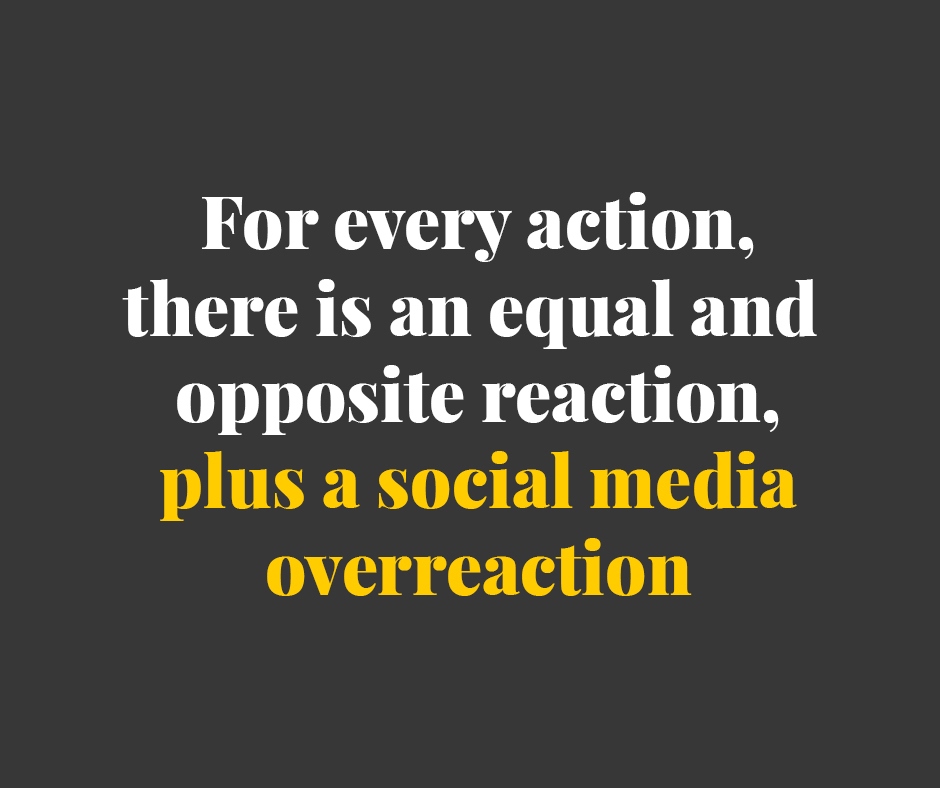
Thanks to social media, especially Twitter,  we are caught in an eddy of reactivity while being pelted with a hailstorm of opinions from news media and followers.  We can barely catch our breath yet alone take time to process major events for ourselves.

Often the vulgar language, the name calling, and offensive vitriol is what catches our attention first — and what we immediately react to — missing completely the main issue that needs a resolution.    We have examples of this poor behavior from both parties and celebrities.

It is a sad reflection on those who lose sight of their personal integrity by allowing their highly charged emotions to take control —  spewing remarks they most surely must later regret.  It is even sadder to think that many of these high profile people have a unique platform to present problems in an honest, intelligent way — and to solicit constructive conversations to find solutions.

Instead, that thunderstorm of contagious heated emotions clouds the core issues  we must collectively address.   We need to find our way back to civil discourse, courtesy and calm.

When parts of our country are hit with natural disasters (hurricanes, wildfires, volcanic eruptions), we seem to find our way back to humanity.   Communities unite to help each other regardless of political party, race, status, religion.  We band together to provide basic needs for survival and then for rebuilding.   Help pours in from everywhere  such as volunteers, fund raisers, even other countries offering aid.

Many of us are currently feeling heart-heavy, news weary and isolated from others because of labels.  Each day we are given opportunities to get out of our comfort zone, to get curious and ask more questions especially of those with whom we disagree.

Perhaps if we treat our country’s complex issues as our collective problem and not problems created by party, we can stop the us vs. them game that feels like tug of war.  We are all in this together.