A Year of Meditation

Making a commitment to practicing meditation twice a day for a full year in 2018 turned out to be a meaningful game changer for me. It was the mental equivalent of gaining the benefits from diet and exercise — more energy, more resilience and more clarity.

There were a few reasons I wanted to give mediation an earnest effort. Mindfulness and Brene Brown’s teachings had really opened my eyes to my conditioned responses to various triggers in my life.

So understanding how I get “hooked” and how I might subsequently react was part one of my personal growth process. Part two is getting better at managing those responses and emotions. That is a role that meditation plays.

We’ve all had those times in our lives when inadvertently someone hit a “soft spot” and we reacted poorly — losing our temper, stuffing our true emotions, or numbing ourselves. We get triggered emotionally and react out of habit.

Not getting hijacked by our racing thoughts, not getting caught up in someone else’s negative energy and being able to have good emotional regulation under pressure — those are all great tools that enable us to better listeners, stronger support systems and resourceful problem solvers.

Practicing meditation regularly helps tame those racing thoughts and return to a place of calm. Where there is calm, there is clarity. We can make better decisions with a clear head.

What further motivated me was learning that we practice meditation for others. Does that sound strange? It did to me until I discovered that mediation helps us bring our best selves to each relationship and each experience. A lot of miscommunication and misunderstandings can be averted when we remain calm and are able to give our full attention to another and to the unfolding situation at hand.

Lastly, I have always been fascinated by the neuroscience of meditation and the positive impact that it has on brain health.

Consider this compelling excerpt from The Chopra Center Website: Over the years, studies from the University of British Columbia and Harvard have proven that meditation is more than just a simple relaxation tool… it can have life-altering effects on your brain!  Fascinating discoveries have shown that regular meditation: increases tissue mass in the area of the brain controlling impulses and maintaining attention; Increases thickness in the region of the brain responsible for body awareness and stress management; and shrinks the amygdala which is responsible for processing sadness, anxiety and negative emotions.

Here are a few examples of how daily mediation has impacted my quality of life in a positive way:

No more rumination — I was the queen of rumination, reliving past experiences, with a lot of the strong emotions still very much attached to hurtful experiences. Always looking for answers to questions that will forever remain unanswered. I’ll confess that I have had many a sleepless night thanks to rumination. Today if I recall a memory of a painful experience I can reframe it, review it with the knowledge and awareness I have today and learn from it. The best part is that the strong emotions that were a driving force in the rumination process are not present in the review process.

Being emotionally aware — When I get triggered or feel a strong emotion, I take time to really feel it and then take a big pause before I react. In that space, I can make a better choice about how (or if) to engage. My integrity and intention will guide me not a knee jerk reaction. I feel more in control. I learned a lot about the benefits of being emotionally. aware from Gary Zukav, author of Seat of the Soul. Meditation practice helped me learn how to do this in the heat of the moment.

Setting and keeping personal boundaries — As a born people pleaser, this was an area that I really needed to develop. I frequently gave in to keep others happy only to find myself unhappy, often feeling unappreciated and disrespected. I knew I was allowing this to happen by not having boundaries and it was fear that others wouldn’t like me or would think me insensitive that prevented me from setting them. That is no longer the case. I can articulate my personal boundaries to others clearly. Most importantly, I honor those boundaries myself — I have learned to say “no”. Oddly enough, it turns out that others actually respect you more when you do have personal boundaries. I will share that it was the guided mediation practices on the Headspace app that played a key role. The app offers a variety of courses in the Personal Growth section that help you dig deeper into those areas where you might be feeling challenged or uncomfortable.

Sleeping better – If I wake up in the middle of the night, I can stop my mind from heading onto the speed ramp of racing thoughts. Daily meditation practice has given me the skills to quiet my mind. Yet I think the real reason I am sleeping longer and more peacefully is due to the stress reduction throughout my day. Meditation is part of my daily self care routine — making time to sit quietly twice a day for the formal meditation practice. This really sets me up to be able to bring those skills into my daily life. So my days are calmer, less stressful, lighter and more productive. That’s a great way to go to bed.

I cleared out a lot of real estate in my busy brain thanks to meditation. It is much easier to be fully present to enjoy both the little and big moments in life when racing thoughts and triggered emotions aren’t distracting me.

Helpful Resources:

Headspace app, developed by Andy Puddicombe

Seat of the Soul, written by Gary Zukav

As always, I recommend watching YouTube videos and Ted Talks by Brene Brown, Deepak Chopra, John Kabat-Zinn and Rick Hanson. Oprah Winfrey’s SuperSoul Sundays on Facebook and her podcasts are also inspiring.
Positive Changes

When I started my blog over three years ago, I was in the early stages of learning about mindfulness and creating a vision of what I wanted from life as I ventured deeper into retirement alone.

Part of the motivation to begin blogging about this journey was to help others who also might be struggling with unplanned changes in their life. At the time, I was living in a large retirement community in central Florida surrounded by others in my age group with a myriad of life events that were also altering their well designed plans. A relationship breakup threw me into a bit of a tailspin and I realized I needed to reevaluate a lot of things in a new light.

Relationship breakups, health crisis and loss of loved ones are not restricted to retirement communities and I soon found that so many people at different stages of their life were similarly searching for ways to build a life that was rooted in balance, peace, trust and respect — and that would enable them to fully enjoy people and activities that they loved.

I am deeply grateful for my Florida friend who introduced me to Mindful Magazine because those articles and those teachers became the foundation for the reshaping of my life plan. She and I forged a buddy system for mindfulness in our lives and we encouraged each other as we dug deeper into what matters most for our happiness.

I won’t lie to you and say that it was easy to take a very deep look at myself and commit to changing old behavioral patterns that were not serving me well. Its really uncomfortable when you know in your heart you are a good person and you want only good for others, but just maybe the way you go about it is not beneficial in the long run.

There are so many great resources available to help us all better understand how and why we have developed our coping skills, our triggers and learned behavioral responses and even how our racing mind sabotages our best intentions.

If you check out some of my prior posts, you will know that I’ve been guided through my personal growth journey by Brene Brown, Rick Hansen, Thich Naht Hahn, Jon Kabat Zinn , Pema Chodrun ,Deepak Chopra and Oprah Winfrey (just to. name a few).

I gained a deeper understanding of how my childhood experiences planted seeds of unhealthy behavioral patterns that I carried far into my adult life. I learned a lot about how my fears of confrontation negatively impacted my self esteem and wise decision making.

Perhaps the most enlightening thing that I uncovered was this: I have a passion for helping others and it brings me joy. Without boundaries however, I was devoting my time and energy to people who were unappreciative or unwilling to do for themselves. I became a magnet for needy people. In the process, I snuffed out my own joy. Now I understand why I felt so resentful.

While soaking up as much knowledge and understanding as I could process from all those inspirational leaders I mentioned above, it was necessary to sit alone and work through how all these revelations played out in my life.

That required a lot of journaling, a lot of crying and miles of long walks — not to mention more of Brene Brown’s Ted Talks.

Ultimately it also meant that I incorporated mediation into my personal development plan. And as noted in prior posts, I was terrible at it. Each time I sat down to meditate, ten thousand thoughts came rushing into my brain.

This was perhaps the one time where my natural stubbornness proved helpful. In 2018, I. made a commitment to meditate every day twice a day. Short meditations — after all I was being realistic. I used the Headspace app which helped me stay accountable to this goal as well as providing some really meaningful topics to explore. I did mostly guided mediations but by autumn, I ventured into unguided sessions too and was remarkably surprised to discover that I had the ability to clear my mind with ease. There are so many good things to share about meditation that I plan to devote another blog post to it very soon.

But for now, I want to share one of the greatest tools for breaking new ground while changing old habits — Friendship.

I am very blessed to have an incredible life long friend who has played an instrumental role as confidante, coach, cheerleader and sounding board. Ironically enough, both my friend and I had been taking stock of our lives in our early 60’s and knew in our hearts that we needed to make some serious changes if we wanted different results.

This is precisely where Brene Brown’s teachings hit home for me. My dear friend was the one I trusted the most to share my deepest, darkest parts of my life story. I could openly tell her about my insecurities, bad decisions, doubts and hardships. I’d carried some of this stuff buried deep for years. Being able to unburden myself with a friend that really listened was one of the greatest gifts I have ever received. And not surprisingly, when you find the courage to open up to someone you trust, they will often share in turn with you. My treasured friend and I have deepened our relationship in the most profound way. We have also helped each other through some very difficult but necessary behavioral changes. Today we high five each other when we tell our stories of how we handled a situation in a much more mindful and productive way.

While it is important to gain knowledge and insight from books, Ted Talks, journaling and meditating, I believe that having compassionate, caring friends that you trust are the glue that makes the personal growth process really come together and stay solidly in place.

As a direct result of all the hard work I have done on my self over these past few years, I have a peaceful, balanced and joyful life. That does not mean that I don’t have trials or troubles. It does mean that I can handle life’s adversities with grace and resilience.

I am a firm believer that when we share our stories and talk honestly about the work we’ve done to grow, we are a source of motivation and inspiration for others.

Helpful Resources:

  • Brene Brown, Researcer
  • Soundstrue.org
  • Mindful Magazine and Mindful.org
  • Rick Hanson, American psychologist
  • Pema Chodron, American Tibetan Buddhist
  • Jon Kabat Zinn, American Professor
  • Thich Nhat Hanh, Vietnamese Monk

The Vulnerability Connection

True connection with others often comes to us through some of the toughest moments in our lives. Isn’t it ironic that when we are our most vulnerable we are the in best possible place to receive love, support, encouragement and hope?

We shed our protective emotional armor in the face of our darkest, scariest moments and let in comfort, soothing words, a warm hug, caring helpers. The compassion, tenderness and kindness of others wraps around us like a warm soft blanket soothing our pains and fears.

Those caring helpers rise to the situation — setting aside their busy schedules, making time to listen, becoming more aware of another’s true needs.

When someone we love is struggling with a challenging life hardship, we step out of our comfort zones and find strength and courage to do what is needed. The desire to help overrides any fears we have about showing up and being really present for someone else.

All this happens very naturally in times of great crisis.

The phenomenon of being so vulnerable and having others recognize it and come to you with open arms and hearts is compassion in its truest form.

We learn a lot about ourselves when we are both the ones in need and also the ones who give.

When we are vulnerable, we break. open and soak in the offerings of love and support. We are just too weary, too scared, too overwhelmed to fight it. Have you ever silently powered through a difficult situation or problem, never once asking for the help or advice that might have eased the situation?

When we “show up” in a big way for someone in great need, we find our courage to be with someone who is in a very dark and lonely place. We take some light to them in the way of comforting words, shared tears, our time. That’s a big one — our time — suddenly we clear our busy calendars and we make time to just sit and listen. Do we do that enough in our every day lives?

Although it is often a big crisis that brings out the most nurturing genuine support and the willingness to accept it, there are so many small opportunities each and every day to make a difference in the lives of those we love.

Be willing to be a little more vulnerable and open us to those you trust and share your stories, your experiences, your problems. Asking for help is not a sign of weakness — it is an opportunity for someone who cares about you to feel valued by being able to offer support.

On the flip side, reach out to others in a meaningful way just in the course of ordinary daily life. A simple act of random kindness can truly have a big positive impact on another. A phone call, a coffee date, a handwritten card, an inside joke — these are all simple gestures that convey you care.

Our most meaningful relationships are often forged by stringing together all the small moments of real connection.

Vulnerability sounds like truth and feels like courage. Truth and courage aren’t always comfortable, but they’re never weakness.” “Vulnerability is the birthplace of love, belonging, joy, courage, empathy, and creativity.” ……Brene Brown

The Practice of Meditation


Perhaps one of the biggest benefits of meditation is how much spaciousness it creates in that crazy racing mind of ours.  Meditation is like a major decluttering experience for our busy brains.

e0692dbcfa3395cb7a304226437af0bd--meditation I remember so very well the first time I attempted to meditate.  Let’s just say it didn’t go so well — not only did my racing thoughts multiply, I heard every little sound in the entire house.  At the time, I was ready to throw in the towel and say “this is definitely not for me”.


Then I recalled that I also felt this same way about golf when I first began to learn that  complex game.  I was overwhelmed with swing mechanics, club selection,  rules and etiquette.  Yet over time,  I became passionate about golf.  In fact, it has enriched my life in so many ways not the least of which is all the incredible friends I have made.

Is it any wonder that meditation was equally challenging for me that very first time I sat cross-legged on the floor?  My mind was like a freeway of thousands of unrelated racing thoughts and no exits.    I didn’t have the knowledge or skills to quiet my mind.

So I decided I’d have to use a similar approach to meditation that I did for golf —  and not give up so readily.  I lowered my expectations to a more realistic level acknowledging  that I was not going to be instantly successful.  I adopted a more open-minded (no pun intended) approach to my “practice”.  Just as in golf, it is the tiny incremental improvements made over time that manifest themselves into big progress down the road.

Initially I found that guided meditation was an easier way to get started.  A skilled meditation leader is like a golf instructor — offering you a few helpful instructions at the onset and then providing quiet space to try it on your own.  Throughout a guided meditation practice,  your “coach” will quietly remind you to bring your wandering mind back to your practice.    Once you become aware of how often random, unrelated thoughts pop into your head, you begin to wonder how you effectively function at any task!

It was incredibly beneficial to have this guided framework for meditation.   I learned a lot from meditation coaches about setting an intention for the practice,  how to focus on the breath to keep the mind quiet, and how to train the mind to set aside distractions.

The “aha” moment for me was discovering that meditation is training the brain to be selective about thoughts and to discard thoughts that are interfering with the present moment experience.   Consistent meditation practice  helps you get more effective at doing this naturally in your active daily life.

Anthony-Profeta-Goal-of-meditation-quote


The beauty of meditation is that over time, you free up a lot of space in your cluttered mind and that spaciousness is really transformational.     You develop a newfound sense of awareness not only during meditation but also in your day to day life and in your relationships.

IMG_9406


I first realized that my meditation was having a big impact when I woke up one night with thoughts running through my head and my new natural reaction was to take a few calming breaths and start letting those thoughts drift away.   I was surprised at how quickly I fell back to sleep.


The most notable impact however is how my practice is now showing up during my waking hours.   This “training of the brain”  allows me to have a lot more clarity when I am making decisions, doing tasks and interacting with others.  An added bonus is that I am enjoying all of these things more than ever because I am less distracted.

images-2

When I first started my daily meditation practice, I confess that it felt like a homework assignment — an obligation.  Over time,  I found that I was beginning to look forward to that quiet chunk of time.  I now consider it an exercise program for my mind.  Just like physical exercise makes me feel stronger and even more energized, meditation makes me feel grounded and more aware.   I would have never guessed that one day I would look forward to my meditation practice with the same happy anticipation that I have for that steaming first cup of morning coffee.

youzignvvv.png

In today’s busy world where we are bombarded with a steady stream of external distractions (especially from our technology), meditation can play a meaningful role for our quality of life.   Decluttering our minds creates space for soaking up the moments in our daily lives that we treasure the most.

images-4


Valuable Resources for Learning More about Meditation:

Headspace App – guided mediation practices and animated informational videos

Mindful Magazine and Mindful.com – informational articles and links to resources

SoundsTrue.com – videos and guided meditation practices, articles

Meditation is Not What You Think –  book authored by Jon Kabat-Zinn

Also, check into local meditation classes which are now being offered at health club, fitness centers and yoga studios.  


What the world needs now

The past several months we have witnessed incredible devastation and loss of human lives due to hurricanes, earthquakes, wildfires, the tragic event in Las Vegas and the loss of U S. soldiers  So many people have suffered a myriad of physical, emotional and psychological traumas through their personal experiences with each of these events.  More than ever,  humankind needs us to be generous and not only with financial donations.  We need to be especially forthcoming with compassion and empathy, kindness and patience.

It’s hard to comprehend how many lives have significantly been impacted by all those events cited above.  It includes family members and friends, first responders, volunteers, hospital and emergency employees, power company employees, clean up crew members and so many more.  It’s a big ripple effect out into our communities, taking a physical,  emotional and psychological toll on each and every one.

I’ve heard some stories and accounts firsthand — it was heartbreaking to see the depth of emotional pain in another human being.  It will be a very long time for the grieving, the healing and the return to some sort of normalcy for so many people.

Over lunch with friends recently, we talked openly about our life experiences with the loss of loved ones, of battling cancers, and a myriad of life tragedies that happened in our families.  Then we talked about what helped each of us most as we put one foot in front of the other each day as we slowly rebuilt our lives.  Without fail, it was the kindness and compassion of another human being that made a heartfelt lasting impact in our journey.

What the world needs now is lots of kindness and compassion, more love and understanding.   When my grandmother was passing away, I recall saying to my uncle that “all we could do was pray” and he turned to face me.  A smile crossed his face as he took my hands into his and he said “Everything we can do is pray.”    He changed my whole perspective with just one word.


You may not realize that the time you spend just sitting and listening to another as they unload their hurt and sadness is priceless to them.  It is everything.

You may not be aware that your handwritten note of sympathy is read a dozen times a day by someone who just lost a spouse or a child.  It is a tribute to the person they love and mourn.

Looking into another’s eyes and acknowledging them is such a simple gesture yet it has more impact than you can imagine.  Trust me, they will feel that human connection.

Human connection, being fully present for another person, opening our hearts to the struggles that others are facing and being a safe place for them to share — these gifts are everything to someone in need.  Make time to be more aware as you go through your day and engage with others.

This Saturday is National Make a Difference Day.    How odd that we have such a day.   Shouldn’t every day be an opportunity to make a difference in someone’s life?

Just remember that what seems small to you just might be everything to someone else.


Vunerability

It takes a tremendous amount of courage to face our own vulnerabilities   Yet it is the only way to free our authentic self so we can be our absolute best.

ca724958af1fab4bbacac24f8b4d3183--brene-brown-quotes-courage-vulnerability-quotes-brene-brown


I’ve spent the past several years committed to mindfulness so that I could free myself from making the same mistakes over and over while wishing for a much different outcome.   Becoming aware of my self-imposed ineffective behavior patterns for dealing with conflict, resentments and disappointments was an eye opener — and often heartbreaking.  I had to face and own my life story.

It is exactly the place where Brene Brown encourages each of us to go.

Unknown-3


Before we can truly make strong positive human connections, Brene says we have to understand our own pain first.  It’s about getting up close and personal with our own vulnerabilities — and that takes blunt honesty and a boatload of courage.

It is our personal stories that shape us and keep our authentic selves at bay.   We develop coping mechanisms to deal with fear, shame and not being good enough.  We avoid conflicts, we stuff our hurts and disappointments, we get angry easily, we blame others.  And all the while, it just doesn’t feel good because we are not in alignment with our true selves.

images-9


During a recent Facebook live feed from her current book tour, Brene acknowledged that “anger is a catalyst for change.  It is also a terrible life companion.  Anger is too big a price to pay for our lives,”  she said.

I feel the same way about shame and fear.  All three of these emotions are often found in our life stories and in fact sometimes they are best friends to each other.

Once we can own our own stories and recognize where anger, fear or shame was the birthplace for our ineffective behavior patterns, we need to be kind and compassionate to ourselves.  Stuffing our emotions and letting our hurts marinate robs us of our joy.  Lashing out in anger isolates us from others and blocks problem resolution.  Avoiding conflict results in resentment, misunderstandings and low self-esteem.  Most importantly, we become disengaged from each other.  We lose our human connection.

QUOTES ON CONNECTION


I’ve been looking for the bridge between personal mindfulness and expanded connection  with others.  How do I take what I have learned from my mindfulness practices and build stronger, healthier, authentic relationships with people?

It starts with each of us gaining a deeper understanding of our own stories and taking responsibility for unproductive or destructive behaviors that we adopted because of our story.   We cannot let our stories deprive us of being the best version of ourselves each and every day.

And then we need to create that bridge to reach out to others — to listen to their stories, to show compassion and empathy,  to find some common ground and gain better understanding, to make amends, to seek compromise and solutions.

Not only is this relevant in our families and workplaces, it is increasingly important for our communities and country.

Brene Brown’s latest book, Braving the Wilderness, is chock full of relatable, tangible ideas for shifting us back to a much-needed human connection.   I encourage you to read her book and check out her live streams on Facebook.  She’s refreshing, inspiring and she’s providing leadership tools for anyone who wants to make a difference.


Breaking the Cycle

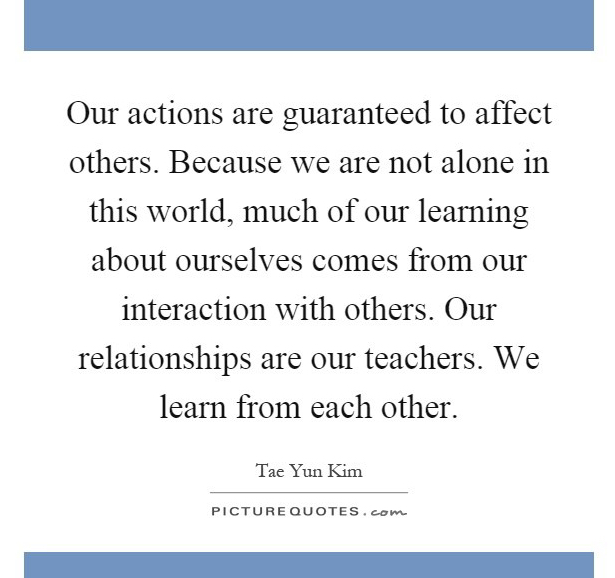
Perhaps one of the most valuable insights we can have about ourselves is the impact that our habitual behavioral patterns have on others.   Sometimes we unnecessarily set off an unwanted emotional chain reaction that changes the mood and energy of a situation in a negative way.

When we get triggered and fall back on conditioned reactive responses, we lose sight of the bigger picture and other’s reactions to our patterns.  Unknowingly, we have invited another to participate in our pattern.   If that person gets triggered and fires back in their own automatic response mode, suddenly we have a whirlwind of mixed emotions, conflict and a big energy drain.  Everyone ends up emotionally distanced from the immediate problem and its resolution.  We get caught in the cycle of poor behavioral habits.

our-actions-are-guaranteed-to-affect-others-because-we-are-not-alone-in-this-world-much-of-our-quote-1

If we tend to shut down in a conflict situation, we just bury our truest feelings and desires.  We deny our loved ones the chance to really understand what is important to us.

If we blow up and blame, we disregard taking personal responsibility.  We deny others the opportunity to learn about our deepest vulnerabilities.

Invariably we end up wasting a lot of precious time and energy that we can never get back.

Years of patterns like this can erode marriages, sibling relationships and friendships.  It is also something that children learn by example and why so many dysfunctional behavioral traits get “inherited” within families.

The best gift we can give to ourselves and our families is to recognize old patterns that are not serving us well and break the cycle.

Unknown-1


It takes serious work to get “mindful” about yourself and why you get triggered by certain things — and how you routinely (and mindlessly) respond to those triggers.  Be compassionate to yourself as you delve into your issues with unabashed honesty.

The real test for making positive changes in conditioned responses is when you find yourself in one of your familiar “triggered” moments.  You’ll have to hit the pause button on the old automatic reaction and take some calming breaths.   Reframe the situation so that you can respond in a better way than you usually do.  I’ll let you in on a little secret — just being calmer in your reaction will go a very long way towards a more positive approach.

It is especially beneficial to talk with your loved ones about the changes you are striving to make and why you are motivated to do so.  It creates an opportunity to break down barriers that you’ve put up in the past.  It’s an active demonstration that you are taking personal responsibility for ineffective behaviors.   Ask for their help and support.

Treat your personal energy as the valuable resource it is.   Use it wisely for things that matter.   Someday you will need to draw on your energy reservoir for something serious — and you will be glad that you didn’t waste it on something trivial.

The same is true for time — we don’t really know how much time we are each allotted in this life.   Hindsight really is 20/20 and looking back, you are sure to find moments where  a shift in your attitude or behavior could have totally turned an experience around.  The time you squandered on a silly argument or pouting could have been better spent appreciating the moment.

Unknown

Recently, I’ve been fortunate enough to witness some of these transformations occurring in families who recognized a change was in order.   What has become so noticeable is the shift in energy.  There is more positivity and a lightness in the home environment.  Couples are feeling like a team, working together toward a common goal rather than feeling like opponents in a boxing match.   There’s a lot more positive reinforcement given to each other when new attitudes and better approaches are taken.  Apologies and forgiveness are offered more readily when the inevitable slip up occurs.

IMG_6380

Most noteworthy is how the young children in these families are benefiting from the improvements and positive energy.   Children pick up on the emotional energy and will often act out to deflect something that feels uncomfortable to them.  These children are also learning good emotional coping skills, along with trust and mutual respect.


I’ve mentioned this in prior blogs, and it is worth noting again.  Pema Chodrun reminds us that when just one of us makes mindful changes, we make it easier for others to do the same.    When we make the commitment to do the work to better ourselves and change bad habits, we become good role models for our children and others.  That is some pretty powerful motivation for positive change.


Get a grip on what triggers you, get a deeper understanding of who you are and how you want to be treated, and


Seeing Eye to Eye

Take a moment to think about how much face time and eye contact we give our phones and devices every day.   Then take another moment to think about how often we really look into the eyes of our partner, our children, or the clerk at the store.

Scanning the local favorite breakfast spot recently, I saw 14 tables of people with their faces in their phones and only 1 table where the friends were actually looking at each other.  That table was full of energy, lively conversation and real honest to goodness eye contact.   The other tables were expressionless and quiet.  People were sitting next to each other gazing at iPads and although each person may have had a different reaction to what they were watching, there was no interaction.  Body language gave a good indication of how they were feeling, but no one in their group saw it.

I’d had a similar experience at a children’s park with my grandchildren.  Parents were staring at their phones while their children were swinging from the monkey bars, jumping off the swings and experimenting with new ways to traverse the winding sliding boards.  Had one of these children fallen or wandered off,  their parents would have never noticed.  Even when the kids were joyfully yelling to mom or dad to “watch this”, few looked up from their devices.

There was a young man in the ocean yesterday with his phone in hand, staring at it while waist deep in water, without a clue that a large wave was headed his way!

We stare at the card reader at the grocery checkout, waiting for the prompts to insert a credit card or enter a PIN number, chatting with the clerk but never really looking at her.  The experience becomes more like self-checkout and we miss an opportunity to engage with another person.

For several months, I have been noticing how little we make eye contact with others.   I’m as guilty as the next of being preoccupied and multi-tasking as I go through my day, so I decided to challenge myself to be more present, make eye contact and pay greater attention to the body language of others.

At first it was hard.  I realized that mindlessness habits I’d developed were stealing precious moments from me.   Turning my full attention to my small granddaughter rather than washing dishes, I watched her entire face light up with pure joy as she clapped her hands in delight over a small personal accomplishment of her own.  Looking into each other’s eyes at that moment was like adding fireworks!

Putting down my phone and facing my daughter when she was asking for my help revealed so much more than just her request.  What I noticed in her body language let me know that she needed a hug and some reassurance as much as she needed help with a clogged sink and a crying baby after another sleepless night.   Face to face, eye to eye attention has the power to change a situation in a very positive way.   We actually ended up laughing about the juggling acts of motherhood.   Its pretty remarkable how eye contact and human connection shifts feeling overwhelmed to feeling supported.

images


A lot of misunderstandings in our relationships could be minimized or even avoided if we took the time to look into another’s eyes.  It’s a fact that we make a strong neurological connection with each other when we give eye contact.


Observe someone’s facial expressions, posture, or other body language — that’s where the real story lies.  Often what we see tells us so much more than the words we are hearing.

I follow The Pact Institute Blog to learn more about neurobiology and relationships.

One invaluable tool that is used by PACT therapists to resolve issues in relationships is changing your physical position when a conflict arises.  Go sit next to your partner or child.  Face them directly and look into their eyes.

I’ve witnessed an angered spouse relax a bit when their partner put the phone down and gave them undivided attention.   It had a calming effect even before the conflict discussion began.  Why?  Because the angered spouse felt valued and seen.

I’ll let you in on a little secret — when we stop what we are doing (like putting the phone down) and turn our attention to the other person, we also avoid feeling annoyed that we are now distracted from whatever we were doing.  We’ve made a conscious decision to make our partner or our child a priority over that text, email or podcast.  Again, that is another positive neurological reaction firing in our brain.   It makes us feel good.

c3b456b20cec85ba88feef910f4281ce


In recent discussions with family and friends, it seems that social media and our devices are keeping us plugged in yet not really feeling connected.   Giving our full attention to our loved ones and friends will strengthen our relationships and enrich our lives as we rediscover that human connection.

And who knows, you just might make a new friend if you actually look at and interact with another person at the coffee shop.


Time out

Watching a small child’s response and shift in attitude when given a “time out” brought home a valuable lesson about sitting quietly and reflecting on our actions.  Something as simple as “taking a break” from an argument or a strong emotional reaction can have powerful benefits for ourselves and our relationships.

When we give a child a time out, we want them to think about their action or behavior and the resulting consequence.  We want to increase their awareness so that the next time they contemplate running with scissors, they remember it’s a bad idea with some pretty painful consequences like getting injured.

So we give the child some time alone to calm down, to reflect all by himself.   Then when the time out is over, we scoop him up, look him in the eyes, have a conversation about what we’ve learned and send him on his way with a reassuring hug.

A self-imposed adult time out is just the ticket when we feel our emotions getting out of control.  Its a far better use of our personal energy than overreacting and making matters worse.

images-2


On occasion, I’m caught off guard by another’s anger, accusation or adult melt down.  I’m working on not getting sucked into another’s emotional vortex and to remain grounded.  In my search to become better at navigating these situations, I read The Art of Communication by Thich Nhat Hanh (Buddhist Zen Master and peace activist).

Thich Nhat Hahn offers clear examples of how we judge others and situations, how we focus on our own needs at the expense of others, and how we habitually respond when triggered by events without a thought to long lasting, hurtful consequences.

He stresses the importance of becoming mindful of our habit energies.

Admittedly this takes discipline and requires personal courage.    Give yourself a  time out —  become aware of your emotions, reactions and patterns of behavior especially when you are in a confrontation.

  • The first step is calming yourself down. Mindful breathing is so beneficial for this. Three deep cleansing breaths will lower your heart rate and clear your mind.
  • The second step is reflecting. Treat yourself like a compassionate friend and explore your emotions without judgement.
  • The third step is assessing if you are conducting yourself in a respectful, productive manner

images-3


Taking your own feelings out of the equation and focusing on the other person’s perspective, you may discover that they have a misperception or have kept something bottled up for far too long. Rather than adding fuel to the fire by blindly reacting on our own emotions, we can listen with empathy and learn.  Thich That Hahn offers a refreshing concept to employ — Beginning Anew:


When a difficulty arises in our relationships and one of us feels resentment or hurt, a good practice to try is called beginning anew.  To begin anew is to look deeply and honestly at ourselves — our past actions, speech and thoughts — and to create a fresh beginning within ourselves and in our relationship with others.

Beginning anew helps us develop our kind speech and compassionate listening because it is a practice of recognition and appreciation of the positive elements of another person.  Recognizing others’ positive traits allows us to see our own good qualities.  Along with these good traits, we each have areas of weakness, such as talking out of anger or being caught in our misperceptions.  As in a garden when we “water the flowers” of loving kindness and compassion in each other, we also take energy away from the weeds of anger, jealousy and misperception.

We can practice beginning anew every day by expressing our appreciation to the people we care about and apologizing right away when we do or say something that hurts them.  We can also politely let others know when we have been hurt. 

                                                   —     An excerpt from The Art of Communication (Chapter 9)


Here’s what I have noticed since I’ve become more of an observer and less of an active participant in some stressful situations.  I’m a better listener and I have more empathy for what another is feeling.  Because I’m more thoughtful and composed in my responses and reactions, the tension often eases more quickly.   I’m following the advice cited in the Art of Communication and being patient, waiting for several days, before revisiting a situation and providing clarity to change a misperception.

Undoubtedly the most noticeable difference for me personally is that I am no longer jumping in to rescue or resolve. As a result, others face the consequences of their own negative behaviors and may even reach out for support to change unproductive habits.

Giving ourselves a “time out” just might be the best gift we give ourselves.

images-5


Best of Intentions

Having good intentions is a great place to start if you want to improve your life and your relationships. Keeping your intention at the forefront of your daily actions and behaviors becomes the game changer.


The latest special edition of Time Magazine is devoted to Mindfulness.  Its a great introduction to the new science of improved health and increased happiness by incorporating mindfulness.

images-1

Mallika Chopra’s article entitled “Yes, You Can Live with Intent”  really grabbed my attention.  This one sentence practically jumped off the page:

 Intention is about living each moment with integrity and in keeping with what matters most to you.

I’ve been practicing mindfulness for almost two years and very recently noticed that as I peel off the layers of my “onion”, I’m getting more clarity about what truly matters most to me.    Trust, respect, peace and compassion are at the top of my list.   How do I ensure that these qualities are more present in my everyday life?


To be committed to positive changes in our lives,  Mallika urges us to be clear about our heartfelt desires and create the best environment to cultivate them.  She encourages us to look closely at the areas of our life that aren’t working and embrace small personal changes that will move us in the right direction.

unknown

It dawned on me that I’ve been thwarting my own heartfelt desires by tolerating and even accepting other’s negative behaviors and their resulting messy situations when I swoop in to “help”.

Helping others is one of my greatest personal satisfactions.  Truthfully,  I haven’t always made the best decisions about those to whom  I’ve committed my help, support and energy.  So here I am, with good intentions towards others — and its backfiring!

My “aha” moment was recognizing that when I’m sacrificing my own happiness to help another, I’m not even close to what matters most to me.

After all, how can I be my best self when another’s behaviors and resulting consequences are in conflict with my core values?  Will I be truly present or will my mind be racing?

An important secondary goal is to give others the knowledge, tools and encouragement they need to flourish.  In the past I often jumped in, did all the work, solved the problem and then was frustrated to see the same patterns or mistakes repeated.  It left me tired and disappointed and was not of any lasting value to the individual I wanted to help.

I need to find ways to get others involved and invested in positive changes.

famous18

I’m inspired by my children and grandchildren to become a strong, positive influence and role model.  Together we are incorporating mindfulness and healthy life decisions into our day to day activities.  It’s fun and rewarding.

That’s the big takeaway from Mallika Chopra’s inspiration:    Align your core values with your good intentions, nurture and encourage.  It feels good and it makes a meaningful difference.

Namaste