

Can you imagine hopping into your car and expecting it to fly? What if you tried to start your car’s engine with the house key? What if your inner child, say around age 4, was in the driver’s seat as you pulled into the stream of traffic? Now that I have your attention, let’s unpack how we are subconsciously doing just that in our lives because we really do not understand how our brains work.
I hope you will stick with me as I curate some of the most revelational insights from Dr. Bruce Perry about neuroscience and how incredible our brains really are. You will start to piece together why there is such a growing interest in meditation, unpacking childhood trauma and discovering dynamic new ways to treat mental health issues.
Neuroplasticity is the term that is used to describe the malleability of the brain. It is the brain’s ability to change and adapt as a result of experience. This is why we can learn new things, enhance our existing cognitive capabilities, recover from strokes and heal from the emotional impact of traumatic events.
Neuroplasticity plays a key role in healing people whose stress response systems are not functioning well. Dysfunctional stress response systems are often the root cause of mental health issues. We make matters worse by not understanding how the brain works and having unreasonable expectations as a direct result.
We can help people heal and reset their stress response systems but we must go about this in a much more (w)holistic way. My goal is to shed some light on valuable information so that we can have better advocacy for mental health.
Dr. Bruce Perry has been doing research for over 30 years on the effects of trauma in childhood. His findings reveal that the first two months of life are crucial for brain development and establishing the regulatory set point for our stress response systems. Consider this the “factory settings” for our brains.
Infant brains are truly astounding. While the baby appears so helpless, the infant brain is undertaking incredibly rapid changes in those first few months of life. The quality of maternal interaction, bonding and connection is crucial during that timeframe. If an infant has attentive, attuned and responsive caregiving, the stress response system becomes very resilient and that child will be better equipped to handle future adversities.
It is the timing of developmental adversity that is key.
If an infant has high developmental risk in the first two months of life, and then is given a more stable, caring environment for the next 11 -12 years, that child’s outcome will be much worse than if the situation were reversed.
If an infant has a nurturing, connected and stable environment for the first two months of life, and then has 11 – 12 years of neglect, abuse or dysfunction, that child will have a better stress response system and will be better able to cope with life’s adversities.
“If an infant has chaos and unpredictability in those first 2 months, the stress response systems are discombobulated. That person will have incredible vulnerability and a cascade of problems that have origins in that first two months of life,” says Dr. Perry.
Dr. Perry shares that a major roadblock in the way we are collectively addressing mental health is that we are treated as if we are all the same.
The complexity of the brain and its functions, along with the incredible differences in each of our life experiences is a clear indicator that this needs to change. Consider that there are 86 billion neurons in the brain. Each one of those neurons has thousands of synaptic connections. Dr. Perry points out that if you visit a children’s mental health clinic, there will be only 6 basic diagnoses — “6 little boxes to put all those diverse problems in.”
Contrast that with our approach to heart conditions. The heart has 16 billion cells and only one major function — to pump blood. A visit to a pediatric cardiology clinic would reveal hundreds of unique diagnoses.
As we become better educated about the complexities of mental health, we can become effective advocates –for ourselves and for others. We can help move the field of mental health forward.
Let’s start with basic neuroanatomy, the relationship between structure and function. How does the brain actually work and how does it process information? Picture the brain as a floret of broccoli– the top of is the cortex, the most human part of the brain. The middle part is emotional and the lowest part is regulatory. Self-regulation is the ability to adapt our emotions and actions to situational requirements and to internal standards and norms.
Traditional adult perspective is that the brain is rational, that it is a “top down” process — a misconception that the cortex is running the show. But this is not at all how the brain processes information. A fundamental principle of neuroscience is the concept of “bottom up” functioning.
Getting up to the cortex means going through the lower part of the brain first. Dr. Perry describes the lower part of the brain as Grand Central Station for regulation. It is where our five senses get ignited, and changes occur in our oxygen levels and heart rate.
Are you beginning to understand why your heart races, your face flushes or you feel like you can’t breathe in a sudden high stress situation? This is happening subconsciously and our reptilian brain is trying to keep us safe.
Dr. Perry makes this stunning observation: The lowest and dumbest part of our brains (the part that can’t tell time) is the secret to understanding stress.
Wait, there’s more. A key component of the activation of our stress response is that it immediately begins to shut down parts of the cortex. So the very tool that “top down” people expect us to use to self-regulate is shut down and made less efficient by the very act of becoming disregulated.
And lastly, the cortex doesn’t fully mature until we are about 30 years of age.
Let’s review: As adults, we pride ourselves on self-control and executive function. We can more readily self regulate and use our cortex to prevent us from saying or doing something stupid. That is, if we have a cortex that is mature and organized. We’ve had years of practice, not to mention a boatload of mistakes when we did lose control of our emotional regulation. The consequences of losing our tempers resonated in a way that made helped shift us from “reaction” to a more controlled “response.”
Children and young adults are works in progress. The same is true for adults with low set points for self regulation.
This is the very reason that we struggle to understand why young children are misbehaving. We think they are making a conscious choice to misbehave! Frankly, it is also a critical piece to the puzzle of mental health for adults. According to Dr. Perry, many mental health professionals, educators and most parents are unaware of this game-changing concept of “bottom up ” subconscious functioning.
There’s one more piece to the puzzle that we are often missing. Even when the set point for stress self regulation is very low, Mother Nature equips us with a natural calming mechanism. Why then do we “over-ride” that feature in children? Let’s unpack this:
Rhythmic patterns are hard-wired in utero and the brain instinctively relies on them as a basic self-regulation tool. Dr. Perrry explains that when in utero that little body is sending signals to its brain continuously –“I’m not hungry, I’m not thirsty, I’m not cold”. Those signals send the message “I am safe. I am regulated.” The signals that come in from the sensory part, through tactical, vibratory and auditory routes, are the syncopated rhythms of mom’s heart rate, and the opening and closing of valves. The tiny body makes an association of patterns and rhythms with being well regulated.
After birth, mom will rock her infant at 60 – 80 beats per minute and the baby calms down. We do this instinctively for newborns — we rock them, play music for them, have them listen to sound machines, take them for stroller walks and car rides.
Then our children become toddlers, preschoolers and adolescents. We tell our kids to sit still, stop tapping their foot or wiggling in their chair. Guess what? These little actions are tools of self-regulation for kids. As unaware adults, we make matters worse by chastising them for utilizing their innate tools of self-regulation. We “over-ride” Mother Nature’s factory settings.
We try to get kids to use “top down” regulation and no kid can do that. Not even the kids who are well regulated can do that. Remember that Dr. Perry explained that parts of our cortex gets shut down when we are deregulated. This impacts attention span and the ability to actually open the cortex to absorb what is being taught.
“The irony is that we are not proactively teaching children how to self-regulate,” says Dr. Perry.
When kids lose interest or are unable to focus, they can also dissociate. Every one of us has also experienced dissociation — when we tune out and go to our inner world. We do it when we are in conversation with others, we do in a classroom, we do it at work. We even do it while driving!
By now, I am hoping that you are beginning to connect the dots about why mindfulness and meditation has become so popular in recent years. As more neuroscience knowledge gets distilled in a way that we can wrap our heads around it, we discover that we “check out” in many ways as we routinely go through our daily lives.
We subconsciously let our emotions and the lowest part of our brain direct our lives. We let our minds wander and miss important content and context. We get caught in a loop of anxiety, rumination or imagined fear that is not serving us well for dealing with reality and making good decisions.
Most of us are doing all of this with pretty good factory settings for our stress self-regulation. Imagine how hard it is for those who struggle with poor emotional regulation set points.
I’ll stick with the car analogy to drive home an important point — we are diligent about taking our vehicles in for regular maintenance. The wear, tear and age of a car takes its toll. We have an opportunity to expand the understanding and the treatment of mental health in that same context. Mental health education, tools and support are the ongoing maintenance we need to improve the overall quality of our lives.

The good news about mental health breakthroughs and advancing the field, is that neuroplasticity means that we can “reset” faulty set points for self-regulation. New neural pathways can be created and sustained using the same standard operating tools we are born with — somatic rhythmic patterns and repetition. That is what is meant by “neurons that fire together, wire together.”
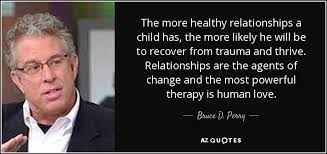
There is however one key component that is rarely discussed. That is the over-arching value of having a strong human support system. Dr. Perry calls this “scaffolding”. We gain tremendous healing benefits from having a person with whom we feel safe who will scaffold us through our “reset” and growth process.
All learning has some discomfort associated with it and a fear that we are not going to master it. As a young child, we learn to crawl, walk and ride a bike because someone scaffolded us through the learning curve. We need that same type of scaffolding for our mental wellness and personal growth. Dr. Perry says that “if you want to heal a lot, go slow.”
He explains the concept of low dosing — an easing into healing and resetting. A person gets out of their shell (leaves their comfort zone) for just a little. It’s a small, controllable dose of discomfort. Then they return to their shell. This is repeated over time, a little dose at a time. Over time, with this slow and steady repetition, they will change and grow. It is important to remain open to these little doses of learning.
Slow, repetitive low dosing and scaffolding is something that each and everyone of us can do for someone else.
And here is a pro tip — two seconds of eye contact sends a signal for a new neural direction. Just two seconds of eye contact can be a wonderful bonding connection. Eye contact when you are scaffolding someone is the best tool in your box.
Dr. Perry believes that while a weekly therapy session is a major entry point, it is the collective support we get from our family, friends, teachers, coaches and others who foster our long term healing process.
I love this image that he shared — a therapeutic web — a collection of people in our lives who give us these tiny doses of kindness, affirmation, information and loving support.
A clear understanding of how the brain works coupled with awareness and intention is the foundation for addressing mental health in a more meaningful way. The more mindful we are, the better we are able to show up and support others. All of us an actively participate in that supportive therapeutic web.
RECOMMENDED RESOURCES:
WiseGirl YouTube interview with Dr. Bruce Perry
https://www.youtube.com/watch?v=Odom2J9wprg

Recommended Resources:






 Inspired New Horizons