Becoming Part of Something Bigger

When I first began my self-discovery journey about six years ago, I had no idea what incredible gifts I would find along the way. At the onset, I was cobbling together teachings from notable mindfulness gurus like Pema Chodrun, Deepak Chopra and Thich Nhat Hahn. I relied on Mindfulness Magazine and SoundsTrue.org to help me find teachers and tools that would guide me. I contributed at least a dozen of the 60 million views to Brene Brown’s Ted Talk on vulnerability.

I felt a lot like Alice in Wonderland when the Chesire Cat offered his wisdom. I had no idea where I was going on this personal growth journey, I just knew in the deepest part of me that something had to change. I had a few breadcrumb clues to work with (patterns that I was discovering as I reflected on my 60+ years), and a 1,000 piece puzzle of both good and not so good pieces of my life. I knew I wanted to heal from heartbreak, to gain some traction in becoming a better version of myself, and above all to live a peaceful, meaningful rest of my life.

Little did I know that I was part of something bigger than I could have ever imagined — a growing community of like-minded people who were hungering for change and who were willing to look at themselves as the starting point for that desired positive change. It became evident that “inner work” was an emerging new path for self-help, enlightenment and personal growth. What fascinated me was how neuroscience was weaving its way into relevant conversations about evolving into our best selves. It is not only possible, it is incredibly beneficial, to rewire our brains for an enriched quality of life.

Last year, I wrote a blog post about how this entire field of inner work and personal growth has grown exponentially over the past five years — and how collectively so many different disciplines, resources and tools are merging to create a solid framework for anyone who wants to proactively address their mental well being and quality of life. Best of all, it is so mainstream now that the stigma associated with counseling, therapy and mental health is loosening its grip. We can almost hear and feel the collective sigh of relief and release. We are long overdue in getting to know our true, authentic selves.

I don’t offer that last sentence lightly. The real transformational change that humanity needs begins by truly knowing ourselves. Brene Brown has been shedding light for years on all the ways that we armor up to hide and protect our vulnerabilities. Yet it is our vulnerabilities that forge our strongest connections and are the birthplace of innovation, change and creativity — the very things that get us unstuck from old patterns and behaviors that just are no longer working.

We think that words like “love, trust and vulnerability” are gauzy and mushy — that they lack the strength, endurance and conviction to bring about meaningful change and deep connection. Well, prepare to be amazed — these words convey an enduring personal empowerment and an undeniable shift to growing self-awareness, perspective-taking and cultivating empathy. When we invest the time and work in truly getting to know ourselves, we shed the heavy armor that gets in our way and weighs us down. We live more at ease, comfortable in our own skin and stories. We have room to grow in the expansiveness we’ve created by purging what is no longer needed.

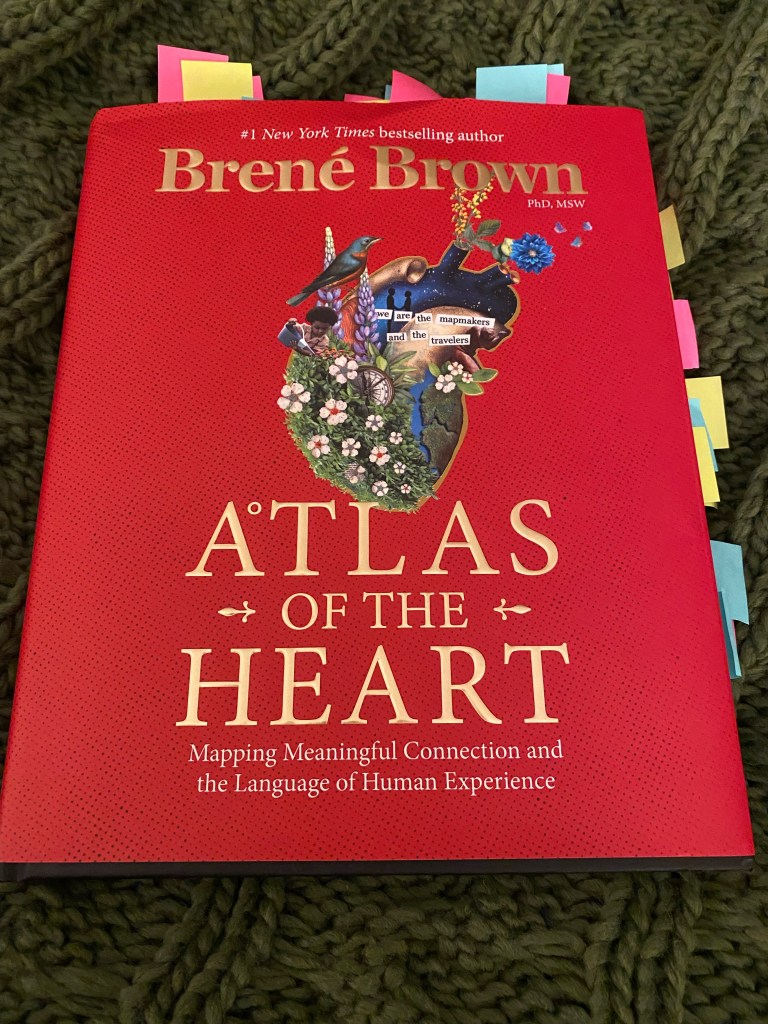
I remember very early on in my personal growth journey the words of Pema Chodrun. She said that once we know ourselves, we will in turn get to know others better too. This is a compelling message that Brene offers to us in her newest book Atlas of the Heart. Brene encourages us to do our inner work so that we can show up in life with “grounded confidence” in ourselves. It is from that deeply rooted place of self-trust that we can in turn engage with others with empathy, awareness and courage.

Just imagine “showing up” in your relationships with skills and tools that foster compassion, respect, non-judgment, safety and trust — instead of old armor that often leads to shaming, blaming, dismissing or avoiding.

Today, If anyone were to ask the Chesire Cat the best path to self-discovery, I am fairly certain that he would mindfully hand them this most incredible book — The Atlas of the HeartMapping Meaningful Connection and the Language of Human Experience. As Brene shares “I want this book to be an atlas for all of us, because I believe that, with an adventurous heart and the right maps, we can travel anywhere and never fear losing ourselves.”

I just finished reading this book a few days ago. It had a profound impact on me. I have been on my committed practice of self discovery and personal growth for six years and what I discovered about myself while reading Brene’s work, was both healing and revealing.

“The lack of self-awareness in folks is not overcomeable without language and the study of emotion. We are not rational, cognitive Vulcans — we are emotional beings. People are trying so desperately to become more self-aware without the lexicon and language to do it. It feels (this book) like something completely different than I have ever done and also the culmination of all my work.” — Brene Brown during her Unlocking Us podcast, Part 3 of A Sisters BookClub on Atlas of the Heart.

Normally at the end of my blog posts, I share my recommended resources with all of you. Today, the only recommended resource I’ll share is this beautiful, hearty, impactful, colorful, inspirational, incredible book. The bonus I’ll throw in is simply to listen to the 3 part Sister series on Unlocking Us where Brene and her twin sisters, Ashley and Barrett, have a book club discussion about Atlas of the Heart. You can listen to Unlocking Us for free on Spotify. You can also find show notes and links to every episode at https://brenebrown.com

Genuine Listening

I found myself in a bit of a conundrum recently. I was fully committed to leaning into my courage and being honest about how some things were landing on me. This meant that I also had to state my boundaries (again). This has always been something that I’ve struggled with – it feels so darned uncomfortable not to mention extremely vulnerable. It can be especially hard for me to share my hurt feelings with those I love. Yet I have made a commitment to myself to do hard things and to develop better navigational skills for just these sorts of relationship conversations. The problem? I entered familiar territory with a new strategy, but the receiver of my message of how I was feeling went into defense mode. Almost instantaneously I could feel that old familiar paradigm washing over both of us. It would have been so easy to fall into our old patterns and roles. But this time, I declined to play my old role and I stay grounded and calm.

I’d love to tell you that there was a quick, happy ending – with hugs and humor. That was not the case.

While the scenario played out much like it always has in the past, it was me who brought a new conviction to the situation. I knew I could not control how my conversation would be received. The only thing I could control was how I chose to respond in return. This is where real change takes place for me — when I make a conscious decision to choose a new path. I will only ever get a different result in the way I am treated if I stay committed to my self-worth and the boundaries that support my values. As a life-long people pleaser and conflict avoider, this will probably always be a work in progress for me.

I learned a lot from being both an observer and a participant in this interaction. Mindfulness and meditation practice have been instrumental in helping me to straddle these two perspectives. I made a lot of mental notes and later poured them out into my journal. Journaling helps me to sort through my emotions, another’s emotions and reactions, and differing points of view. It is often through journaling that I gain a deeper understanding of myself and why certain situations matter so much to me. In this case, it was not all surprising to recognize myself on both sides of the fence.

You see, I was on the receiving end of someone trying to insist that their idea was best for me but I had stated clearly that I did not want that. I used to be that person – the helper — who would jump in and “fix things” even when my help was not wanted or needed. Ugh….so that is what it feels like to be steamrollered by good intentions and poor “listening to understand” skills. Naturally, the person trying to help me solve a problem (and not even the right problem), was hurt that I would not be appreciative of their efforts and their thoughtfulness. (Oh my, I have been that wounded helper so many times in the past.)

On the other side of the fence, is the new me, trying my best to set and hold boundaries, to honor myself by stating clearly what I want or need. It was important to me that my wishes would be respected. The reason this is such a tender and vulnerable issue for me is that for many years, I would acquiesce to keep the peace, I would sacrifice my own needs and desires to placate others, and I was often afraid that I would lose treasured relationships if I held my ground. The tap root for all this people pleasing and timid behavior was embedded in my childhood experiences.

Since boundaries are something that I am striving to develop with confidence and conviction, I am trying to practice new skills with what seem like relatively small matters. What I discovered was that even a small situation can be fueled with a lot of emotions, defensiveness, misunderstanding and poor listening.

Ironic isn’t it — that I could see myself as both the over-zealous helper and the evolving person striving to set clear boundaries. What a rich lesson for me to absorb. It is a reminder that when we get to know ourselves better, we also gain a greater awareness and empathy for others.

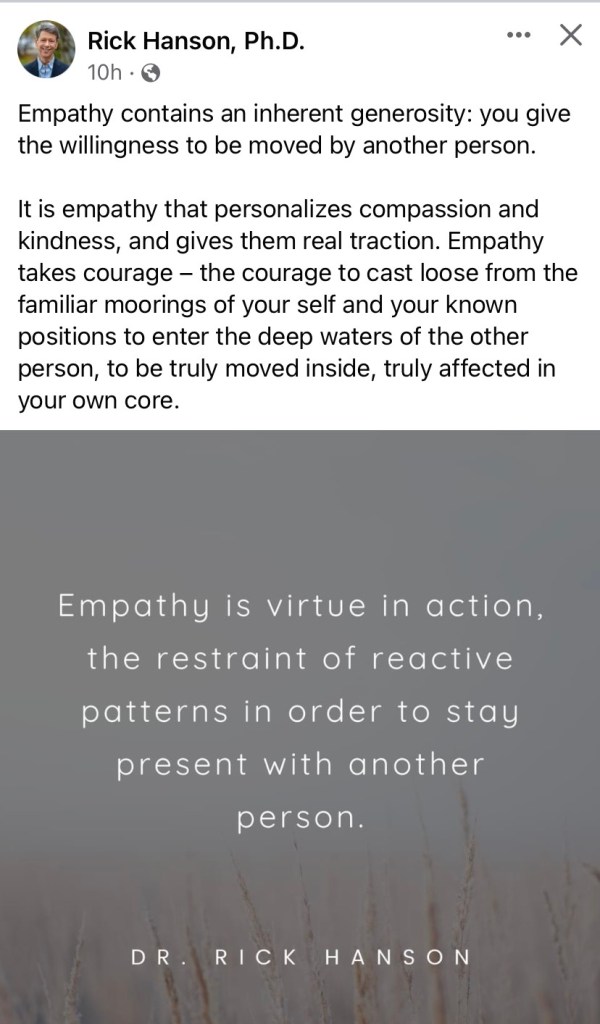
It just so happened that I came across some invaluable insight from Dr. Rick Hanson just as I was processing all of this:

It was those words — “the restraint of reactive patterns in order to stay present with another person” that stopped me in my tracks. What I had wanted most during that hard, heated conversation was to be heard — and what I was learning from my own part in that same conversation was the value of genuine listening. Listening to understand. Genuine listening that moves us to truly hear what another person wants us to know about their most vulnerable places.

Too often, we find ourselves unconsciously falling into the same old conversations and familiar but ineffective patterns. Judgements and defensiveness are roadblocks that lead to dead ends. Dr. Hanson offers a better way for us to enter these challenging conversations — by being open to hearing how someone really feels.

This does require that we tap into our empathy and that we pay attention to old reactive patterns (our own and another person’s). So many times, our actions are well-intended, but we miss the opportunity to respect how it might land on someone.

Making a genuine effort to change how we “show up” for each other in these hard conversations can have a transformational impact in our relationships.

Listening to understand creates a bridge for a better conversation — and a deeper connection. And did you know that repairing a misunderstanding or a wrongdoing can actually strengthen a relationship?

Relationships also grow stronger and flow more easily the better we know each other. Just as we are careful with the sensitivities of young children, we can work to be more cognizant of these tender places with our friends and family. Some of those tender places are the wellspring of the best attributes of people we love.

There is a happy ending to my story. It took a few days and several more conversations — and yes, there were a few good laughs to boot. (Did you know that laugher completes a stress cycle?).

Perhaps the best take-away from this whole experience is that I earned a merit badge in the personal growth department. I am finding solid footing for expressing my boundaries and I am able to refrain from getting caught in old, unhealthy emotional swirls. It really feels good to use my tools and get a favorable result in the end, even if I still need a lot more practice.

RECOMMENDED RESOURCES:

Dr. Rick Hanson – Check out Dr. Hanson’s many resources including his books, podcasts, newsletters, and courses. Follow him on Instagram and Facebook for daily doses of practical wisdom and insight.

https://www.rickhanson.net/rick-hanson/

Nedra Tawwab – Therapist, NY Times Bestselling Author and Relationship Expert – Nedra is best known for her work on boundaries! Follow her on Instagram “NedrasNuggets” for daily doses of inspiration for setting, holding and honoring boundaries.

https://www.nedratawwab.com

Elizabeth Earnshaw, Clinical Psychologist, Author, Gottman Institute Trained Counselor — Elizabeth is one of my favorite young resources for sound relationship advice and experienced guide for invaluable tools to navigate all of our most important relationships. Follow her on Instagram — LizListens

https://www.drlizlistens.com

Broken Spirits

I have often shared how it was a broken heart that put me on the path of personal growth. The truth is that I also suffered from a broken spirit, one that was decades in the making. It was my fragile, broken spirit that needed to be healed first. I just did not know that at the time.

This morning I was reflecting on those first few weeks of being on my own after that painful breakup — how I wrote in my journal that I wanted peace, to feel safe and to be free to be myself. Ironically I thought that living alone was the best way for me to achieve those three things. What I should have been asking myself is “why were you not finding these things within your relationship?”

An inventory of both past and present relationships might have revealed some truths that required further investigation. It dawned on me that when I am behaving and feeling most authentically myself, then I am both at peace and feeling safe — both alone and within my relationships. No one else is responsible for ensuring those core values are ever present but me.

What became very evident was that I need to untangle myself from a complex combination of childhood trauma, learned behavioral patterns, exhaustion from hustling for my worth, and a heavy trunk of unprocessed emotions. It was this complex combination that had been breaking my spirit, slowly and consistently over time. I was completely unaware of the toll it was taking — on me, on how I showed up, how I reacted, on the dynamics of my most cherished relationships.

One thing became crystal clear to me. Those times in my life when I felt most at peace, safe and my buoyant, resilient self was when I was with people who saw past my flaws, who recognized my potential and who mentored me through role modeling and coaching.

My young broken spirit was often mended by my beloved Aunt Betz, my church choir director, a high school teacher, a cherished friend. These are the marble jar people that Brene Brown talks about — those who are so trustworthy that we feel safe to take refuge in their care. These earth angels give us little footholds to help us tap into our innate worthiness and foster our growth. I don’t think that I would have been able to cope with all the chaos in my family’s dysfunction without the help of these incredible people. They not only gave me a safe place to land for a while, they gave me wings to fly a little higher than my circumstances. When I was young, they were helping to untangle me from the baggage that was breaking my spirit.

As I dug deeper into personal growth work, two things really began to gel for me. One was that it is our responsibility as adults to do the work of untangling ourselves from outgrown narratives and old baggage. The second was that even the most dedicated practitioners also get snagged on their past, and fall into unconscious, unhealthy patterns from time to time. It is often in times of high stress, great loss or adversity that trigger us to fall back.

Much as I would like to pretend that this did not happen to me in my 60’s, it did. I fell back into old uncomfortable but very familiar pattern reminiscent of my childhood without even being aware of it. I slipped into the role of helper extraordinare and then followed that unhealthy path down a rabbit hole into enabler and co-dependent. Completely unaware of my blind spots, I became the one who was instrumental in breaking my own spirit. The warning signs of resentment, stuffing my emotions, and feeling so uneasy that I was jumping out of my skin at sudden noises only fed an old story line that I was not good enough, not worthy, falling short –again. Unbeknownst to me, I had drifted into the very unhealthy end of my enneagram spectrum. I was in a strange and complex paradox of trying to get my needs met while accepting behaviors that were in direct conflict with those needs.

To add to my confusion, while I was falling so short in that relationship, my friends and family members saw me as an easy going, cooperative, optimistic and encouraging person. How was it that others could see those good parts of me but my partner could not? This paradigm is common actually — as I discovered through long conversations with friends. Could the answer be in how we “show up” differently without so many deep rooted emotional entanglements clouding the waters. If so, what is it about ourselves that we do differently in our closest relationships that contribute to this conundrum?

For me, it was the fear of making things worse by bringing up something important to me. The tap root of my unwavering need for trust that was broken repeatedly in my childhood. So often when I would speak up for me and my brothers, the consequences were far worse than the initial event.

This pattern began to appear in my relationship and I got hooked on old insecurities. Trust unraveled and my spirit took a hit. I did try to explain this to my partner once but I was clumsy about it. It is a textbook example of why we need to get skilled at having hard conversations — both in the way that we articulate our truth and how we listen to learn.

The better we understand ourselves as well as our basic needs and desires, the healthier our relationships can be. I only wish that I had been introduced to the enneagram earlier in my healing journey. You see, the enneagram sheds a lot of light on childhood roots of learned behavioral patterns and what it is that we each need in order to feel fulfilled, loved, valued and safe. The enneagram is truly one of the most valuable self-awareness and self-discovery tools we can access. A companion resource for the enneagram is Brene Brown’s powerhouse book, The Gifts of Imperfection. This book illustrates so well the armor that we choose to protect ourselves from the core motivations and fears that the enneagram reveals to us.

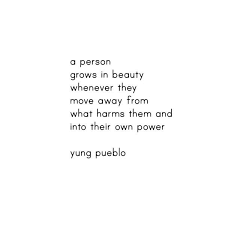
Check out Yung’s deeper explanation of this wisdom in the Recommended Resources at the end of this post.

As I was working on my draft of this blog post, the above quote from Yung Pueblo landed in my inbox. It was so timely and his accompanying insights dovetailed with my own experience and the wisdom I’m striving to impart. While Yung Pueblo leans heavily into his meditation practice to peel back the layers of his patterns, I turn to the enneagram for course correction. When I find myself feeling off kilter, I know I am drifting into the unhealthy end of my spectrum. I heed the warning signs of resentment or feeling unappreciated as cues that I have overcommitted myself or failed to set a boundary.

These examples really just scratch the surface of all that you can learn from the enneagram. Perhaps one of the greatest gifts is helping us to see others in a whole new light. When we understand that each of the nine types has a dominant way of showing up in life, it releases us from taking things so personally. That creates a bridge to understanding and empathy. We can begin to recognize the bids for connection that others are making even when they might be clumsy about it.

When I reached the point of being able to trust myself enough to know what I needed to feel at peace, safe and valued, I knew that I was making meaningful strides in my goal of being my authentic self. Admittedly this was hard work and requires ongoing practice. Shedding the armor of being a people pleaser or shape shifter to feel like I fit in or was liked has been the equivalent of shedding unwanted pounds. It is easier to express my emotions and my needs now without all those old entanglements getting in the way.

This brings me back to broken spirits and broken hearts. Everyone experiences broken spirits and broken hearts in their lives — and sometimes that brokenness takes a very long time to heal. So often we do not realize just how much another is hurting, in need of empathy, compassion and trust. Sometimes we project our pain onto others because we lack self awareness. Sometimes we take things too personally because we ourselves are fragile. When we are not skilled at having hard conversations, we can inadvertently shame or blame others. This is why I believe Brene Brown’s work on vulnerability is crucially important. Self-awareness and vulnerability are two of the strongest gifts we can give to ourselves and each other. Deeper, more fulfilling relationships are cultivated in these rich spaces of trust, honesty, acceptance and understanding.

RECOMMENDED RESOURCES:

Yung Pueblo — Author of Clarity and Connection. Follow him on Instagram and Facebook for daily insights on personal growth, maturity and growth mindset partnerships.

Being Well Podcast with Dr. Rick Hanson and his son, Forrest Hanson

https://www.rickhanson.net/being-well-podcast-how-to-create-a-relationship-that-lasts/

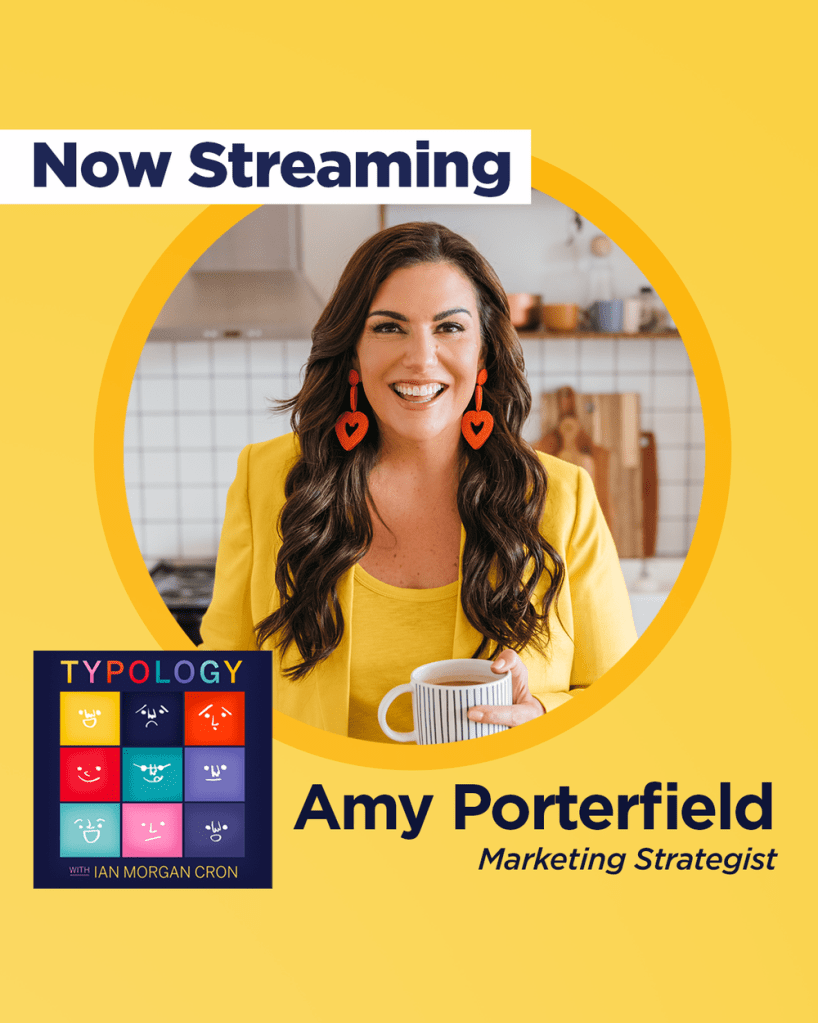
Sharing this episode from the Typology Podcast with Ian Morgan Cron about the Gifts of Self-Awareness. Spoiler Alert: Amy Porterfield not only shares my name, but my enneagram Type 2 also! https://www.typologypodcast.com/podcast/2021/07/10/amyporterfield

Present Day Me in my Hometown

Recently I was back in my hometown where I spent over a half century of my life. So much of my history is woven into the streets, the houses, the buildings and businesses of this now expansive community of Lancaster County, Pennsylvania. I marveled as I drove through city and countryside recalling memories of the younger me. I surely must have had a dozen lives to have such a vast collection of experiences and metamorphoses.

It is cathartic to return to my hometown as a much different woman than I once was. I’ve shed the childhood armor that I carried far too long. I’m beginning to recall and recognize the courageous moments in my younger life where my true nature was pushing through all along.

Maybe that is the way that our growth spurts occur over our lifetime — little nudges pushing us out of our comfort zone and into evolving version of ourselves. Most of it is just the natural, organic process of maturing. Some of it occurs through change — unplanned and unwanted, and some of it through change we pursue.

I grew up in the heartland of Amish farm country — nutrient-rich soil, verdant green fields, seasonal harvests of the best local produce, warm summer sunshine and drenching nourishing downpours. The farms and gardens of Lancaster County represent what is possible with the right environment in which to grow and flourish. This metaphor is not lost on me as I reflect on all that I have learned through my personal growth journey. What insights can I share with younger generations to help them in cultivating a healthier, nurturing, supportive environment in which to reclaim their true nature and embrace their full potential?

We are all products of our environment at some level. The earlier in our adult lives that we claim agency about what that environment needs to be in order for us to be our best selves, the better equipped we will be to handle all that unfolds in our lives. Driving through my hometown, reflecting on my life from childhood through 50+ years, I saw things much differently than I did before my deep dive into personal growth. I could readily recognize the origins of behavioral patterns, insecurities and false narratives that made my life harder than it needed to be. At the same time, I found myself feeling an overarching sense of gratitude for all that I was able to accomplish in spite of those tethers. This awareness fuels my motivation to help others untangle themselves from the impediments that hold them back from living their best wholehearted life.

As I drove through Lancaster County, I was often accompanied by my brother or a longtime friend. We’d share our memories with each other as we took in the things that remained the same and those that had changed dramatically in our hometown. It was often in these stories that we would unravel some of our personal history. Our perspective has broadened over time. Our renewed appreciation for each other’s complex lived experiences deepened our empathy and our connection to each other. My brother touched my heart when he shared with me that he hadn’t truly realized just how quickly I needed to grow up, assuming adult responsibilities for our family much too soon.

Some attributes we honed as children served us well. Other attributes became stumbling blocks or major road blocks. It occurred to me that in many cases, we changed our physical environment by moving out of dysfunctional homes when we were 18, but we brought with us unconscious behavioral patterns and childhood baggage. Our emotional environment was still tethered to our past.

We entered marriages with fairy tale-like visions of what we anticipated, but completely unaware of how our family histories and unhealthy coping skills would tear at the seams of those dreams.

Is it any wonder then that well-worn unhealthy familial patterns get unknowingly passed from one generation to the next? This was especially true of my parents’ generation who preferred the “don’t ask, don’t tell” policy when it came to hard truths.

Long and deep conversations with my friends revealed that many of us operated believing the limiting and false narratives that originated in our childhood. Those narratives became the voices of our inner critic telling us that we were not worthy, not lovable, not smart enough, or we were too much. Our childhood circumstances did not define us, but in many cases, we blindly accepted that others judged us as though it did.

My close circle of friends have worked hard to break free from unhealthy behavioral patterns that stunted personal growth and shrouded authenticity. People pleasing, shape shifting, conflict avoidance and stuffing emotions did not serve us well as we tried to build a network of genuine friends, foster our marriages, raise children or advance in our careers.

Through many of the conversations I was blessed to have on this extended visit, one thread that weaved its way through consistently was that none of our lives turned out exactly as we had planned or anticipated. We all had highs and lows. Yet we got through adversities, with our inner strength, with the support of family and friends, with love and hope. We rebuilt our lives — often.

I believe that this is also the natural, organic ebb and flow of life. As Dr. Bruce Perry says “none of us gets through life unscathed.” Dr. Perry teaches the value of having a relational web and how that web provides the scaffolding we all need to pull us through hard times and show us what is possible. Relational webs are those people who have our backs, who show up and sit with us in our darkest hours, who help us reframe things with a fresh perspective, who help us discover our inner strengths and who encourage our potential.

My friends and I talked a lot about the hard lessons we learned about the people who were in our lives that we wanted to be part of that web, but who often let us down, or made matters worse. Over time, we learned who we could trust. We began to be more discerning about the people in our inner circle. We learned the value of setting boundaries. We now recognize that this is a very important component of a healthy environment in which to grow, mature and flourish. We need to be surrounding ourselves with people who support us in positive ways. That old adage that you are most like the 5 people you spend the most time with is a sound guidepost.

The gold in my visit back to my hometown was in the warm embrace of all those connections I’d made over 50+ years with family and friends. We talk with ease about some of the hardest moments of our life and what we learned from them. I marvel at the strong women I have known most of my life who have overcome so many hurdles and big setbacks and how they are thriving today. They are incredible mothers and grandmothers. In many ways, we’ve become “advance scouts” for others who want to live life more authentically and with a lot less baggage.

I’m so encouraged about the future for our adult children and our grandchildren for one compelling reason. It is awareness. There is a growing awareness of how our childhood experiences, unprocessed trauma and mental wellness can negatively impact a person’s quality of life. There are so many fantastic resources available to us to support our healing and personal growth. And there are a lot of really awesome grandmothers and grandfathers who are doing their own work and in turn, shining a light on that path for their adult children and grandchildren.

Many young adults are hungry for deep conversations, for mentors and supporters who will listen without judgment to their trials and their dreams, for role models for navigating divorce, co-parenting and rebuilding life. I think of these young adults like the starfish on the beach. I envision my incredible friends making a difference in the lives of others in their families and in their communities by taking the time to hold space for the younger generation and to offer the supportive environment they need to heal and flourish.

RECOMMENDED RESOURCES:

This incredible book underscores the importance of being truly present for our children, and how repairing our relationships when we mess up contributes to resilience, trust and healthy emotional attachments.

https://www.penguinrandomhouse.com/books/562899/the-power-of-showing-up-by-daniel-j-siegel-md-and-tina-payne-bryson-phd/

Bestselling author, Harriet Lernerm focuses on the challenges and importance of being able to express one’s “authentic voice” in intimate relationships.

The key problem in relationships, particularly over time, is that people begin to lose their voice. Despite decades of assertiveness training and lots of good advice about communicating with clarity, timing and tact, women and men find that their greatest complaints in marriage and other intimate relationships are that they are not being heard or they cannot affect the other person, that fights go nowhere and that conflict brings only pain. Although an intimate, long term relationship offers the greatest possibilities for knowing the other person and being known, these relationships are also fertile ground for silence and frustration when it comes to articulating a true self. And yet, giving voice to this self is at the center of having both a relationship and a self. Much as she did in The Mother Dance, Harriet Lerner will approach this rich subject with tales from her personal life and clinical work, inspiring and teaching readers to speak their own truths to the most important people in their lives. (Harper Collins)

Nuggets of Wisdom – Visual Images

Visual images are some of the most beneficial aids in my mindfulness toolbox. Today’s post is chock full of my “go to” images that I depend upon to keep me present in the moment and showing up in an authentic way. Even if I’m feeling really strong emotions (mine or others), these helpful tools keep me from impulsively reacting to big feelings.

About 20 years ago, I met the most incredibly calm and benevolent young woman. She was the instructor for my 5:30 a.m. hot yoga class. She would start our practice with a visual image: planting our bare feet firmly on our mat, we were to envision small roots growing into the ground, anchoring us in our yoga practice for the next 90 minutes.

When I was gaining a little traction with my meditation practice a few years ago, I recalled that image from yoga class and thought about how I could create a similar visual to help me take my meditation “off the cushion” and into daily life.

My visual image is of dropping my anchor into my very core of calmness — that place I find when I can let thoughts go and focus my attention in the present moment. In meditation this is returning to my breath. In real life, it is staying present with the situation at hand — and most importantly, not getting attached to my own emotions or those of others. I can make better decisions when I am calm. I will be much more likely to act in alignment with my true nature when I am calm. That mental image of dropping my anchor de-escalates things for me pretty quickly.

A wise mindfulness teacher once said that most situations are benign — they are neither good nor bad. It is how we respond or react to them that makes them positive or negative. What is a big deal to one person may not even get on the radar screen of another. Staying calm and paying attention to how others are feeling, helps me get a grasp on why a situation may be a big deal or a small one for someone else. Often this is more relevant than the actual circumstances.

This may be one of my personal favorites — the visual image of holding a brightly colored spool and letting out a little extra kite string, watching that kite dance a little higher in the sky, adjusting to the currents and gaining fresh perspective.

Sometimes we are just too afraid to let go, even just a little. We chase what we think we need or want so badly. We might micromanage our lives or others. We can be prone to hover or smother, be needy or greedy. We can let fear hold us back from trying new things, or taking that leap of faith.

At this stage of my life, I use this visual image most often when it comes to relationships, especially adult children and extended family. Letting a little kite string out means that I am holding space for others, recognizing that their lives are busy and that they want to solve their own problems. I don’t need to be tugging so hard for attention or to be the one they turn to for advice. I just…..let out a little kite string.

I credit Malcolm Gladwell for this visual. If anyone can look at a situation from a ga-zillion perspectives, it is Malcolm Gladwell. And he does it with a child-like curiosity and unabashed wonderment. To me, this is how it feels to look through a kaleidoscope, twisting and turning it with pure delight, fascinated by the changes.

So often, we view things from our same old vantage point. The fact is that we are changing all the time, and oddly enough so are those chronic ongoing situations in our own lives, in our communities, country and globally.

Listen to a few episodes of Revisionist History podcast with Malcom Gladwell and you will witness a big shift in perspective when a situation is viewed from all angles, and through the experiences of everyone involved.

Remember the old adage, one man’s junk is another man’s treasure? This visual is a little like that for me. I envision myself holding a smooth cylindrical kaleidoscope that has a little weight to it, placing it in front of my eye, and watching the problem present itself in a myriad of ways. It’s a reminder to withhold judgment, get out of my box, stay curious — and make sure I am actually looking at the real problem. (Credit goes to Michael Stanier Bungay and his book The Advice Trap for this wisdom. Far too often we jump in to problem solve so fast, we “solve” the wrong problem).

When I first discovered mindfulness, I had a little cork that I placed in a small clear vase on my kitchen window sill. I would see it every morning when I poured my first cup of coffee. It was my reminder not to get bogged down in rumination, disappointment or sadness. I had read an article in Mindful Magazine that talked about how freeing it is to let go of getting caught up in the negativity bias. The image of letting one’s cork float effortlessly through the flow of life was inspirational to me.

I didn’t know at that time just how much I was actually tethered by old behavioral patterns, my life history and the disappointment of a dream disintegrating. Over time, with awareness and daily practice, I freed myself from those weights and found that I really did feel lighter in many ways. Today when I feel myself growing a little heavy in spirit, I think about that cork on my windowsill. It’s a reminder to look for the good.

The little things that unfold in our daily lives offer buoyancy to us if we are paying attention. Make eye contact with someone when you are having a conversation — you will feel your cork rising when you see it in their eyes that they know you are really listening to them. It’s magic and it’s rare….because too often today our faces are gazing at our phones and not each other. Call a friend or your sibling instead of texting — hearing each other’s voices adds the spice. Don’t be surprised if you learn so much more than you expected. Think about someone who makes your life better — and send them a card or a text expressing your appreciation. Smile more. Laugh out loud. Listen to the sounds of nature. Read a good book. Listen to your favorite music. Dance in the kitchen. Take a break.

Just holding on to those little moments of joy for ten seconds releases happy hormones and that will definitely let your cork rise and buoy your spirits.

I hope you enjoy reading about my visual images. I do love sharing them. Sometimes a simple mental image that is all we need to bring us back to the present moment.

Older and Wiser Parenthood

One of my favorite things is talking with my adult children about the stuff that they are navigating in their mid-life. I don’t shy away from any aspect of these conversations even when the topics are tough. Something that I have noticed as they hit their 40’s, is that their perspectives on me are evolving as they get deeper into mid-life. They are now going back and revisiting the past through their own parenting lens. There is a depth to our discussions that I love, for it pulls back the layers of our family history and allows for healing and growth.

I’m in a better place for these meaningful talks because of all the personal growth work I have done. I no longer listen with my mind racing about how to solve a problem for them. I recognize that this is not my role now. They are grown ups and they need a confidante, a sounding board, and a judgment free space. When my focus is on listening, I find myself discovering so much more than what is on the surface. We can dig a little deeper.

As my adult children have navigated through their own life experiences with marriage, parenting, and careers over the past ten years or so, they too are discovering more about me as a whole person, and not just “mom”. It is in these nuanced conversations that we find new common ground and mutual respect for each other. The very stuff that they grapple with today, I also struggled with. My experiences provide perspective and assurance they too can get through the tough parts of life. The best gift that I can offer to them today is the insight I have gained on how I might have done it better. It is precisely why I gave them each a copy of the Gifts of Imperfection by Brene Brown. I wish I had not only known about the 10 guideposts for wholehearted living, but that I had someone I could confide in who would help me cultivate them earlier in life.

That is precisely the resource I want to be now for my adult children.

It’s hard as a parent to witness adult children going through tough struggles. I’d hoped they’d be spared some of those adversities, but that is not how life goes.

I don’t think it is all that unusual for adult children to be reluctant to discuss their challenges with their parents. There is a part of them that doesn’t want to admit to mom and dad that they are wrestling with life issues. They don’t want to disappoint, to burden or to get lectured.

And yet….the truth is….that we as parents have been exactly where they are and we not only know firsthand the worries, the second-guessing and the what-if’s — we know that we made it, that we might have done better and that we want to be the support system we either had — or wish we had.

These 10 guideposts for Whole-Hearted Living give me a great place to start when it comes to having some of these deeper conversations with my adult children.

I’ve come to realize that it is necessary for our adult children to have a healthy dose of life experiences under their belt before we can delve into some of this wisdom. After all, it only makes sense when they can actually relate to it.

My son who has gone through a divorce and is co-parenting his 8 year old daughter very well with my daughter-in-law, has a much different lens through which to view my divorce from his dad when I was his age. He can also assess the relationship that his sister had with their dad when she was only 8 through a parenting lens. My hope is that this does not impact his current relationship with his dad, but that it offers a new framework to understand prior mysteries about the complexities of his sister’s relationship with their father. My son can now understand that my parenting job for his much younger sister was made harder by the choices their father made about his relationship with his daughter. The ripple effect from his dad’s co-parenting decisions resulted in a lot of painful confusion and estrangement in our family for a very long time. That hard lesson learned has resulted in my son and daughter-in-law being very cognizant of keeping their daughter at the forefront of intentional co-parenting.

My oldest son reminds me a lot of myself at his age, burning the candle at both ends at work and at home. He is striving to be an over-achiever professionally and personally. Been there. Done that. I recall very clearly how exhausted I was from it all so it’s easy to put myself in his shoes when we chat. Where I used to quickly dole out advice, I now listen more and ask more questions. My focus now is to empower him to find his own meaningful solutions. I recently read The Advice Trap by Michael Stanier Bungay to help me get better in supporting him in this way. My stories about wrestling with similar work and parenting issues when I was his age offer some comfort and assuage some of his fears about the future. I can even get a chuckle out of him when I tell him that it has taken me many years to “ooze this much wisdom.”

My daughter is a decade younger than her brothers and has a lifestyle that is quite different. Her husband is a professional athlete has has been for 12 years. This means several moves to new locations every year, with many moving parts to each. She is home-schooling her two children to provide continuity for their education in spite of all these relocations every year. She has had to become a master of logistics to pull this all off in a seamless way for her husband, her children and her dogs. Like every other young mother, she can feel pulled in a thousand directions, feel like she’ll never get it all under control and she sets the bar high for all that she should accomplish in a day’s time. I used to give her examples of all that I juggled when I was raising her and her brothers and boy did that backfire. It was not helpful — and I know that now. She felt like I was judging her with all my comparisons. Thank you Brene for helping me to realize the error of my ways. What my daughter really needed was for me to see her, acknowledge what she was feeling and to articulate how I valued her and all that she does with so much love for her family. She did not need me to rush in and do things for her. She needed to know that I have her back and she can offload all her stresses with me in a safe, judgment free zone. It occurred to me that when I was her age, I was similarly overwhelmed. It was then that I realized that I had to overcome my lack of organization and ability to prioritize if I was going to keep my sanity. Oddly enough, it was my own chaos and overwhelm that led to me becoming an efficient planner, organizer and resourceful problem solver. The one area that I totally neglected however was my own self-care. I’m so grateful to be able to have these honest conversations with my daughter about the importance of taking time for herself and her own interests. She is now a role model for her own little girl – the best source of motivation there is.

Everyone of the 10 guideposts that Brene Brown offers in the Gifts of Imperfection permeate my conversations with my adult children these days. Through our deeper conversations we revisit the past with fresh perspectives, empathy and benevolence. Honestly, we are starting to heal some chasms that existed for far too long.

In a recent Being Well podcast on connecting with our true nature, Dr. Rick Hanson and his son Forrest, shared some of their own father/son dynamics along with childhood experiences. Dr. Hanson stressed the value of adult children being able to have conversations with their parents and even grandparents about the family’s past. When we are older, we can handle some of the relevant details that may not have been appropriate to share when we were younger. He explained that this can lead to a deeper understanding of the bigger picture and can lead to improved relationships and family healing.

Brene Brown and her twin sisters had a similar conversation during the second episode of the Unlocking Us Summer series. They reflected on their own mother and what she might have been struggling with that ultimately led to divorce from their father later in life. There was no angst or big emotions as they talked through this, but rather a keen desire to understand mom and dad a little better — and to extract the lessons.

I have a few friends who have shared with me that they had long-standing problematic relationships with one of their parents for many years. It was only when they were much older and some key circumstances had changed that they had a breakthrough. In some cases, it was a parent that stopped drinking. In others it was becoming a caregiver for an ailing, aging parent. The stories my friends share are heartwarming because they came to know their parents in a totally different light. They discovered common ground, greater understanding and a humbling realization that most of us are flawed, messy humans doing the best we can. A lot of heartache has been healed through these hard conversations. A lot of wisdom has been imparted.

As my own personal growth journey unfolded, I realized that I had a lot of childhood trauma that led me to develop some of my triggers and behavioral patterns that stuck with me for decades. Unfortunately both of my parents were deceased and I could not have these conversations that might have answered so many of my questions. My brother and I have had quite a few conversations about our family and our shared experiences. This has been enormously helpful to both of us and has truly strengthened our bond. We are all that is left of our family at this point and very grateful to have each other. We are the best of friends.

I had no idea when I started my deep dive into my own personal growth six years ago that it would prepare me so well for being able to have deep, hard conversations with my own adult children. Again, I find myself extremely grateful. Anything that I can offer to my adult children to help them understand their childhood, their own triggers and behavioral patterns is an invaluable gift to them. My adult children getting to know me as a whole person, with all my crazy dreams, my flaws, my wild stories and my unconditional love, well that is the best gift I could ever receive.

RECOMMENDED RESOURCES:

Being Well Podcast – Connecting with Your True Nature

https://www.rickhanson.net/being-well-podcast-connecting-with-your-true-nature/

Being Well Podcast – Internal Family Systems Therapy with Dr. Richard Schwartz

https://www.rickhanson.net/being-well-podcast-internal-family-systems-therapy-with-dr-richard-schwartz/

Unlocking Us Podcast – Summer Series — Part 2 on the Gifts of Imperfection by Brene Brown
https://brenebrown.com/podcast/part-2-of-6-brene-with-ashley-and-barrett-for-the-summer-sister-series-on-the-gifts-of-imperfection/

The Greater Good Science Center – Article – The Cost of Blaming Parents

https://greatergood.berkeley.edu/article/item/the_cost_of_blaming_parents

Red Flag Insights

I’ve often shared how a relationship breakup put me on the personal growth path in my 60’s. While moving on from a broken relationship was challenging by itself, trying to understand why I ignored red flags and held on so long to an unhealthy dynamic proved to be the hardest part. It also became the most profound pivot of my life.

Today as I was listening to a Being Well podcast, I found myself feeling so “heard and understood” by Dr. Rhonda Freeman. Learning how the brain is impacted in our relationships explained a lot of the mystery that kept both me and my partner in unhealthy cycles. Repetitive patterns and the release of brain chemicals that “reward” us play significant roles.

Turns out that Dr. Rhonda Freeman also went through a similar relationship and breakup as me. She had the same experience afterward with friends and an unhelpful counselor that I did. She also had a strong desire to learn from the lessons which resulted in her turning to personal growth resources to find her healing. Dr. Freeman discovered that this foundation in her very own field of expertise — neuropsychology. While her main focus had been dementia, she now applied the science and tools to healing from a dysfunctional relationship.

While I did not have that field of expertise, I did have a keen fascination in neuroscience as well as a budding interest in mindfulness — and that led me to discovering Dr. Rick Hanson. The profound pivot for me was turning my attention inward and committing to some major changes. For most of my life, I’d always been about helping others, so this was a complete 180 for me. It was Dr. Hanson’s book, Hardwired for Happiness that jumpstarted the process.

Listening to the podcast today revealed the complex impact of an emotionally dysfunctional relationship on the brain. Suddenly a lot of pieces started to fall into place for me as I gained clarity about red flags and why my healing from that relationship took several years. I found Dr. Freeman’s honesty about her own relationship experience to be comforting and reassuring. She too had missed the red flags. She too had kept doubling down on efforts to salvage a fraying relationship. There is such a strong influential pull in romantic relationships fueled by our innate need for belonging and connection, that we can often override and overlook what should seem obvious.

Even Dr. Hanson confessed that he was once “talked into” following a cult-like group at one point in his life and in spite of his background, he too was completely affected and bamboozled by the influential power of the group. He pointed out that because we humans are by nature empathic and compassionate, we are also vulnerable to being influenced and drawn into relationships with others that are not so healthy. Sadly, emotionally dysfunctional relationships are all too common these days.

It’s not that unusual to have blind spots to the red flags. We may just dismiss them or explain them away. It can happen to anyone. We get flooded and overwhelmed by strong influences. Dr. Hanson cautions us to have a deep appreciation for the power of social conformity, acceptance and openness to being manipulated by others.

Once the conversation established how we find ourselves getting pulled into unhealthy relationships, it then turned to what is needed in the aftermath. How do we heal? What lessons do we learn and how do we develop our awareness and attunement to red flags and our own unconscious patterns?

Dr. Rhonda Freeman explained the double whammy of recovering from dysfunctional relationships. Not only do we have to heal from the pain of an emotionally dysfunctional relationship, we also have to address the shame that accompanies it. Shame we put on ourselves for allowing ourselves to be pulled into such a dynamic and shame from others. Very often well-meaning but misguided friends will also shame us. “How could you get into this relationship? Why did you accept that behavior? How did you miss those red flags and long-standing behavioral patterns?

As I listened to Dr. Freeman’s stories about her friends who took a “tough love” stance and told her to “get over it” and “just move on”, it resonated deeply with me. The tough love approach can do more harm than good and often only causes additional heartache. Now I understood why I felt so awful back then and even avoided friends who doled out their tough love advice or thought I should dive headfirst into a new relationship.

As Dr. Hanson pointed out, you need a trusted friend to fill the emotional void that is inevitable after a breakup. This is a key element to healing — because it is the emotional void that can cause rumination, longing and extended suffering. It is much more supportive to have a trusted friend who will hold space for you and be willing to listen without judgment. You need a reliable friend who can curl up on the couch with you and watch a movie, make you laugh, offer grace to you as you take time and space to reflect, to recover.

While this was not covered in the podcast, it was only through a lot of deep introspective work that I realized some aspects of my former relationship had triggered memories and emotions buried deep in me from my childhood experiences with my mother. Oddly enough, this started to come out in my journaling. I would have missed many opportunities to go deeper with my personal growth work had I not stuck with it. The breakup actually served to be quite cathartic for me.

Once I was more aware of those old emotional layers, I committed to healing them as well. It is why I now have a daily practice for my mental health and well being. In fact, there have been many aspects about my former relationship that became gateways to learn more about how the brain functions, childhood trauma, depression, emotional intelligence, addictions, neuroscience and the enneagram.

While my partner may not have had narcissistic issues, I believe that emotional disregulation and old behavioral patterns contributed to relationship dysfunction that feels remarkably similar to what was discussed in this Being Well podcast. He often described himself as a delicate flower — and I now understand that this was how he felt about the fragility of his ego. I often felt like I was walking on eggshells around him, never knowing what passing comment would trigger him. This led to more guarded conversation than light-hearted banter.

Our approaches to life’s challenges were quite opposite –I’d head for a walk in nature to clear my head and he’d curl up in bed, in the dark, for hours and often emerge heavier and sadder. I’ve come to understand that his enneagram characteristics predisposed him to hang out with deep dark emotions, often ruminating about the past. It was his comfort zone – a soothing mechanism that did not serve him well.

I’d been traumatized as a 4 year old when my mother locked me in a dark attic as punishment for running home from pre-school after an incident with a bully. So the last place you will find me is in a darkened room if the sun is shining. Since I did not understand his innate preference for sitting at length with his heavy emotions in the dark and he did not understand my need for sunlight and energy, we were both blind as to why our responses to adversities were so different. He felt unsupported because I could not stay in the dark where I unconsciously felt scared and very uncomfortable.

At the onset of our relationship, I mistook his deep pool of emotions for vulnerability and a capacity for empathy. I have subsequently learned from enneagram educators who share his type that this is a common misconception and a frequent cause of relationship issues. HIs self-focused actions often caused me and others hurt and confusion. It was his lack of remorse and understanding about his impact on others that baffled me the most. Surely if he himself could feel emotions so deeply, he must be able to understand another’s feelings. There was a disconnect about what he needed and what he was able to reciprocate. I chose the word “able” intentionally here. I know he was “capable” but I believe that unconscious behavioral patterns created his blind spot.

I’d seen the poor coping skills early on in our relationship, but chalked it up to the aftermath of a troubled marriage that ended in divorce. Especially because it often seemed to be most apparent whenever he and his ex had a disagreement about matters relating to their children. He was a doting dad who cared deeply for his children. But over time, I witnessed his struggle with emotional regulation and poor coping skills cropping up in many areas. It seemed that he really struggled to make any distinction between what should have been a 1 or 2 on the radar screen. Everything got a response as though it were a 10. This was an exhaustive pattern for both of us. I urged him to work on it so that we would have some reserve for the bigger milestones and adversities that life would surely bring us. This conversation sent us back to couples counseling.

Recently I have learned through Dr. Bruce Perry how the bar for our emotional stress regulation gets set in childhood. While I do not know my former partner’s full family history, I have some clues that might explain why he innately struggled so much with emotional regulation. While I did implore his family members to learn more, no one seemed to really have any answers, just the observation that ” he’s always been that way. ”

The very thing that brought us together — golf — was the final blow in our relationship. Instead of us having fun and enjoying our mutual passion for the game, each round was filled with his drama, poor sportsmanship and blaming others over bad shots.

That was when I took stock of the bigger picture and recognized that the behavioral patterns I experienced were not confined to our relationship. They were prevalent in his men’s golf groups, some friendships, with a prior girlfriend and at the very end, even with a cherished family member. It was in that moment that I asked him if this is how he really wanted to live his life. A few months after we broke up, he moved a new partner in with him.

Here is why I think that it is imperative to share as much information as possible about the tools and research that support mental health, self-awareness and personal growth. During our relationship of 6 years, we saw 5 couples counselors. We never made any significant and sustainable progress. Looking back, with the knowledge I now have, I can see where there were some big clues disclosed by each of us in our sessions, but no counselor ever picked up on them or suggested that we do some solo counseling. My partner was also treated for depression but again it was limited to dispensing medication. Even his long time friend and family doctor would just shake his head and say the he was the most complex guy he ever knew. The stress overload he carried surely contributed to a string of serious health issues.

We have to find better ways to support people who have healing to do from childhood trauma, who need help to rewire their neural pathways so they can be free from rumination, chronic low-grade depression, high levels of anxiety and PTSD. Unresolved trauma or loss can be so overpowering that it affects the quality of our lives. Dr. Bruce Perry explains that unprocessed trauma and poor emotional regulation will stay with us all through adulthood and will result in a cascade of relational problems and serious health issues. I’ve witnessed this reality in my own family and this relationship.

It is the very reason that I have shifted my focus to broader outreach and awareness of mental health for both children and adults. I will continue to share resources, research and tools to support each of us in healing. As I recently heard on a podcast with Dr. Dan Siegel — “it is not our fault that trauma happened, but it is our responsibility to recognize how it impacts us and others.

RECOMMENDED RESOURCES:

Being Well Podcast – Recovering from a Relationship with a Narcissist

https://www.rickhanson.net/being-well-podcast-recovering-from-a-relationship-with-a-narcissist/?highlight=recovering%20from%20a%20relationship%20with%20a%20narcissist

Being Well Podcast – Depression and the Brain

https://www.rickhanson.net/being-well-podcast-depression-and-the-brain/?highlight=depression%20and%20the%20brain

YouTube Interview with Dr. Dan Siegel – The Power of Showing Up

https://www.youtube.com/watch?v=gFhuj0lhW7Q