Inspiration from Imperfections

My Zoom book club has taken a summer break and I am missing the camaraderie of good friends taking deep dives into rich conversations about life. Perhaps it is why listening to Brene Brown and her twin sisters, Barrett and Ashley, discuss the ten guideposts of the Gifts of Imperfection has been such a treat. I totally marinated myself in the realness of these three sisters having those big conversations. Honestly, you would never have guessed that this was a public podcast. It just felt like being part of a no-holds barred girls getaway.

Brene and her sisters used the Summer series of Unlocking Us to talk about how they use the 10 guideposts in their own lives. Mostly they talk about how challenging it is to break old habits and integrate new ones; how helpful it is to unpack how they developed learned behaviors earlier in life that aren’t serving them so well now. They took those deep dives into two of the ten guideposts every week. There was a lot of laughter, some very serious aha moments and a warm wash of being heard and valued that felt like a cozy blanket and a hug.

They used the Wholehearted Living Inventory as a starting point for each week. Brene offers this tool on her website and encouraged her listeners to take it before they listened to the podcast. Brene’s approach is to consider using a gas tank analogy for each of the 10 guideposts — measuring how full your tank is on each of the life skills. This is so much better than viewing it through a strength and weaknesses lens. That mindset alone makes such a difference. It is also a relatable and relevant way to look at how we are showing up in life.

As the three women talked about having just a half tank in some of the areas, it opened up a lot of really good dialogue about awareness and change. It was a safe and inviting space to do that exploration and excavation.

And….the reality is that even when we have the best of intentions, it is really hard to have a full tank in all ten of these guideposts at one time. To me, it is the interweaving of these guideposts that creates a strong framework for personal growth. When we only have half a tank in one area and we might have 3/4 of a tank in another. That combines to lift us up — to a better version of ourselves. It is the natural rhythm of life, an ebb and flow of our emotions, events, energy and intentions.

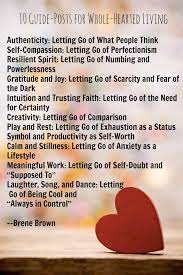
Check out this awesome diagram for the 10 guideposts. The left hand side in bright green are the qualities to cultivate. The right hand side in “stop this” red are the things to work on releasing.
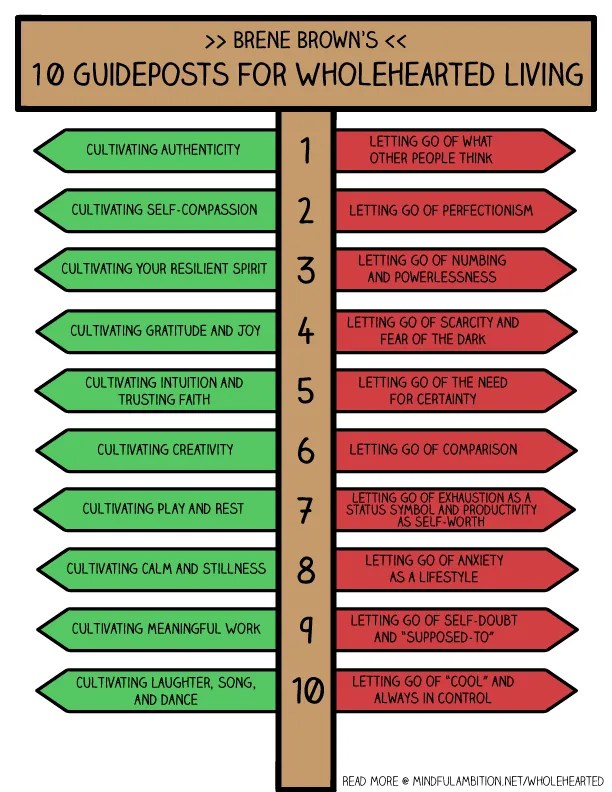
Brene and her sisters use a lot of the same tools that I do to help them integrate the guideposts into their own personal growth journey. The enneagram is a great resource for understanding our core motivations for some of our learned behaviors and best of all it helps us recognize our blind spots. The enneagram also uses a measurement approach similar to the gas tank analogy — it is a spectrum, from healthy to unhealthy. When we move to the healthy end of enneagram type, we are using our gifts and talents in the best ways possible. We find more joy and fulfillment in life and others enjoy being in relationship with us. When we start operating on auto-pilot and act more unconsciously, we move to the unhealthy end of the spectrum. Often this is when we begin to have relationship issues, are prone to numbing to avoid painful emotions and make poor choices.

Being a big believer in both the enneagram and Brene’s work, it was so beneficial for me to hear how using these tools in tandem were so meaningful to Brene, Barrett and Ashley.

Another area that really resonated with me was the candor with which these three siblings could talk about their childhood, the experiences that shaped them as they were growing up. Brene is the oldest and she assumed the role of protector for her younger sisters. Like so many of us, their childhood also had dysfunction weaving through it and this set them up for many of those roadblocks that are in that red column above — being a control freak, having a need for certainty, always comparing ourselves to others who seem to be doing it right, working ourselves to exhaustion to prove our worth.

As they discussed these experiences and how it shaped each of them, they also revealed how they were coming to know their parents in a whole new light — mostly as messy, flawed and big-hearted human beings doing the best they could at that time. This is one of the gifts is truly a blessing that goes both ways — adult children gaining a deeper perspective and parents being given space and grace for all they navigated, often with little support for their overall quality of life. This is where we often discover the root causes of so many of our unconscious behaviors that are listed in that red zone above. Brene research shines a light on the armor we use from one generation to another to be protect ourselves. Getting our family skeletons out of the closet is just like mom or dad shining a flashlight under our bed when we were young, confirming that the monster was mostly a figment of our imagination.

I see a lot of overlap in the discussions that Brene and her sisters had and my Zoom book club. We are taking what we are learning and applying it to our lives — past and present. Applying it to the past fosters healing. Applying it to the present frees us to live authentically. We are helping each other along the way through honesty and vulnerability.

I’m also part of several Facebooks groups that revolve around Brene’s Dare to Lead teachings and Glennon Doyle’s game changing book, Untamed. For the most part, the women and men in these online discussion groups are strangers. Yet there is a clear understanding that we are there to support each other with respect, kindness and empathy. The outpouring of stories, questions and a need for supportive help is profound. Every single day, there are a handful of stories that look and feel much like pages in the book of my life. It is incredibly uplifting to read the touching, encouraging responses. It is even more profound to see how many people have overcome tragedies and adversities and now are shining beacons of hope for others.

So there it is — Brene’s podcast, my Zoom book club and these online discussion groups — all taking that leap of faith and sharing their imperfections and vulnerabilities — and inspiring each other to keep going, keep growing and lean in to those who care.

RECOMMENDED RESOURCES:

Check out the Wholehearted Inventory Assessment in the Gifts of Imperfection Hub. Listen to the Summer Series if you’re looking for motivation and inspiration for integrating the 10 guideposts for Wholehearted Living in your life.
https://brenebrown.com
Glennon has evolved through many chapters of her life, often sharing those experiences in great detail in her books. In this one, Untamed, she really pulls the layers off the onion, offering poignant self-examination stories that many of find so relatable.

Please check out Nedra Tawwab — especially if you want some solid footing when it comes to setting healthy boundaries. I discovered Nedra through a Being Well podcast with Dr. Rick Hanson and his son, Forrest. I follow her on Instagram and absolutely love her Nedra Nuggets! https://www.nedratawwab.com
Nuggets of Wisdom – Visual Images

Visual images are some of the most beneficial aids in my mindfulness toolbox. Today’s post is chock full of my “go to” images that I depend upon to keep me present in the moment and showing up in an authentic way. Even if I’m feeling really strong emotions (mine or others), these helpful tools keep me from impulsively reacting to big feelings.

About 20 years ago, I met the most incredibly calm and benevolent young woman. She was the instructor for my 5:30 a.m. hot yoga class. She would start our practice with a visual image: planting our bare feet firmly on our mat, we were to envision small roots growing into the ground, anchoring us in our yoga practice for the next 90 minutes.

When I was gaining a little traction with my meditation practice a few years ago, I recalled that image from yoga class and thought about how I could create a similar visual to help me take my meditation “off the cushion” and into daily life.

My visual image is of dropping my anchor into my very core of calmness — that place I find when I can let thoughts go and focus my attention in the present moment. In meditation this is returning to my breath. In real life, it is staying present with the situation at hand — and most importantly, not getting attached to my own emotions or those of others. I can make better decisions when I am calm. I will be much more likely to act in alignment with my true nature when I am calm. That mental image of dropping my anchor de-escalates things for me pretty quickly.

A wise mindfulness teacher once said that most situations are benign — they are neither good nor bad. It is how we respond or react to them that makes them positive or negative. What is a big deal to one person may not even get on the radar screen of another. Staying calm and paying attention to how others are feeling, helps me get a grasp on why a situation may be a big deal or a small one for someone else. Often this is more relevant than the actual circumstances.

This may be one of my personal favorites — the visual image of holding a brightly colored spool and letting out a little extra kite string, watching that kite dance a little higher in the sky, adjusting to the currents and gaining fresh perspective.

Sometimes we are just too afraid to let go, even just a little. We chase what we think we need or want so badly. We might micromanage our lives or others. We can be prone to hover or smother, be needy or greedy. We can let fear hold us back from trying new things, or taking that leap of faith.

At this stage of my life, I use this visual image most often when it comes to relationships, especially adult children and extended family. Letting a little kite string out means that I am holding space for others, recognizing that their lives are busy and that they want to solve their own problems. I don’t need to be tugging so hard for attention or to be the one they turn to for advice. I just…..let out a little kite string.

I credit Malcolm Gladwell for this visual. If anyone can look at a situation from a ga-zillion perspectives, it is Malcolm Gladwell. And he does it with a child-like curiosity and unabashed wonderment. To me, this is how it feels to look through a kaleidoscope, twisting and turning it with pure delight, fascinated by the changes.

So often, we view things from our same old vantage point. The fact is that we are changing all the time, and oddly enough so are those chronic ongoing situations in our own lives, in our communities, country and globally.

Listen to a few episodes of Revisionist History podcast with Malcom Gladwell and you will witness a big shift in perspective when a situation is viewed from all angles, and through the experiences of everyone involved.
Remember the old adage, one man’s junk is another man’s treasure? This visual is a little like that for me. I envision myself holding a smooth cylindrical kaleidoscope that has a little weight to it, placing it in front of my eye, and watching the problem present itself in a myriad of ways. It’s a reminder to withhold judgment, get out of my box, stay curious — and make sure I am actually looking at the real problem. (Credit goes to Michael Stanier Bungay and his book The Advice Trap for this wisdom. Far too often we jump in to problem solve so fast, we “solve” the wrong problem).

When I first discovered mindfulness, I had a little cork that I placed in a small clear vase on my kitchen window sill. I would see it every morning when I poured my first cup of coffee. It was my reminder not to get bogged down in rumination, disappointment or sadness. I had read an article in Mindful Magazine that talked about how freeing it is to let go of getting caught up in the negativity bias. The image of letting one’s cork float effortlessly through the flow of life was inspirational to me.

I didn’t know at that time just how much I was actually tethered by old behavioral patterns, my life history and the disappointment of a dream disintegrating. Over time, with awareness and daily practice, I freed myself from those weights and found that I really did feel lighter in many ways. Today when I feel myself growing a little heavy in spirit, I think about that cork on my windowsill. It’s a reminder to look for the good.

The little things that unfold in our daily lives offer buoyancy to us if we are paying attention. Make eye contact with someone when you are having a conversation — you will feel your cork rising when you see it in their eyes that they know you are really listening to them. It’s magic and it’s rare….because too often today our faces are gazing at our phones and not each other. Call a friend or your sibling instead of texting — hearing each other’s voices adds the spice. Don’t be surprised if you learn so much more than you expected. Think about someone who makes your life better — and send them a card or a text expressing your appreciation. Smile more. Laugh out loud. Listen to the sounds of nature. Read a good book. Listen to your favorite music. Dance in the kitchen. Take a break.

Just holding on to those little moments of joy for ten seconds releases happy hormones and that will definitely let your cork rise and buoy your spirits.

I hope you enjoy reading about my visual images. I do love sharing them. Sometimes a simple mental image that is all we need to bring us back to the present moment.

Correlations and Connections…

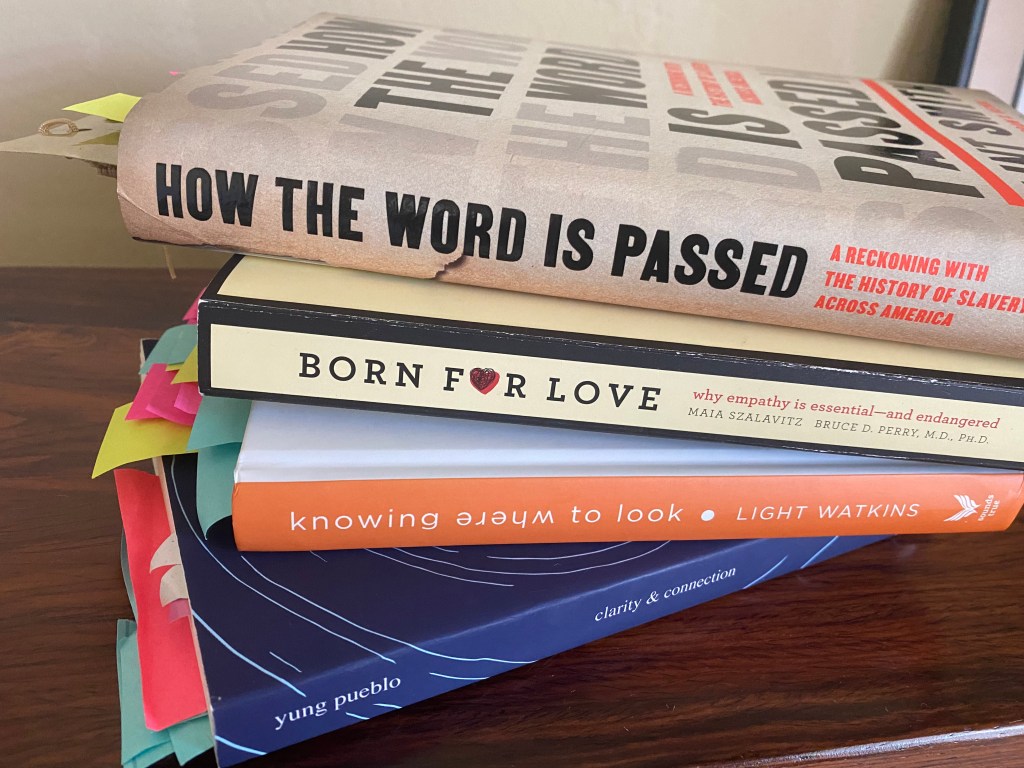
My son in law gazed at the stack of books on my table and asked me if I found any correlations that ran through the various genres of my diverse interests. How curious that he would ask me this question, for I had just been making that connection. The evidence was in the plethora of brightly colored post it notes jutting from my books with scribbled observations on most of them. There are indeed common threads that weave themselves throughout my books, podcasts and conversations. Consider this a bit like an adult version of “If You Give a Mouse a Cookie.”

I recently read Born for Love by Dr. Bruce Perry who was sounding the alarm 10 years ago for our collective empathy poverty. Dr. Perry and his co-author shared in-depth details of real life experiences from their practices and research about childhood brain development. As the case studies were presented, it was revealed just what went wrong in a young child’s brain development that impacted their capacity for empathy and lack of ability to self-regulate. As the stories unfolded, those resulting consequences led to some devastating results for the child, parents, and others to whom they caused harm — often later in life. To be honest, many of these stories were so relatable to me due to my own lived experiences, and through the experiences of family members and friends.

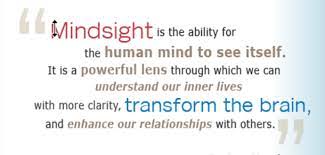
The correlation? All the work that Brene Brown offers on vulnerability has a direct link to empathy. Vulnerability and mindfulness work together to build empathy. When we are aware of our own feelings, when we can witness them, and process them in healthy ways, we expand our compassion for ourselves and our empathy for others. Empathy is being able to perceive what is going on for others. We have the capacity to really connect with others by a genuine relatable understanding of how it feels to experience what they are dealing with in the moment. We know how it feels in our body and how it affects our mind. We connect our own past experience and someone else’s current experience through empathy. Dr. Dan Siegel calls this Mindsight.

The connection? Learning how early childhood brain development can negatively impact emotional intelligence and the ability to self-regulate is a gateway to understanding why people may struggle with behavioral issues. This is a new lens through which to view complex relationship and social issues. Doing our own personal growth opens our eyes to our blind spots and how we might block our own emotions in unhealthy ways. Self-discovery frees us from personal roadblocks to our own vulnerability. Once we grow in self-compassion and personal emotional awareness, we can then strengthen our relationships with others in a much healthier and honest way.

Born for Love is one of those books that has an everlasting impact. It made me reflect on all the changes we could be making to educate young parents about brain development of their newborn, how extended families could be educated and encouraged to provide additional continuity and support for mothers and newborns — and mostly it made me think about all the young children borne in poverty and dire situations who have little chance of being given the opportunity for healthy brain development. Imagine the positive impact we could have for society as a whole if we could just give every child the best “head” start.

The next book I read was How the Word is Passed by Clint Smith. Although this reading order was quite by accident, I am grateful for the timing. My empathy was clearly amplified by my increased awareness of what I had just learned about childhood brain development, trauma and intergenerational impacts from Born For Love. This prepared me to absorb a much deeper understanding on all that I was about to discover. The sub-title of Clint’s book is “A reckoning with the history of slavery across America.”

Clint Smith is a gifted writer who weaves past and present together with a needle of truth and threads of shared humanity. I read his compelling book very slowly. I read it slowly because it is the type of book that makes you stop in your tracks, to reflect what you are learning and to process the wash of emotions that stir from his vivid stories. There is no doubt that the profound historical education I got from this book sinks deeper into my heart because of Dr. Perry’s insights on our persistent empathy poverty.

Clint Smith traveled across the country visiting landmarks and monuments — those that are honest about the past and those that are not — and offers the reader an intergenerational story of how slavery has been central in shaping our collective history and memory. It was his conversation with John Cummings that drove home the power of empathy for me.

John Cummings is an aging white multi-millionaire who turned the Whitney Plantation in Louisianna into our country’s first slavery museum in 2014. Stop and think about that — a private citizen provided our country its very first slavery museum. A privileged, affluent older white man. What motivated him to dedicate himself to this mission of telling the tragic history of slavery?

John Cummings educated himself about the totality of the oppression that Black people have experienced through the records he acquired when he purchased the Whitney Plantation in the late 1990’s. He has read more than eleven hundred oral histories of slaves and he described the strange feeling that came over him as he took in their words. He told Clint that it felt as though someone was talking to him who never had a voice. He did not feel guilt — he had a feeling of “discovered ignorance.” “How could this have happened and I didn’t know about it?, he said.

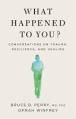
The correlation? John Cummings was overcome with empathy for our shared humanity as he read these oral histories. Empathy opened his eyes and his heart to the tragedies and atrocities these fellow human beings endured from slave owners and the social acceptance of slavery. Empathy brings us clarity and a hunger to learn the whole truth. Dr. Perry has recently co-authored another book I’m reading – What Happened to You? I’ve listened to many of his lectures on this book and have been captivated by what a compelling question this is to ask someone. Rather than chastising by saying “What is wrong with you?” asking “what happened to you?” will help us bridge the great divide .

The connection? We cannot heal our country’s collective trauma if we gloss over or ignore the truth about our history. The analogy for me is simply this: Just as we have to be honest about personal intergenerational family trauma and history in order to break the chain and begin healing, we must do this same hard work as a country. We have an opportunity to re-write our collective story and free us all from a past that is holding us back from extraordinary healing and growth.

This brings me to a book I read last spring – A New Earth by Eckhart Tolle. It is a spiritual manifesto for building a better way of life and building a better world. In his recently launched podcast series, Essential Teachings, Eckhart and Oprah take a deep dive into the chapters of that book. Just a few days ago, It was the chapter 3 episode that grabbed my attention. In turn, I grabbed my post it notes and wrote “labeling and resistance” on them.

Brene Brown has been very vocal about all the harm that is caused by labeling groups of people — and calling people names. It dehumanizes people and in turn it desensitizes those who brandish the labels on others. It is this very desensitization that overrides a person’s empathy and allows them to harm others without remorse. Eckhart Tolle echoed this same message in his recent podcast — labeling desensitizes us to the aliveness, the humanity of another.

I found myself reflecting on all the ways our society uses labels — not just for individuals and groups of people, but also for the hard conversations that we legitimately need to be having. We label these hard conversations, we pick a side or a political party, and we take a strong stance. The media amplifies the label in every news stream. All too often, these labels and their ensuing conflicts distract us from the legitimate issues that need to be examined.

Eckhart also pointed out that whatever we resist, persists. What we fight, we strengthen. Conflict and negativity are not tools for problem solving. He asks “do you want peace, or do you want drama?”

The correlation? How many labels have been used throughout our country’s history to dehumanize and oppress others? How many labels have been used to address chronic, systemic issues? The innumerous examples of how we label and dehumanize on social media are heartwrenching. Are we blind to the many occasions that we witness and accept labeling?. If labeling people, groups or issues desensitizes us, is it any wonder that empathy is in great decline. The us vs. them fight that permeates almost every subject matter today is only strengthening our divide. We seem to be fighting over the very things that those who came before us fought hard to gain for us. We were their future. The connection? Awareness, acceptance and empathy intersect in these books, podcasts and in life. Eckhart Tolle referenced several times about how similar our collective struggles are to our personal struggles. We have the capacity to co-exist with awareness, acceptance and empathy. We do this automatically when a natural disaster strikes, such as a hurricane or wildfire. We did it most extraordinarily immediately after 9-11. Eckhart reminds us that negativity and defensiveness do not solve problems but keep us addicted to unhappiness and drama. Rather, he suggests, make peace with the issues, accept reality. Meaningful, humanitarian and sustainable actions come from compromise, empathy and presence.

Pletohora of Podcasts!

During the pandemic, I added a new element to my self care routine — podcasts. Less news, more learning, wide variety of topics. And this is when I found Revisionist History with Malcolm Gladwell. I was over the moon delighted with my discovery and often binged on them the way my friends were binging on Netflix. His podcast is “a journey through the overlooked and misunderstood –something from the past –an event, a person, an idea and even a song — and asks whether we got it right the first time. Because sometimes the past deserves a second chance.

What I love about Gladwell is his child-like curiosity and his brilliance at connecting the seemingly unrelated in extraordinary ways. I envision Malcolm using a kaleidoscope the way one would use binoculars — that’s how colorful, creative and unique his perspective is on a wide array of topics. It is just this sort of curiosity that we need more than ever. It is also just the kind of multiple perspective lens we need when looking back at history and asking the most relevant question – “what have we learned from this experience?”

I recommend listening to these two episodes to jumpstart this process for yourself: Miss Buchanan’s Period of Adjustment (June 28, 2017) which will shed light on school segregation and black teachers’ fate after a landmark Supreme Court Case; the second one is The Foot Soldier of Birmingham (July 5, 2017) which will reveal how a single photo impacted the country in the midst of one of Dr. Martin Luther King’s most famous marches. The plot twists reveal unforeseen consequences that underscore the importance of solving the right problem — and if we are not curious enough, if we don’t ask enough questions, we just might be spending all our time solving the wrong problem. (I’ll give a nod to yet another book The Advice Trap by Michael Stanier Bungay.)

The correlation? History has a lot to teach us, but it is necessary to have the full scope, the whole truth, if we are to derive the most meaningful lessons. Asking the questions about whether we got it right the first time, and if not, how can we do it better?

The connection? Own the problem — that does not mean ignoring it or fighting about it. Accept the reality of the problem. Leave judgment at the door and get curious. Ask questions, lots of questions — and ask the people who are most affected for their experiences and their ideas. Learn from mistakes. Did you know that “rupture and repair” is the glue for most healthy relationships? Whether it is a personal relationship or a country’s relationship there will be ruptures — misunderstandings, conflicts, issues — but it is the “repair” that not only heals, it fortifies and strengthens the relationship — the kind of resilient relationships that stand the test of time.

Food for Thought:

After reading How the Word is Passed, I scrolled through the online reviews of the Whitney Plantation on their website and was disheartened to see that many visitors treated it like a tourist stop rather than the historical education that John Cummings intended. So often, we just “skim the surface” of things in our own lives as well as humanitarian issues. If we scratch the surface and dig a little deeper for more information, more understanding we will gain insight and even compassion.

Malcolm Gladwell offers that we “think with our eyes” and we “feel with our ears”. He told Stephen Colbert in an interview that books makes us think but that podcasts can make us cry. He also believes that crying is how we get in touch with our own vulnerability. If something brings you to tears, it will stick with you. It’s so true, isn’t it? We can listen to an interview for an hour and it is the 30 seconds of vulnerability, the emotional punctuation in a heart-touching story that lingers with us long after the conversation ends. These are the seeds of connection — that remind us of our shared humanity.

I was living in Fort Lauderdale when the Parkland school shooting occurred. I recall seeing a Facebook posting of David Hogg in a photo-shopped pink crocheted hat with a tag that read “The liberals have found their snowflake.” I cried. I’d see these Parkland kids and their families in the community after that horrific experience. I saw their shock, their pain, their fears. Those raw emotions were palpable in our community — for many months. There was not a parent in our neighborhood who did not express their fears about putting their kids on the school bus shortly after that tragedy. Events like this reverberate to others all across the country and can be the cause of PTSD, emotional triggers and high anxiety. The effects of labeling also reverberate in a similar fashion. Odd isn’t it that one action of dehumanization causes desensitization in the one who labels and over-sensitization in the one it was intended to hurt.

Awareness is the key to many of our individual and collective problems. “Pay attention to what you pay attention to” is a cornerstone of mindfulness. How much of our attention goes to complaining or defending…..and how much goes to understanding and problem-solving? Another cornerstone of mindfulness is “reframing” — an invaluable reminder to shift or expand perspective. Too often we have a blind spot because we just keep looking at things the same old way. “Pass that kaleidoscope, Malcolm, it’s time for some curiosity and creativity to infuse our perspective!”

RECOMMENDED RESOURCES:

On the bookshelf:

Here are the links to the 2 episodes of Revisionist History that I referenced above: These episodes are so worthy of your time.

https://www.pushkin.fm/episode/miss-buchanans-period-of-adjustment/

https://www.pushkin.fm/episode/the-foot-soldier-of-birmingham/

For stimulating discussions, try some podcasts:

Older and Wiser Parenthood

One of my favorite things is talking with my adult children about the stuff that they are navigating in their mid-life. I don’t shy away from any aspect of these conversations even when the topics are tough. Something that I have noticed as they hit their 40’s, is that their perspectives on me are evolving as they get deeper into mid-life. They are now going back and revisiting the past through their own parenting lens. There is a depth to our discussions that I love, for it pulls back the layers of our family history and allows for healing and growth.

I’m in a better place for these meaningful talks because of all the personal growth work I have done. I no longer listen with my mind racing about how to solve a problem for them. I recognize that this is not my role now. They are grown ups and they need a confidante, a sounding board, and a judgment free space. When my focus is on listening, I find myself discovering so much more than what is on the surface. We can dig a little deeper.

As my adult children have navigated through their own life experiences with marriage, parenting, and careers over the past ten years or so, they too are discovering more about me as a whole person, and not just “mom”. It is in these nuanced conversations that we find new common ground and mutual respect for each other. The very stuff that they grapple with today, I also struggled with. My experiences provide perspective and assurance they too can get through the tough parts of life. The best gift that I can offer to them today is the insight I have gained on how I might have done it better. It is precisely why I gave them each a copy of the Gifts of Imperfection by Brene Brown. I wish I had not only known about the 10 guideposts for wholehearted living, but that I had someone I could confide in who would help me cultivate them earlier in life.

That is precisely the resource I want to be now for my adult children.

It’s hard as a parent to witness adult children going through tough struggles. I’d hoped they’d be spared some of those adversities, but that is not how life goes.

I don’t think it is all that unusual for adult children to be reluctant to discuss their challenges with their parents. There is a part of them that doesn’t want to admit to mom and dad that they are wrestling with life issues. They don’t want to disappoint, to burden or to get lectured.

And yet….the truth is….that we as parents have been exactly where they are and we not only know firsthand the worries, the second-guessing and the what-if’s — we know that we made it, that we might have done better and that we want to be the support system we either had — or wish we had.

These 10 guideposts for Whole-Hearted Living give me a great place to start when it comes to having some of these deeper conversations with my adult children.

I’ve come to realize that it is necessary for our adult children to have a healthy dose of life experiences under their belt before we can delve into some of this wisdom. After all, it only makes sense when they can actually relate to it.

My son who has gone through a divorce and is co-parenting his 8 year old daughter very well with my daughter-in-law, has a much different lens through which to view my divorce from his dad when I was his age. He can also assess the relationship that his sister had with their dad when she was only 8 through a parenting lens. My hope is that this does not impact his current relationship with his dad, but that it offers a new framework to understand prior mysteries about the complexities of his sister’s relationship with their father. My son can now understand that my parenting job for his much younger sister was made harder by the choices their father made about his relationship with his daughter. The ripple effect from his dad’s co-parenting decisions resulted in a lot of painful confusion and estrangement in our family for a very long time. That hard lesson learned has resulted in my son and daughter-in-law being very cognizant of keeping their daughter at the forefront of intentional co-parenting.

My oldest son reminds me a lot of myself at his age, burning the candle at both ends at work and at home. He is striving to be an over-achiever professionally and personally. Been there. Done that. I recall very clearly how exhausted I was from it all so it’s easy to put myself in his shoes when we chat. Where I used to quickly dole out advice, I now listen more and ask more questions. My focus now is to empower him to find his own meaningful solutions. I recently read The Advice Trap by Michael Stanier Bungay to help me get better in supporting him in this way. My stories about wrestling with similar work and parenting issues when I was his age offer some comfort and assuage some of his fears about the future. I can even get a chuckle out of him when I tell him that it has taken me many years to “ooze this much wisdom.”

My daughter is a decade younger than her brothers and has a lifestyle that is quite different. Her husband is a professional athlete has has been for 12 years. This means several moves to new locations every year, with many moving parts to each. She is home-schooling her two children to provide continuity for their education in spite of all these relocations every year. She has had to become a master of logistics to pull this all off in a seamless way for her husband, her children and her dogs. Like every other young mother, she can feel pulled in a thousand directions, feel like she’ll never get it all under control and she sets the bar high for all that she should accomplish in a day’s time. I used to give her examples of all that I juggled when I was raising her and her brothers and boy did that backfire. It was not helpful — and I know that now. She felt like I was judging her with all my comparisons. Thank you Brene for helping me to realize the error of my ways. What my daughter really needed was for me to see her, acknowledge what she was feeling and to articulate how I valued her and all that she does with so much love for her family. She did not need me to rush in and do things for her. She needed to know that I have her back and she can offload all her stresses with me in a safe, judgment free zone. It occurred to me that when I was her age, I was similarly overwhelmed. It was then that I realized that I had to overcome my lack of organization and ability to prioritize if I was going to keep my sanity. Oddly enough, it was my own chaos and overwhelm that led to me becoming an efficient planner, organizer and resourceful problem solver. The one area that I totally neglected however was my own self-care. I’m so grateful to be able to have these honest conversations with my daughter about the importance of taking time for herself and her own interests. She is now a role model for her own little girl – the best source of motivation there is.

Everyone of the 10 guideposts that Brene Brown offers in the Gifts of Imperfection permeate my conversations with my adult children these days. Through our deeper conversations we revisit the past with fresh perspectives, empathy and benevolence. Honestly, we are starting to heal some chasms that existed for far too long.

In a recent Being Well podcast on connecting with our true nature, Dr. Rick Hanson and his son Forrest, shared some of their own father/son dynamics along with childhood experiences. Dr. Hanson stressed the value of adult children being able to have conversations with their parents and even grandparents about the family’s past. When we are older, we can handle some of the relevant details that may not have been appropriate to share when we were younger. He explained that this can lead to a deeper understanding of the bigger picture and can lead to improved relationships and family healing.

Brene Brown and her twin sisters had a similar conversation during the second episode of the Unlocking Us Summer series. They reflected on their own mother and what she might have been struggling with that ultimately led to divorce from their father later in life. There was no angst or big emotions as they talked through this, but rather a keen desire to understand mom and dad a little better — and to extract the lessons.

I have a few friends who have shared with me that they had long-standing problematic relationships with one of their parents for many years. It was only when they were much older and some key circumstances had changed that they had a breakthrough. In some cases, it was a parent that stopped drinking. In others it was becoming a caregiver for an ailing, aging parent. The stories my friends share are heartwarming because they came to know their parents in a totally different light. They discovered common ground, greater understanding and a humbling realization that most of us are flawed, messy humans doing the best we can. A lot of heartache has been healed through these hard conversations. A lot of wisdom has been imparted.

As my own personal growth journey unfolded, I realized that I had a lot of childhood trauma that led me to develop some of my triggers and behavioral patterns that stuck with me for decades. Unfortunately both of my parents were deceased and I could not have these conversations that might have answered so many of my questions. My brother and I have had quite a few conversations about our family and our shared experiences. This has been enormously helpful to both of us and has truly strengthened our bond. We are all that is left of our family at this point and very grateful to have each other. We are the best of friends.

I had no idea when I started my deep dive into my own personal growth six years ago that it would prepare me so well for being able to have deep, hard conversations with my own adult children. Again, I find myself extremely grateful. Anything that I can offer to my adult children to help them understand their childhood, their own triggers and behavioral patterns is an invaluable gift to them. My adult children getting to know me as a whole person, with all my crazy dreams, my flaws, my wild stories and my unconditional love, well that is the best gift I could ever receive.

RECOMMENDED RESOURCES:

Being Well Podcast – Connecting with Your True Nature

https://www.rickhanson.net/being-well-podcast-connecting-with-your-true-nature/

Being Well Podcast – Internal Family Systems Therapy with Dr. Richard Schwartz

https://www.rickhanson.net/being-well-podcast-internal-family-systems-therapy-with-dr-richard-schwartz/

Unlocking Us Podcast – Summer Series — Part 2 on the Gifts of Imperfection by Brene Brown
https://brenebrown.com/podcast/part-2-of-6-brene-with-ashley-and-barrett-for-the-summer-sister-series-on-the-gifts-of-imperfection/

The Greater Good Science Center – Article – The Cost of Blaming Parents

https://greatergood.berkeley.edu/article/item/the_cost_of_blaming_parents

Red Flag Insights

I’ve often shared how a relationship breakup put me on the personal growth path in my 60’s. While moving on from a broken relationship was challenging by itself, trying to understand why I ignored red flags and held on so long to an unhealthy dynamic proved to be the hardest part. It also became the most profound pivot of my life.

Today as I was listening to a Being Well podcast, I found myself feeling so “heard and understood” by Dr. Rhonda Freeman. Learning how the brain is impacted in our relationships explained a lot of the mystery that kept both me and my partner in unhealthy cycles. Repetitive patterns and the release of brain chemicals that “reward” us play significant roles.

Turns out that Dr. Rhonda Freeman also went through a similar relationship and breakup as me. She had the same experience afterward with friends and an unhelpful counselor that I did. She also had a strong desire to learn from the lessons which resulted in her turning to personal growth resources to find her healing. Dr. Freeman discovered that this foundation in her very own field of expertise — neuropsychology. While her main focus had been dementia, she now applied the science and tools to healing from a dysfunctional relationship.

While I did not have that field of expertise, I did have a keen fascination in neuroscience as well as a budding interest in mindfulness — and that led me to discovering Dr. Rick Hanson. The profound pivot for me was turning my attention inward and committing to some major changes. For most of my life, I’d always been about helping others, so this was a complete 180 for me. It was Dr. Hanson’s book, Hardwired for Happiness that jumpstarted the process.

Listening to the podcast today revealed the complex impact of an emotionally dysfunctional relationship on the brain. Suddenly a lot of pieces started to fall into place for me as I gained clarity about red flags and why my healing from that relationship took several years. I found Dr. Freeman’s honesty about her own relationship experience to be comforting and reassuring. She too had missed the red flags. She too had kept doubling down on efforts to salvage a fraying relationship. There is such a strong influential pull in romantic relationships fueled by our innate need for belonging and connection, that we can often override and overlook what should seem obvious.

Even Dr. Hanson confessed that he was once “talked into” following a cult-like group at one point in his life and in spite of his background, he too was completely affected and bamboozled by the influential power of the group. He pointed out that because we humans are by nature empathic and compassionate, we are also vulnerable to being influenced and drawn into relationships with others that are not so healthy. Sadly, emotionally dysfunctional relationships are all too common these days.

It’s not that unusual to have blind spots to the red flags. We may just dismiss them or explain them away. It can happen to anyone. We get flooded and overwhelmed by strong influences. Dr. Hanson cautions us to have a deep appreciation for the power of social conformity, acceptance and openness to being manipulated by others.

Once the conversation established how we find ourselves getting pulled into unhealthy relationships, it then turned to what is needed in the aftermath. How do we heal? What lessons do we learn and how do we develop our awareness and attunement to red flags and our own unconscious patterns?

Dr. Rhonda Freeman explained the double whammy of recovering from dysfunctional relationships. Not only do we have to heal from the pain of an emotionally dysfunctional relationship, we also have to address the shame that accompanies it. Shame we put on ourselves for allowing ourselves to be pulled into such a dynamic and shame from others. Very often well-meaning but misguided friends will also shame us. “How could you get into this relationship? Why did you accept that behavior? How did you miss those red flags and long-standing behavioral patterns?

As I listened to Dr. Freeman’s stories about her friends who took a “tough love” stance and told her to “get over it” and “just move on”, it resonated deeply with me. The tough love approach can do more harm than good and often only causes additional heartache. Now I understood why I felt so awful back then and even avoided friends who doled out their tough love advice or thought I should dive headfirst into a new relationship.

As Dr. Hanson pointed out, you need a trusted friend to fill the emotional void that is inevitable after a breakup. This is a key element to healing — because it is the emotional void that can cause rumination, longing and extended suffering. It is much more supportive to have a trusted friend who will hold space for you and be willing to listen without judgment. You need a reliable friend who can curl up on the couch with you and watch a movie, make you laugh, offer grace to you as you take time and space to reflect, to recover.

While this was not covered in the podcast, it was only through a lot of deep introspective work that I realized some aspects of my former relationship had triggered memories and emotions buried deep in me from my childhood experiences with my mother. Oddly enough, this started to come out in my journaling. I would have missed many opportunities to go deeper with my personal growth work had I not stuck with it. The breakup actually served to be quite cathartic for me.

Once I was more aware of those old emotional layers, I committed to healing them as well. It is why I now have a daily practice for my mental health and well being. In fact, there have been many aspects about my former relationship that became gateways to learn more about how the brain functions, childhood trauma, depression, emotional intelligence, addictions, neuroscience and the enneagram.

While my partner may not have had narcissistic issues, I believe that emotional disregulation and old behavioral patterns contributed to relationship dysfunction that feels remarkably similar to what was discussed in this Being Well podcast. He often described himself as a delicate flower — and I now understand that this was how he felt about the fragility of his ego. I often felt like I was walking on eggshells around him, never knowing what passing comment would trigger him. This led to more guarded conversation than light-hearted banter.

Our approaches to life’s challenges were quite opposite –I’d head for a walk in nature to clear my head and he’d curl up in bed, in the dark, for hours and often emerge heavier and sadder. I’ve come to understand that his enneagram characteristics predisposed him to hang out with deep dark emotions, often ruminating about the past. It was his comfort zone – a soothing mechanism that did not serve him well.

I’d been traumatized as a 4 year old when my mother locked me in a dark attic as punishment for running home from pre-school after an incident with a bully. So the last place you will find me is in a darkened room if the sun is shining. Since I did not understand his innate preference for sitting at length with his heavy emotions in the dark and he did not understand my need for sunlight and energy, we were both blind as to why our responses to adversities were so different. He felt unsupported because I could not stay in the dark where I unconsciously felt scared and very uncomfortable.

At the onset of our relationship, I mistook his deep pool of emotions for vulnerability and a capacity for empathy. I have subsequently learned from enneagram educators who share his type that this is a common misconception and a frequent cause of relationship issues. HIs self-focused actions often caused me and others hurt and confusion. It was his lack of remorse and understanding about his impact on others that baffled me the most. Surely if he himself could feel emotions so deeply, he must be able to understand another’s feelings. There was a disconnect about what he needed and what he was able to reciprocate. I chose the word “able” intentionally here. I know he was “capable” but I believe that unconscious behavioral patterns created his blind spot.

I’d seen the poor coping skills early on in our relationship, but chalked it up to the aftermath of a troubled marriage that ended in divorce. Especially because it often seemed to be most apparent whenever he and his ex had a disagreement about matters relating to their children. He was a doting dad who cared deeply for his children. But over time, I witnessed his struggle with emotional regulation and poor coping skills cropping up in many areas. It seemed that he really struggled to make any distinction between what should have been a 1 or 2 on the radar screen. Everything got a response as though it were a 10. This was an exhaustive pattern for both of us. I urged him to work on it so that we would have some reserve for the bigger milestones and adversities that life would surely bring us. This conversation sent us back to couples counseling.

Recently I have learned through Dr. Bruce Perry how the bar for our emotional stress regulation gets set in childhood. While I do not know my former partner’s full family history, I have some clues that might explain why he innately struggled so much with emotional regulation. While I did implore his family members to learn more, no one seemed to really have any answers, just the observation that ” he’s always been that way. ”

The very thing that brought us together — golf — was the final blow in our relationship. Instead of us having fun and enjoying our mutual passion for the game, each round was filled with his drama, poor sportsmanship and blaming others over bad shots.

That was when I took stock of the bigger picture and recognized that the behavioral patterns I experienced were not confined to our relationship. They were prevalent in his men’s golf groups, some friendships, with a prior girlfriend and at the very end, even with a cherished family member. It was in that moment that I asked him if this is how he really wanted to live his life. A few months after we broke up, he moved a new partner in with him.

Here is why I think that it is imperative to share as much information as possible about the tools and research that support mental health, self-awareness and personal growth. During our relationship of 6 years, we saw 5 couples counselors. We never made any significant and sustainable progress. Looking back, with the knowledge I now have, I can see where there were some big clues disclosed by each of us in our sessions, but no counselor ever picked up on them or suggested that we do some solo counseling. My partner was also treated for depression but again it was limited to dispensing medication. Even his long time friend and family doctor would just shake his head and say the he was the most complex guy he ever knew. The stress overload he carried surely contributed to a string of serious health issues.

We have to find better ways to support people who have healing to do from childhood trauma, who need help to rewire their neural pathways so they can be free from rumination, chronic low-grade depression, high levels of anxiety and PTSD. Unresolved trauma or loss can be so overpowering that it affects the quality of our lives. Dr. Bruce Perry explains that unprocessed trauma and poor emotional regulation will stay with us all through adulthood and will result in a cascade of relational problems and serious health issues. I’ve witnessed this reality in my own family and this relationship.

It is the very reason that I have shifted my focus to broader outreach and awareness of mental health for both children and adults. I will continue to share resources, research and tools to support each of us in healing. As I recently heard on a podcast with Dr. Dan Siegel — “it is not our fault that trauma happened, but it is our responsibility to recognize how it impacts us and others.

RECOMMENDED RESOURCES:

Being Well Podcast – Recovering from a Relationship with a Narcissist

https://www.rickhanson.net/being-well-podcast-recovering-from-a-relationship-with-a-narcissist/?highlight=recovering%20from%20a%20relationship%20with%20a%20narcissist

Being Well Podcast – Depression and the Brain

https://www.rickhanson.net/being-well-podcast-depression-and-the-brain/?highlight=depression%20and%20the%20brain

YouTube Interview with Dr. Dan Siegel – The Power of Showing Up

https://www.youtube.com/watch?v=gFhuj0lhW7Q

Empathy – Essential and Endangered

One of the big discoveries on my personal growth journey has been that the more I get to really know myself, the more I have expanded my awareness of others. I often find myself wondering what others have experienced in their lives that impacts how they show up for themselves and their relationships. My deep dive into the enneagram has given me a greater perspective into the diversity of core needs we all have and the many ways we go about getting those needs met. Replacing frustrations or judgments about others with curiosity and an intention to truly understand them has enriched my relationships and fostered a deeper compassion for others.

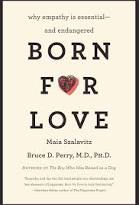
Recently I’ve been reading Dr. Bruce Perry’s book, Born for Love, which he published in 2010. He was sounding the alarm for the “empathy poverty” that has become pervasive in our society. He and Maia Szalavitz co-authered the book, sharing detailed stories of children and adolescents whose childhood experiences impacted their quality of life, and contributed to dysfunctional emotional and mental health issues. Over and over in each of these insightful and heartwrenching stories, we learn the incredible value of empathy as the foundational glue for healthy, happy and meaningful relationships.

What struck me was that our collective empathy poverty has only gotten much worse over the last decade. What gives me hope is the growing number of people recognizing a need for change — in their own lives and also in the lives of others. The global pandemic, political divisiveness, racial and gender inequalities, climate changes– they’ve all served as wake up calls. This book — Born for Love — should be a primer for anyone who wants to expand their knowledge on the root causes of so many of the issues facing humanity today.

Transgenerational patterns keep us tethered to the past and often resistant to embracing necessary changes. Lack of knowledge about infant brain development, especially in the first few months, prevent us from educating new parents about the importance of a calm, loving and nurturing environment. Programs, education and tools are needed for infants and their families who are in high risk situations for abuse and neglect to protect and ensure healthy brain development. This is vital to developing resilience and healthy emotional and behavioral regulation in the future.

We chastise young children for misbehaving without the base knowledge of their inability to do so because their cortex isn’t fully developed – and won’t be til their late 20’s. We expect kids to sit still and pay attention without an awareness that the tapping of their foot or the juggling of their pencil is a stress regulator — and a parachute to keep their little brains engaged and open to learning. We send juveniles to jail and wonder why they don’t learn their lesson. No time is spent on understanding their personal life history, providing them with stability and relational support for meaningful rehabilitation. Instead, we often put them with hardened criminals where they learn to double down on already problematic behaviors.

We have the power to change long-standing systematic and transgenerational problems. But first we must understand the root causes and then develop programs and tools to break the cycle. Each and everyone of us can contribute to this process. Empathy is the driver for long overdue changes.

Empathy underlies virtually everything that makes society work—like trust, altruism, collaboration, love, charity. Failure to empathize is a key part of most social problems—crime, violence, war, racism, child abuse, and inequity, to name just a few.” 
― Bruce D. Perry, Born for Love: Why Empathy Is Essential–and Endangered

As I mentioned earlier, my self discovery and personal reflection work has made me keenly aware of how my own past experiences pre-disposed me to behave in certain ways when I was feeling misunderstood, disrespected or ignored. This self awareness work actually opened up a deeper compassion in me. In mindfulness practices, this is often referred to as “other” centered. While I’d like to believe that I was usually an empathic person by nature, there is no doubt that facing my own childhood experiences had a transformational influence on how I viewed others. Instead of focusing on their behaviors, patterns and projections, I found myself wanting to know what happened to them. What was the root cause that eroded trust, self-worth, self-confidence and resilience?

In some cases, I had a good working knowledge of the hardships, adversities or abandonment that had happened to people I love. My blind spots were just how these difficulties played out in their own behavioral patterns and armor to protect themselves from having a repeat experience. This is where the enneagram became such an invaluable resource. It was a big aha moment for me to realize that often it was fear or insecurity driving another’s anger, blaming or denial. It shifted everything about how I wanted to respond.

And how I wanted to respond was with patience, attentive listening, non-judgment and calmness.

My own “improved” self-awareness enabled me to see that others were simply operating on autopilot too — and using old behaviors to survive, navigate or soothe. My compassion for what they were truly feeling began to grow. My empathy deepened, knowing what it feels like to often make things worse by throwing up a smoke screen rather than getting to the heart of the matter.

This change in “responding differently” to others diffused all that emotional investment that often happens in relationships and especially in conflict. We are prone to take things too personally. If we just take a moment to pause and center ourselves, we can turn our full attention to the the other person and really listen. Being calm, giving eye contact, and holding space are incredible tools for letting someone know that we are paying attention and we care. When we are able to refrain from getting caught up in all that super-charged energy, waiting to pounce with a defensive response, the dynamic shifts. There is room for empathy to join in. Empathy can bring clarity to a situation.

I think we have all had the experience of passing judgment on someone and then quickly observing details that paint an entirely different picture than our initial reaction. We feel embarrassed for jumping to a snarky conclusion and we feel a warm wash of empathy come over us as we take in the new information, and change our perspective.

This is the power of empathy — it opens us up to receive new information, and invites us to change our minds. In fact, if we want to proactively cultivate empathy, we need to stretch out of our comfort zones, examine our biases, and move beyond our own worldview. Trade judgment for curiosity — ask good, meaningful open-ended questions and keep asking to gain even more clarity and perspective. Have difficult, respectful conversations. Read books – both fiction and non-fiction will expand creativity and spark greater curiosity. (I do hope I have inspired you to read Born For Love. )

We get opportunities each and every day to practice cultivating empathy. The more we do it, the easier it becomes. We can all contribute to helping empathy get off the “endangered” list. We are born for love and connection. Our children are counting on us and what we do today will shape their tomorrows.

“Will increasing empathy solve all the world’s problems? Of course not. But few of them can be solved without it.”  — Born for Love by Dr. Bruce Perry and Maia Szalavitz

RECOMMENDED RESOURCES:

Please take the less than 3 minutes to listen to Dr. Perry succinctly summarize the importance of undoing our relational and empathy impoverishment. Dr. Bruce Perry – Born for Love: Why empathy is essential and endangered: https://www.youtube.com/watch?v=rmn8uvSyJSo

Check out this recent Typology Podcast with Former Governor of Tennessee, Bill Haslam. His insights dovetail with the content of this blog post in a meaningful way.
https://www.youtube.com/watch?v=TLxl8gJqCto&t=2347s

This week, Former Governor of Tennessee, Bill Haslam returns to the show. This time we talk about his new book, The Promise and the Peril of Faith in the Public Square, turning his attention inward to matters of the soul since his term ended, and what he’s learning about himself as an Enneagram 3. Bill Haslam is the former two-term mayor of Knoxville, Tennessee, and former two-term governor of Tennessee, reelected in 2014 with the largest victory margin of any gubernatorial election in Tennessee history. During his tenure, Tennessee became the fastest improving state in the country in K-12 education and the first state to provide free community college or technical school for all of its citizens, in addition to adding 475,000 net new jobs. Haslam serves on the boards of Teach for America and Young Life. In the fall of 2019, Haslam became a visiting professor of political science at Vanderbilt University. He and his wife of thirty-eight years, Crissy, have three children and nine grandchildren.

GREATER GOOD SCIENCE CENTER For a More Empathetic World, People Have to Choose Empathy https://greatergood.berkeley.edu/article/item/for_a_more_empathic_world_people_have_to_choose_empathy

Roots of Empathy Organization – Building Caring, Peaceful and Civil Societies. https://us.rootsofempathy.org

Roots of Empathy develops empathy in children today so that they can build the world that they deserve. This organization has reached over one million children globally with school based programs, and they have research to prove impact. Roots of Empathy reduces aggression, increases sharing, caring and inclusion and promotes resilience, well-being and positive mental health.

Trailblazers, Teachers and Lamplighters

Have you ever experienced the Frequency Bias? You are thinking about buying a certain model of car and all of a sudden you noticed that model car everywhere — the freeway, the grocery store parking lot, ads on TV and your neighbor’s garage. The frequency bias is a way of describing what happens when something you are holding in your mind influences where your attention goes.

I’ve been experiencing the frequency bias a lot lately and it has ignited an excitement in me that has me feeling a bit like a little kid! What has me so fired up is a “growth mindset“.

When we practice growth mindset principles, we see possilbiity instead of limitation. Failure becomes a valuable opportunity for learning, and the success of others inspires us rather than discourages us. (http://www.renaissance.com)

The frequency bias that has captured my attention is a correlation between an expanding personal growth community and Joseph Campbell’s teachings of the Hero’s Journey. Joseph Campbell, a leading mythology expert and modern day philosopher, revealed how story has been passed down through centuries and cultures to help humanity evolve.

The Hero’s Journey is a common story template that involves a hero that goes on an adventure, learns a lesson, wins a victory with that newfound knowledge and returns home transformed. The hero in the story template offers a shining example of personal growth work. We witness the transformation as heroes confront their own inner barriers, discover inner resources and test themselves. They return victorious from their adventures and conquests with a strong desire to motivate others.

Here is the magic in Joseph Campbell’s insights: It is far better for us to have a story to look through than an explanation. The story is richer – it pulls us in, makes us feel all those strong emotions, connects us to the character through those emotions, trials and discoveries. When we cheer for the hero, we are also cheering for ourselves — for possibility. A moving story inspires us, reminds us of our shared humanity and expands our empathy.

How many hero’s journeys have you personally experienced in your lifetime?

How many times have you had a sudden jolt in your world that changed the course of your life? What did you discover about yourself in those times of great trial? How did you help others when you emerged?

Those who have become Trailblazers, Teachers and Lamplighters are no different than you or I. They just recognized that their hero’s journey was only complete when they came through their personal growth experiences with a transformation so needed, so worthy that they shared the rich details to provide a scaffolding for us. We have a responsibility to those brave, courageous heroes to assist in our collective evolution. We don’t have to get it right, we simply have to do it better.

Take a moment to reflect on the things you often take for granted that might not be possible had others not fought for change. It could be collectively significant such as voting or being able to have credit in your own name. It could be singularly significant such as a parent getting you and your siblings out of a toxic environment. It could be life-saving heart surgeries or cancer treatments not available to prior generations. We are all benefactors of all those who came before us and did hard things that paved the way for something better. Nothing about life is stagnant – we are changing moment to moment. The major thing that gets in our way is when we inadvertently or unconsciously stunt our personal growth.

Every minus is half of a plus……waiting for a stroke of vertical awareness. What awareness can you add to it so that you get a far bigger picture? –Alan Cohen, Author and cast member of the movie, Finding Joe

What I have been noticing with greater awareness is that my Frequency Bias is picking up the patterns that are evident in the Hero’s Journey, the growth mindset, and the expansion of the personal growth community. The components and benefits of all sound remarkably similar:

Joseph Campbell’s lessons from the Hero’s Journey include accepting the possibilities of the present; trusting yourself and doing what makes you feel most alive (following your bliss, discovering your passion); part of the journey is exploration, facing our fears; stretch yourself (put yourself in uncomfortable situations every 7 days); we grow the most from things we stretch the most; no one holds you back but yourself.

Research links the GROWTH MINDSET with many benefits, including: greater comfort with taking personal risks and striving for more stretching goals; higher motivation; enhanced brain development across wider ranges of tasks; lower stress, anxiety and depression; better relationships and higher performance levels. (www.skillsyouneed.com)

Mindfulness tools include meditation and deep breathing; engage in activities you are passionate about; bring your attention to the present moment; sit with and truly feel all your emotions; journal for self-reflection; practice active listening; become aware of habitual but ineffective behavioral patterns; avoid numbing emotions and experiences.

I’ve written about the upward trajectory and merging of all this meaningful work in prior posts. What I have been amazed to discover is how often I’m having conversations today that reveals just how much it is beginning to seep into regular conversations.

Just in the past two weeks, I have had chats with waiters, grocery clerks and strangers at the coffee shop about personal growth, hard conversations, mental health and managing anxiety. No mindless conversation about the weather and plans for the rest of the day. I get the sense that people are hungering to find a better path forward as we emerge from the pandemic. There is a buzzing kind of energy that feels like the universe nudging us to chart a new course.

Could all of this explain the growing fascination with mediation apps like Headspace and Calm? And why Brene Brown’s work is exploding way beyond her initial Ted Talk and first book, I Thought It Was Just Me? She’s now hosting two podcast platforms on Spotify and she’s published 7 books with another one currently in the works. What incredible timing for Oprah and Prince Harry to launch their documentary on mental health; and for Oprah and Dr. Bruce Perry to release their new book “What Happened to You.” Neuroscience is weaving its way into mainstream conversations and intersecting with mindfulness, meditation, mental health, anti-racism and childhood development.

It seems we are open to the invitation that humanity is extending. It is our collective Hero’s Journey. The Hero’s Journey has 3 basic parts — Separation, Initiation and Return.

The pandemic provided that separation in more ways than we could have ever imagined. The initiation had us all dealing with unforeseen trials, isolation, and obstacles to our previously normal life, and we all got pulled into caves for self-reflection and a reality check. And now…..the return as we emerge. The big question before us is how will we show up?

Enlightenment occurs when we take time out for serious self-reflection and we face the things that scare us the most. Sometimes those scary things are the equivalent of a monster under our childhood bed. Bring them out into the light, learn more, do some perspective taking. There’s no doubt that it takes courage to recognize that we have some blind spots, some unfounded fears. Stretching out of our comfort zone a little at a time shines some light under that dark bed and informs us. We have a plethora of high quality resources to help us — books, documentaries, podcasts, conversations with people whose views are different from our own.

Many of our most invaluable resources are the rich stories of our Trailblazers, Teachers and Lamplighters. What lessons can we take from their heroic journeys? How can we honor the forward progress that they made for our benefit? We are the gardeners of the future….what seeds are we planting? What weeds are we pulling?

I’m sharing two stories I have learned over the past year from Glennon Doyle and her book Untamed. I think these are relatable examples of love in action and a willingness to open minds in whole new directions. The gateway to these shifts in perspective was through the heart. In her book, Untamed, Glennon shares the story of her parents attending a church-inspired community meeting in rural Virginia in 2015 in response to the racial issues agitating America’s consciousness after the Charleston mass shooting. There were about a hundred white folks in attendance. A woman called the meeting to order and announced the decision to send care packages to the predominately black school across town. The group embraced with relief this “outward action”, performance instead of transformation. Glennon’s father was confused and frustrated. He stood up and said “I’m not here to make packages. I’m here to talk. I was raised in a racist Southern town. I was taught a lot of things about black people that I’ve been carrying in my mind and my heart for decades. I don’t want to pass this poison down to my grandkids’ generation. I want this stuff out of me, but I don’t know how to get it out. I think I’m saying that I’ve got racism in me, and I want to unlearn it.” Glennon paints the picture of her dad as a good man, dedicated to family and community…in other words he looks and acts just like most of us. But as she so wisely states “he dared to imagine that he played a role in our sick American family. He was ready to let burn his cherished identity of “good white person”. He was ready to stay in the room and turn himself inside out.” (excerpted from Untamed by Glennon Doyle, Chapter entitled “Racists”).

The second story is about Glennon’s mother. Not surprisingly, her mother was full of fear and concerns when she learned the shocking news from her daughter that she was in love with a woman. While it was no surprise that Glennon’s marriage to Craig was broken and a divorce was imminent, it was a lot for Glennon’s mother to absorb this new revelation. What Glennon realized was that her mother was reacting as most of us moms would naturally do — a strong desire to protect her beloved daughter from the onslaught of judgment, harassment and negativity that was sure to come her way. And that protective instinct overrode her mother’s ability to separate her emotions around that from how she really felt about Glennon and ultimately Abby. Her love for Glennon was never in question. Her support for Glennon was layered under all the fears. When the dust settled and the air cleared, Glennon’s mom not only embraced the joy and love so evident between Abby and Glennon, she became a committed activist for the LGBTQ community. Glennon readily admits that her mom is now more involved in this activism than even she is. I share these two stories as examples of awareness and transformation in two people that are in their later years, facing change in unexpected ways and evolving. In fact, they are sources of inspiration to me and others who view this chapter of life as an opportunity to live on purpose, with purpose to create a better world for our children and grandchildren.

Personal growth and humanitarian growth are inextricably linked. When we know ourselves better, we tap into that deep reservoir of wisdom and understanding. We aren’t meant to get it perfect, but we are encouraged to keep working to make it better.

RECOMMENDED RESOURCES:

Finding Joe Documentary on Joseph Campbell and the Hero’s Journey

https://www.youtube.com/watch?v=s8nFACrLxr0

My son and I are both reading this phenomenal book right now. It will open your eyes and your heart in unexpected ways ….hopefully it will break you open to greater understanding.


https://brenebrown.com/podcast/brene-with-dr-clint-smith-on-how-the-word-is-passed/
in 2010 Dr. Bruce Perry brought to our attention the Empathy Poverty. Fast forward to 2021 and so much of what he shared, we have lived in many iterations. This book is more relevant today than ever. The root cause of so many of society’s problems lie in childhood trauma and neglect. Another book that will teach you things you never imagined impacting our daily lives.

We Can Do Hard Things Podcast – with Glennon Doyle and her sister, Amanda

https://podcasts.apple.com/us/podcast/we-can-do-hard-things-with-glennon-doyle/id1564530722

Master Class

I’ve been captivated by the extensive research that explains how childhood experiences shape our personalities and impact our ability to cope with life’s inevitable adversities. It intrigues me on several levels. One, it helps me unpack a lot of mystery and confusion about relationships I have had since childhood. And two, it fuels my advocacy for children, mental health and the importance of personal growth.

I’m extremely grateful for the work that Dr. Bruce Perry, Brene Brown and many others have been doing over the past several decades that is culminating in a greater awareness and deeper understanding of our hard-wired need for love and belonging. Research is shedding a lot of light on all the ways people go about trying to fill these deficits of worthiness, trust, and connection — and what goes wrong more often than not.

The cause of these feelings of deficit are often rooted in our childhood experiences and even the culture of the time.

Acceptable and normalized punishments for “bad behavior” from my generation have thankfully evolved. As is so often the case, because we did not understand basic brain functions, we were making things worse — for ourselves and our children. We didn’t know what we didn’t know. We are now beginning to understand that a child’s bad behavior is not a choice, but a natural limitation due to childhood brain development.

Our personalities and our behavioral patterns are all shaped in early childhood. They are a direct result of our lived life experiences. We develop our coping mechanisms and behavioral patterns as a child to to keep us safe all while also seeking to be accepted, to be valued and to be heard. We need love and belonging to grow and thrive.

As we make our way into the adult world, we subconsciously take these childhood experiences and patterns with us.

Imagine how many relationship problems could be resolved in a supportive and meaningful way if we actually addressed the “right’ problem. Between the armor we have all piled on to protect ourselves from childhood trauma and insecurities — and the behavioral patterns that become walls to scale, we truly do get in our own way of achieving a wholehearted life.

When I left a failed relationship six years ago, I decided I needed to unravel whatever it was that I was doing that was blocking my success in rebuilding my relational life after Skip’s death. I had no idea how invaluable that broken relationship would become as a reference point for educating myself about the complexities of living an authentic, wholehearted life.

One of the most revelational tools I discovered was the Enneagram.

The enneagram was the equivalent of having an MRI to uncover my learned behavioral patterns and the core motivation driving them. When I took my first enneagram test to determine my type, I found it to be remarkably accurate. It dovetailed perfectly with my childhood experiences, and the people pleasing skills I carried far into adulthood. It was a helpful starting place for me to unpack the “why” questions. Why was I a “rescuer”, why did I avoid conflict and why was I so afraid to express my own needs.

As I began to recall childhood memories, I saw the pattern of frequent occurrences of painful experiences. In order to navigate the chaotic uncertainty, I developed coping skills to mitigate adverse consequences. I was also witness to the experiences that my two younger brothers had and as the big sister, I felt a responsibility to protect them.

The enneagram evaporated all the beliefs I had that I was somehow irreversibly flawed. It allowed me to realize that the behavioral patterns I’d developed were simply coping skills intended to protect me. These now irrelevant behavioral patterns were the product of my environment. I was not a product of my environment. At the core, I was a big-hearted, tender, spirited girl.

My personal growth work was to reconnect with that girl — and step out of the armor I no longer needed.

I don’t think my story is all that unusual. A hardship or a heartbreak causes pain and self-reflection. Some of those events bring about change that cannot be avoided, like me having to get on with life after Skip died. Some become the catalyst for proactive change and that can be a job, a divorce, a diet, a move — or personal growth. Self-awareness, personal accountability and acceptance can all feel very vulnerable and overwhelming.

It is often a family member or close friend who becomes the emotional glue when we are in that vulnerable state. They care for us through the healing. They encourage us through the transition. It just takes one trusted, caring human being to make a meaningful difference.

Dr. Bruce Perry has repeatedly stressed the value of having one trusted person that we can confide in, who will provide the scaffolding we need as we work through the awareness, the healing and the growth. In fact, professional therapy may not even be required for most people.

I was so blessed in this department — for some unknown and incredible reason, my friend Judy and I reconnected at that very vulnerable point in my life six years ago. Although our lives had taken remarkably different paths, we found ourselves in the same place at the same time. We both were knee deep in some personal development work. We initially stuck our toes in the pool of vulnerability and self-disclosure and once we discovered how safe and therapeutic it was, we took deeper dives.

Honestly, we didn’t know then just how helpful and transformational our deep friendship would be for our personal growth. We did not know about Dr. Perry’s research. We bumbled along for a while without the benefit of the enneagram, peeling back layers with the encouragement of Brene Brown, daily devotionals, inspirational quotes and self-help books. Our trust in each other grew organically and our healing came naturally. We forged a rare sisterhood built on our mutual commitment to become better versions of ourselves and we held each other accountable to the work, to our progress and to continued learning.

I was recently listening to a podcast with Dr. Bruce Perry where he was describing a “teaching” experience he had twenty years ago, but didn’t realize it at the time. He needed to have more experiences, more knowledge, more insight to extract the wisdom from that teaching moment. This really resonated with me because I too have very recently become aware of the master class I was enrolled in during chapters of my life.

It is only now, as I sit on the other side of a lot of hard personal introspection and the work done to heal and transform, that I can look back and see others through a much better lens. If I step way back from those confusing, dysfunctional relationship issues, I am aware that we were often addressing the wrong core problems. We were attempting to treat the consequences of behavioral patterns. We should have been addressing the key motivations.

This is precisely why it is so imperative that we each “do our own work.”

I was often puzzled why people in my life could not see and feel how much I loved them. I would wear myself out, doubling down on my efforts to help, to rescue, to solve, to soothe. The truth is, they were not in “receiving” mode — they could not take in what I was offering and accept it unconditionally as proof positive that they were loved, valued and seen. All the armor they wore, all the core beliefs they had about being unworthy, unloveable and not belonging blocked any possibility that they could absorb these affirmations and confirmations. It underscored my belief that I was a failure. Two people trapped in old history, false narratives and blind spots. Mother and daughter, husband and wife, brother and sister. Nobody wins in these scenarios.

Dr. Perry talks about how the wheels get set in motion in early childhood years — a disregulated stress response system contributes to poor coping skills and emotional regulation later in life. Learned behavioral patterns close us up to receive what we need the most, so that even when we get it, it is foreign to us and we feel vulnerable. This is the root cause of emotional triggers, PTSD and panic attacks. Left unaddressed, these factors will set us up for a cascade of problems throughout our adult lives.

Overlay Brene Brown’s research on shame and vulnerability on top of Dr. Perry’s findings and you get a profound sense of why her work resonates with millions of people all over the globe.

Brene has taught us that when we numb all these hard emotions in an effort to get some relief, we also numb the joy in our lives. This is yet another example of not being in “receiving” mode. Numb the pain and check out for a while. It means we “disconnect” so we just double down on what causes the problem. Disconnection, isolation, not being present in the moment — we are treating our pain with the very stuff that causes it.

Sitting with our real feelings, even the hard painful ones, is our brain and body’s way of processing. It builds resilience and it helps us self-regulate in a healthy way. We use the phrase “No pain, no gain” for our physical health, but we shy away from it for our mental health. As Dr. Perry says, no one gets out of life unscathed. We will all suffer loss, health issues, heartaches, adversity. We can — and we should — do hard things.

We have the tools to do this in a safe, healthy, productive way. It can start with a trusted friend. Asking for help is not an admission of weakness — it is a sign of strength and a desire to overcome whatever is holding you back from enjoying life and building resilience. This is precisely why Brene calls vulnerability the birthplace of courage and creativity.

I believe that the enneagram is another invaluable tool for self-discovery. Just as it evaporated my false beliefs about who I am at the core, it can have that same impact for others. It diffuses all that negativity and heavy emotional investment we have around our sensitivities and needs. It turns the spotlight onto the core motivations and that gives way to clarity and understanding. I believe we all really do want to support and help each other, but it gets so hard, so frustrating and self-defeating if we put all our time and energy into solving the wrong problem.

The more I learn about all nine types in the enneagram, the greater my awareness of what makes others tick. I have a clearer sense of what drives their behavior especially if I am familiar with some of their life history. A little awareness, coupled with a healthy dose of empathy can go a long way in creating the scaffolding for anyone who wants to get a foothold on their own personal growth.

Life is always providing lessons for us. The more we know what we don’t know, the greater the motivation to discover. I started out just trying to make sense of my own life six years ago and now I find myself a part of something that will greatly benefit my children and grandchildren. Imagine how we can all benefit from these game-changing, transformational shifts in how we raise children and how we support with each other.

RECOMMENDED RESOURCES:

Untangled

The definition of mental health is simply this: a person’s condition with regard to their psychological and emotional well-being.

What is not so simple is the complex and intricate ways our psychological and emotional well-being get out of balance.

When I started on my personal growth journey, I wasn’t thinking about my mental health. I was thinking about my heartbreak, my derailed dreams and my utter exhaustion. After slogging through a lot of self-help books and meditation magazines, I began to understand mental health in a new light. We contribute to each other’s mental health in our daily interactions and responses. Poor emotional regulation, lack of self awareness and old habitual patterns can suck us into a complex web of familiar but dysfunctional chain reactions. I began to realize the interconnection of members of my blended family and how we were inadvertently triggering each other’s most vulnerable emotional memories.

I could see how my own unconscious behavioral patterns and resulting coping mechanisms were in fact affecting my mental health. As I overlaid how members of my family were also operating unconsciously, what came to mind was the image of intricate, delicate necklaces all twisted and knotted together. Untangling all of this was going to take a committed effort — and it had to start with me. Our mental health was at stake — and it was affecting everyone’s quality of life.

I had plenty of evidence that my anxiety level was high. Stress was running the show and running me ragged. I was now a chronic ruminator, prone to stress eating, had trouble sleeping and was becoming forgetful. I credit my long-time fascination with neuroscience for preventing me from going into denial about the connection between stress overload and old behavioral habits feeding the cycle. I stumbled onto Dr. Rick Hanson, Ph.D and his teachings on the neuroscience of happiness.

I began learning about rewiring the brain to break the anxiety cycle and create new neural pathways. I discovered that strong emotional intelligence — the conscious ability to regulate our emotions — contributes to better psychological health and lessens the risk of anxiety disorders and depression.

At the same time, I was also absorbing what Brene Brown was uncovering about shame, vulnerability and our need for true belonging. Her research revealed all the things we do to avoid revealing our imperfections — and how debilitating those things are to living a wholehearted life.

Numbing anxieties is not the solution. The point that Brene Brown makes that when you numb pain, you also numb joy was very evident in my personal life. I felt my joy draining from me like the battery on my iPhone when I was in high stress situations. We can numb pain with food, drugs, alcohol, work, suppression and avoidance. None of these choices will solve the root problem. And when we numb joy, we lose sight of the blessings in our lives, the love and support that is already present. Joy provides balance and ballast for our lives.

I have lived with family members who had very poor coping skills and tried numbing to ease their pain. It ultimately led to dysfunction in their day to day lives, illnesses and addictions. Not only did they suffer greatly both emotionally and physically, there was a lot of collateral damage to others whom they interacted with at home, work and even play.

Failure to address and manage our stress will only amplify anxieties and insecurities. It clouds our thinking, distorts reality and creates confusion. Ignoring our emotions and over-reacting to our emotions deteriorates our mental health and impacts our physical health. As Brene teaches, we armor up. In doing so, we just keep adding to our growing iceberg of our core issues. You’ve probably heard that saying “the body keeps the score.” Chronic and life-threatening health issues can develop due to stress overloads.

Here again I had personal experience — extended periods of high stress in my life were the precursors of breast cancer at age 40 and then 18 years later the sudden development of lymphedema in my right arm.

I began to clearly see the big picture and understand the direct correlation between physical health, mental health and overall quality of life. Focusing on getting to the healthy end of the mental health spectrum became a top priority for me. It was neuroscience and rewiring the brain that created the framework for my personal mental health improvement plan.

All mental activity — your thoughts and feelings, joys and sorrows –require neural activity. Neurons that fire together, wire together. Repeated patterns of mental activity require repeated patterns of brain activity. Repeated patterns of brain activity change neural structure and function. You can use your mind to change your brain to change your mind…..to benefit yourself and others. — Dr. Rick Hanson, Ph.D, Author of The Neuroscience of Lasting Happiness.

The infrastructure I built inside that neuroscience framework consisted of mindfulness to expand my awareness of my behavioral patterns; meditation practice to help me recognize and stop the patterns in their tracks; meditation practice to learn how to let go of racing thoughts, rumination loops, and attachment to strong emotions. I supported my mental health goals with a lot of reading, journaling and deep vulnerable conversations with my trust buddy, Judy.

Brene Brown calls friends that you can confide in with complete honesty and trust “marble jar friends”. You only need one or two of these deeply rooted friends to help you gain traction in personal growth work. They are life jackets and air bags for all of life’s turbulence.

Brene Brown’s grounded research reveals how we have similar behavioral patterns and how/why we developed them. Dr. Rick Hanson teaches us how to retrain our brains to let go of those old patterns and replace them with more beneficial responses. Behavioral science and neuroscience come together to help us diagnose the problems and then heal them.

I took myself out of the entanglement. I acknowledged to myself what was tripping me up. I asked my family to help support my efforts and I held myself accountable for needed change. I blogged about my experiences, the trial and error and the discoveries.

The greatest gift is being a much improved resource for my family and friends now. I was not able to do that in a meaningful way five years ago and I wasn’t even aware of it. The more I learn about myself, the more I am able to discern when others are in struggle. My empathy, acceptance and non-judgment of others has grown exponentially as a direct result of doing my own work.

I am grateful that there is a dedicated collective effort taking place to de-stigmatize mental health. It is a collective problem — we truly are impacting each other’s mental health in how we show up in life. If we continue to drag around unprocessed emotions and trauma, to numb or hide it, we will not break the cycle of impairment. Taking care of our mental health is as fundamental as taking care of our physical health.

We can become advocates of our own mental health just as we are for our physical health. We can also help advance the cause to destigmatize mental health. Mental health is not an “either or” proposition — you are either mentally healthy or you are not — is totally inaccurate. We are all on the spectrum of mental health, just as we are with our physical health. As events and circumstances in our lives change, so does our mental and physical health.

I started on my personal growth journey because I wanted to be “at my best” for whatever the future held for me. At the time, I envisioned grandchildren, milestones and health issues — the good and the bad. I naively thought that “at my best” meant being physically strong and well-rested, no drama and a positive attitude. I was blind to how my past was impacting my mental health and how I was unconsciously reacting to myself and others. I certainly was unaware of how interconnected we all are with regard to mental health. We can do a better job of taking care of each other.

RECOMMENDED RESOURCES:

Greater Good Science Center, Berkley, CA – Four Things to do Everyday for your Mental Health https://greatergood.berkeley.edu/article/item/four_things_to_do_every_day_for_your_mental_health

Trauma experiences leave traces on minds, emotions and biology. Sadly, trauma sufferers frequently pass on their stress to partners and children. — Bessel van der Kolk, MD

https://www.rickhanson.net

Dr. Martin Seligman: Check out this interview:

https://www.apa.org/research/action/speaking-of-psychology/positive-psychology

Fresh Start

As we are easing our way back into some post quarantine normalcy, take some time to reflect on any changes to your former routine and lifestyle that you might like to make. What have you learned from the last 15 months that will inform your choices going forward?

Unlike any other time in recent history, we have all had chance to view our lives through a much different lens. Working from home gave many families a rare opportunity to see the entire landscape of their busy lives all converging at once –from their living room. When we blindly run on auto-pilot, we are often unaware of the needs and nuances of our other family members. It is only when something goes wrong with the well-oiled machinery of our daily lives, that we pay closer attention. The pandemic and quarantine brought us to a screeching halt and kept us there for over a year. If we haven’t determined something that could use a change as we return, we may be missing a golden opportunity.

Pivotal moments like this can be a dynamic catalyst for making meaningful changes. Katy Milkman, a behavioral scientist and Wharton professor, calls it “the fresh start effect.”

“There are moments throughout our lives when we feel like we are facing a chapter break or a new beginning. It could come from a major life event like a new job or moving to a new home. Or something as small as the start of a new week. These fresh starts provide a break from the “old” you”

Fresh starts are a really potent motivator, and really effective if we can use them as a springboard towards change. Right now, as the world begins to emerge from the pandemic, there’s an opportunity for a collective fresh start. I hope we won’t let the moment pass, that people will be deliberate.” — Katy Milkman, Wharton professor and author of How to Change.

“What will you do differently?” has become the hot topic of conversation lately. Ideas run the gamut from better work/life balance, to saying no more often to things we really don’t want to do, cultivating high quality friendships, less time on social media, reviving family game or movie night, and more home cooking than take out.

Some are re-assessing how their children are educated, childcare options, working from home permanently, relocating to be closer to family, re-allocation of personal financial budgets or changing careers. Many of these decisions are based in a renewed desire to pursue a more enriching quality of life.

Today I listened to a Dare to Lead podcast with Priya Parker who deftly articulated the complexity of changes that businesses are facing during this re-entry. Businesses made adaptations throughout the pandemic to meet the needs of employees and customers under unusual circumstances. Now they are taking what they have learned and restructuring business processes and reallocating budgets. There is no master blueprint for pulling all of this off seamlessly. This is truly a collective “fresh start” for businesses and organizations all across the globe.

I’ve been spending a lot of time thinking about how we can all choose to “show up” in this moment of seismic change. We will be called upon to “show up” in a variety of ways — for ourselves and families, for friends and communities, at home, at work and out in the big wide world. Drawing on what I have learned through mindfulness, here is some food for thought:

There are bound to be some new ideas that have flaws or are not executed well. Be open-minded rather than critical. Look for what is working and build on that. Ask thought-provoking questions about the barriers to successful implementation. Reframe a situation. Curiosity opens the pathway for creative solutions. Remember the old adage – don’t throw the baby out with the bath water.

Letting go and not being attached to the outcome are powerful launching tools for innovation. When we cling too tightly to just one vision of what a good outcome would be, we create blind spots, often missing something unfolding that is even better than our original plan. Embrace a new idea with positivity and supportive efforts to help it gain traction. Be receptive to making changes. We most definitely will be learning as we go.

Keep a broader perspective in mind before reacting. Putting ourselves in another’s situation helps us to gain greater insights about the big picture. Ask more questions to gain clarity and understanding — and “hold space” for someone to really think before they answer. This is how we foster empowerment in others to make good decisions for themselves. Asking meaningful questions helps them identify their own barriers and come up with solutions they’ll invest in. Avoid giving unwanted advice and helping too much. Holding space when mistakes are made is also going to be invaluable. Mistakes are part of the process of change.

Learn from the past but don’t let it tether you to outdated ideas. We are evolving every day. Stay open to trying new things that better suit the present moment.

I’ve had a few of these fresh start moments in my personal life, and I have been the benefactor of some of the greatest relationships in my life after I committed to meaningful change.

Collectively, we have the most incredible “fresh start” possibilities awaiting us in this present moment. Let’s make it count.

RECOMMENDED RESOURCES:

CNBC Article – 3 Science Backed Tips for Creating Change

https://www.cnbc.com/amp/2021/05/14/science-backed-tips-for-creating-change-in-your-life-according-to-a-behavioral-scientist.html

https://brenebrown.com/podcast/brene-with-priya-parker-on-how-we-return-and-why-it-matters-part-1-of-2/

NPR Life Kit Segment: How to Achieve a Goal (with Katy Milkman, Author of How to Change

https://www.npr.org/2021/05/14/996939779/a-behavioral-scientists-advice-for-changing-your-life