Life Lessons from the Sea

My teenaged daughter and I were aboard a dive boat anchored in the Caribbean blue waters of St. Thomas. As we double checked each other’s scuba gear, our fellow divers were clamoring to jump overboard, creating a frenzy of commotion and noisy, disruptive entry splashes we’d been advised not to make. Two compelling thoughts raced through my daughter’s head and she urged me to hurry up. A fear of missing out by not being first — and a concern about not being part of the bigger group — had snagged her attention.

One of our seasoned dive masters was assessing the chaos that had unnecessarily disturbed the calm beauty of this idyllic setting with chagrined disappointment. As I caught his eye, I turned to my daughter and said “Just wait. It will be more than worth it.”

Some divers descended to the ocean floor quickly while others bobbed on the surface, fighting small waves and themselves, making it harder to deflate their lungs and their buoyancy control vests so that they could calmly drift down by the anchor line. Too many people making too many unskillful moves causing silt and debris to cloud the once-clear ocean waters. 

Paired diving buddies got separated, visibility was obscured, and the dive masters were diverted from their preferred role of ocean exploring tour guides.  Now they had to pivot to become search and recovery teams for disoriented divers and missing gear.

My daughter and I waited a bit longer and then we quietly entered the crystal blue waters just as we had been instructed. As we ever so slowly descended into the ocean, we watched the silt do the same, sinking slowly back to the sandy bottom. We marveled at the rays of sunlight dancing through the now clearer waters illuminating the rich diversity of the coral reef and extensive array of colors in the parrotfish, spotted butterfly, tangs and angelfish. 

By this time, the other divers were nearly out of sight, just a fading trail of fins and bubbles off in the distance. Being patient paid off. My daughter and I explored in leisurely, pure delight as the wonders of this mystical undersea world poked their heads back out and returned to their daily routines now that the coast was clear.

We took our time, investigating nooks and crannies, paying attention to the tiniest of sea creatures and intricate textures of coral reef vegetation.  Our dive guide coaxed small neon violet and lemon yellow Royal Gramma fish from tube-shaped sponge coral.  I could hear my daughter giggling through her regulator.

Our dive guide taught us how to navigate through the reef using our lungs instead of relying solely on our compressed air tanks. We learned to gently rise and descend by using our own inhales and exhales, skillfully navigating without disturbing sand or sea life.  We even had a hovering contest to see who could get closest to the ocean floor without actually touching it.

When we returned to the dive boat, my daughter and I discovered that we actually had a longer dive than the rest and surprisingly, we also had the most air remaining in our tanks. The dive master explained to the group that we conserved the compressed air in our tanks by controlling our own breathing.  He made a point of telling them that their overly excited and sometimes frantic reactions at the start of their dive predisposed them to erratic breathing; so they relied more heavily on their air tanks than their lungs. 

Ironically, we were the last to enter the water, yet we had a longer dive time. However, it wasn’t just more time that made our dive experience so rich – it was being calm and fully present that drew us into discovery and expanded exploration. 

When all the divers were safely back on the boat, the dive masters invited everyone to share their experience and use a laminated chart to identify the colorful fish they had seen. As we listened, my daughter had a big realization. By hanging back and being patient, we hadn’t missed out at all. In fact, we had one of our most incredible diving experiences after all the dust had settled. She gave me a sly little wink.  There were so many life lessons embedded in this one magical, awe-filled deep sea dive.  

The first lesson that really stands out is how hard it is put into practice the actual training and skills in the “heat of the moment”. All the divers on that boat had to be open water certified in order to even participate in this excursion. They had passed both a written and under water test to earn their dive card. In addition, the charismatic dive masters reviewed in great detail the proper protocol for each dive before anyone entered the water. Nonetheless, all bets were off when the anchor was tossed overboard. Excitement, anxiousness and the strong desire to be first superseded the training and instructions.

This very same experience happens to most of us when we are put to the real life test of using better emotional regulation and relationship skills in the “heat of the moment”. It’s one thing to learn about new tools and quite another to remember to use them.  Ironic isn’t it? We have a strong desire to employ better tools and skills when we take a dive into those murky waters of emotional disregulation, disagreement or overwhelm but we can override our best intentions in a heartbeat.

The metaphorical lesson learned from the dive boat experience is that losing control and forgetting our skills can actually create more confusion and muddy up any chance of clearly understanding what is going on. It can also make things more challenging for others than they need to be as we cause unnecessary and distracting disturbances.

The neuroscience lesson is that when we get excited, anxious or overly stimulated, our brains decide we need energy to match the moment. We got a shot of cortisol in anticipation of what is about to go down. Our hearts race, our muscles twitch and before we know it, we are jumping into the ocean or a confrontation, completely disregarding both our knowledge and our intention to use it.

When a diver prepares to enter the water, he or she fills their buoyancy vest with a few puffs of air from their compression tank, so they can initially stay afloat and get their bearings before beginning a descent. 

The metaphorical lesson from this skill is that taking in a deep breath and then slowly exhaling is the equivalent of filling ourselves with the buoyancy we need to be present in the moment, and to get our bearings before we respond or engage.

The neuroscience lesson is that taking that deep breath is how we check in with our body’s inner workings; easing it from autopilot and the default mode to our own agency and self regulation. That simple calming breath slows our heart rate and clears ambiguous messaging in our brains so that we have more clarity.

Just like the divers on that boat, we are all at different levels of awareness and skills when it comes to putting better relationship tools and emotional self regulation into practice. 

A few of the divers may have been newly certified while others may have had 10 to 20 dives under their belt. Since each dive is uniquely different, those people had numerous opportunities to practice their skills in varied conditions and environments. Some divers may be quick studies and are able to easily integrate their education and training into their real life experience of a deep sea exploration. They may be able to relax and enjoy the ocean’s currents quite naturally. Others may be a little unsure, feel tense and have some resistance when the current sways them in a different direction. 

The metaphorical lesson is that we need to put our knowledge and tools into practice through real life experiences. The rubber hits the road when we take our training from a predictable indoor swimming pool to the ever-changing eco system of the sea. Practice does not necessarily make perfect, but it vastly improves our confidence in our ability to skillfully use our knowledge and tools in a variety of circumstances and conditions. 

The neuroscience lesson is that we actually create new neural networks in our brains when we begin to use new skills and tools. It is the consistent practice that moves the needle. We can practice in low stakes situations to gain more confidence with setting boundaries, staying calmer, listening to understand, and not getting attached to the outcome. As we become more skillful with these tools, we will feel better resourced to use them effectively in our most valued relationships.

When I was first learning to scuba dive, I always felt safest with a seasoned diver as my dive buddy. Being with others who have more experience and are highly skillful is how we learn through osmosis and real life role plays.  We pay close attention and keenly observe their actions and choices and most importantly, the subsequent outcomes.

Later, when I had earned my certification and my kids wanted to learn to scuba dive, my role shifted from student to teacher. My attention was now on demonstrating and explaining things in a way they would understand. I also felt a strong sense of responsibility, much like we do when we teach our kids to drive a car. Staying calm while exchanging our dive gear on a platform 60 feet deep in a cold quarry was paramount. 

The metaphorical lesson is that we are teaching others, and most especially our kids, how to navigate life and relationships using the skills and tools we’ve honed.  Our own practices, coping skills and experiences influence how and what we teach. We wouldn’t put our kids behind the steering wheel of our SUV and employ the same teaching strategies that we often unconsciously resort to with temper tantrums, whining and confrontation. Parenting guru, Dr. Becky Kennedy, refers to our parental role in teaching life skills and emotional integration as “sturdy leadership.” Sturdy leadership is what a dive master provides. When we are sturdy leaders for our kids and for others, we help them feel safe, find calm and develop skills for emotional regulation and resilience.

The neuroscience lesson is that we co-regulate and co-create with each other. One cool, calm, collected sturdy leader helps others return to their emotional baseline faster. Then with clear heads and more emotional regulation, we can co-create a better situation and outcome. 

Those affable and charismatic dive masters created a sense of camaraderie, fun and curiosity with a group of strangers on a dive boat. They delivered their instructions for each dive with warm smiles, a little humor and attention to detail. Their goal was to keep us safe and set us up for the best experience possible.

Setting a positive intention provides the framework and guardrails for what might be considered two opposing truths: Being and feeling safe – and exploring uncharted territory.

The metaphorical lesson is when we have to engage in a hard conversation, deal with a difficult situation or person, we can also lead with a statement of positive intention. Brene Brown has long taught us that clear is kind; that we can be generous in believing that others are doing the best they can in the moment when we stay in our integrity and set boundaries about acceptable language and behaviors. 

A statement of positive intention is how we enter these challenging conversations. We state clearly and genuinely that we care deeply about a person and our relationship with them. It is our “why” for a desire to resolve our differences or a misunderstanding. A statement of positive intention can diffuse the tension and resistance that often prevents us from having these hard conversations. We offer kindness, compassion and respect – the ingredients to feel safe enough to be vulnerable and truthful. Reframe these hard conversations as a “search and recovery” opportunity.

The neuroscience lesson is that we often get in our own way when it comes to conflict resolution because of the stories we have told ourselves to make sense of things that happened in the past. Our brains are prediction machines relying on a historical database. In our efforts to protect ourselves from being hurt or disappointed yet again, we resist opening up to gaining helpful context, nuance and perspective. When we are open to “listening to gain understanding”, we are in essence installing an “update” to our data base. Taking in new information with context we may not have been aware is how we free ourselves from craggy old beliefs and narratives that snag and entangle us.

When my teenaged children were learning to scuba dive, I had a lot of friends who chided me for letting them do something so risky. At the time, I shared with those concerned friends that we also teach our kids to drive, which is equally risky and something we all do nearly every day. Kids take driver’s ed, they study and pass exams to get a learner’s permit and we parents take them out to practice in parking lots and less traveled rural roads. We give them the tools and the practice they need to earn that driver’s license and we celebrate the milestone of turning over the car keys and letting them venture out on their first solo drive. 

How remarkable is it then that we really don’t give much serious contemplation to the emotional and relational skills we need the most and that we will use every single day for the rest of our lives?

We need sturdy leaders to teach us how to self-regulate, to learn from our internal dashboard of emotions and experiences, to use self-awareness, healthy coping skills and relationship tools to navigate all parts of life.

Today, we are fortunate to have incredible new science-based insights and knowledge about the importance of emotional integration, the inter-connectedness of our brain and body systems, and a plethora of resources to support better ways of showing up for ourselves and others.

Find the “dive masters” that are the sturdy leaders that resonate with you. Study and learn from them.  Acquire some new and improved relationship skills and play around with them. Start with low stakes situations to build confidence. 

Find some seasoned “dive buddies” to help you hone your ability to use more effective tools. Friends, family members and mentors can become these dive buddies for you. Seek their wisdom, ask questions and ask for help. Swap stories and experiences to deepen your understanding.

Don’t forget to put all that education and study hours into actual practice. Use that calming breath to fill your life vest with some air, get your bearings and then enter an interaction grounded and calm. Remember to use the new skills you are learning. Put them to the test with some patience and compassion for yourself and others.

After each new “dive experience”, take some time to reflect on how it went. How did you feel and what did you learn? Were you able to listen to understand, validate someone else’s experience or perspective, find some common ground? Did you feel more emotionally balanced and recognize that this helped others calm down faster?  Taking the time to do a thoughtful de-briefing reinforces your learning and hones your new skills.

Imagine all the positive changes that are sure to come when we collectively begin to acquire and use better emotional and relationship skills. These new tools and skills will be transferrable to all aspects of our life; fewer self-made obstacles and less complicated relationship entanglements.

After all, look how many of us can competently drive a variety of vehicles on a busy highway or skillfully navigate a crowded parking lot. 

We can teach each other complex navigational skills.

Healing Cycles of Trauma with Mariel Buque — if you find yourself telling others they are too sensitive or overreacting, then you will find this episode so insightful https://podcasts.apple.com/us/podcast/being-well-with-forrest-hanson-and-dr-rick-hanson/id1120885936?i=1000640891293

One of the Best Parenting Resources for our time — Dr. Becky Kennedy. Check her out on Instagram and her YouTube Ted Talk

Check out this HubermanLab podcast episode featuring Adam Grant discussing his newest book Hidden Potential. How often do we limit our own potential and that of others without even being aware? https://podcasts.apple.com/us/podcast/huberman-lab/id1545953110?i=1000636628726
Midlife is a Chrysalis, not a Crisis: Life Gets Better with Age. This dynamic conversation with Chip Conley will have a big impact on anyone who is reassessing what they want out of a new chapter of their life. https://podcasts.apple.com/us/podcast/the-rich-roll-podcast/id582272991?i=1000641285807

Who Really Pulls the Emotional Trigger?

I’m guessing that you know exactly how it feels when you’re emotionally triggered by something — it seemingly comes out of nowhere, sparks intense negative feelings and abruptly makes you defensive.

We get flooded with adrenaline and cortisol when we are triggered which only amplifies what we are feeling. The conundrum with emotional triggers is that they pull us back into the past while we are also experiencing the very present moment. It’s no wonder we are completely off-kilter when we are emotionally triggered.

It’s human nature to blame someone else for pulling our emotional trigger but the truth of the matter is that our emotional triggers are internal; they are ours alone. No one else is pulling that trigger. Most of the time, no one else even knows that we have a strong emotional trigger that has just been engaged. What they do imagine is that we are over-reacting, have lost control or lost our minds.

Many of our emotional triggers are rooted in our childhood, when we had very little agency. Unbeknownst to us, those strong negative emotions that we felt as kids (but were not acknowledged by our parents and caregivers) got lodged into our brains and imprinted with readily accessible information. So when we “feel” a similar experience even as an adult, our brain pulls out that file and reminds us we aren’t feeling safe. An emotional trigger is a red alert warning.

Give some thought to experiences that cause you to become emotionally triggered. What are you really feeling when a strong, uncomfortable, emotional reaction grabs you? Are you feeling misunderstood, abandoned, unwanted, unloveable, or treated unfairly?

These are all very common feelings for young children, especially if we were punished or banished for expressing them. Those experiences got bookmarked in our brains and we developed a sensitivity to be on the lookout for repeated events like this in the future. We were our most vulnerable when we imprinted these experiences. So it stands to reason, that we will become emotionally triggered when we are feeling vulnerable, insecure or irrelevant as adults.

An emotional trigger is defined as having a strong, uncomfortable reaction to a stimulus that wouldn’t ordinarily cause that response. With this framework, it is easy to see that when we are feeling emotionally balanced, a snarky comment or a misunderstanding doesn’t cause us a problem. We aren’t triggered because we have our emotional act together; we can remain flexible and resilient.

Now give some thought to past adult experiences where you were emotionally triggered — and see if you can recognize that you were feeling pretty vulnerable in those moments. Were you overly tired, consumed by anxiety or overwhelm; were you feeling invisible, under-appreciated? We are most prone to getting triggered when our emotional reserves are low. It’s really no different than our being more susceptible to catching a cold when we are physically run down.

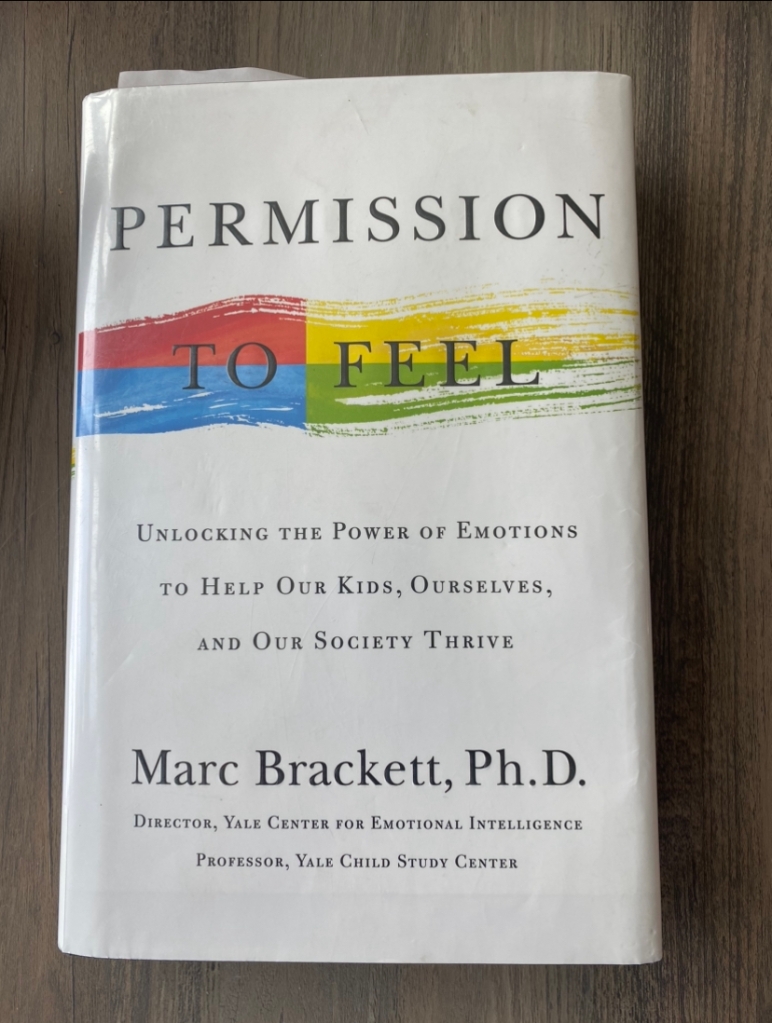
The best defense is a good offense. This is a very good strategy to employ for both handling and overcoming emotional triggers. In his book, Permission to Feel, Dr. Mark Brackett explains that when it comes to being triggered by our emotions, we have to “take responsibility for our actions rather than shift the blame elsewhere. ”

“It may not feel like a choice, but it surely is — we decide how we will respond to life’s provocations. Don’t want to explode in rage when your child is disrespectful? Come up with a better way to respond. Clearly the old way, matching nastiness for nastiness, doesn’t work.” –Dr. Mark Brackett, author of Permission to Feel

We don’t judge ourselves when we are physically run down and know we might be more likely to catch a cold. We make a mental note to get more sleep, stay hydrated and wash our hands more often. The best defense is a good offense.

We can take this same approach when we are emotionally depleted. We can make a mental note that we will be more susceptible to knee jerk reactions than skillful responses. We might even make an announcement to our family members that we just don’t have the emotional bandwidth to deal with unnecessary drama. Again, the best defense is a good offense.

We should be normalizing the fact that regardless of our age, we are all humans with similar emotional needs and changing emotional capacities. This is really invaluable to be teaching our children. Dr. Brackett shares that when we try to shield our children from this reality, it has an unintended result. Children will have a hard time acknowledging adults’ feelings, let alone respecting them.

Emotional triggers are an integral part of our self discovery process. They help us identify what is most important to us and what our current needs are. Once identified, we can free ourselves from the “strong, uncomfortable emotional reaction” to something that really shouldn’t set us off. Instead, we can be more skillful with our emotional regulation and more clear about our needs.

If we are on overload because we have been caregiving on steroids all day, one unintended disrespectful remark from a friend or family member is likely to cause us a twitching trigger finger. Dr. Brackett reminds us that we can take preventive measures for moments like this.

When we offer ourselves some self-compassion, we are acknowledging that we are on overload and are susceptible to losing our cool. We can remind ourselves that if we weren’t so physically and emotionally drained, we would not overreact to an insensitive comment. If we weren’t so worried out, we might even have the dexterity to banter about it.

Does the comment hurt? Of course it does. Let’s not dismiss that either.

But here’s the pivot. An emotional trigger never really addresses our true needs. It gets in the way of expressing ourselves in a way that can be heard and taken to heart. Others just react to our “overreaction” and our basic need is lost in the smokescreen. It’s hard to hear a whispered “I could use a little help here” when there’s a lot of yelling or threatening going on.

Have you ever noticed that emotional triggers can also set off a chain reaction? It is not unusual to hear phrases like “you never listen” or “you always do this”. A lot of baggage is often attached to our emotional triggers, so it’s easy to tap into all those previous experiences and dredge up old grievances. Whatever small incident has set off the emotional trigger now cascades into something much bigger.

Instead of being able to focus and attend to one small and manageable issue, we are now knee deep in triage for a major emotional pileup. It’s hard to assess which issue was the catalyst and which one requires immediate attention. All too often, the one small incident that set off an emotional trigger gets lost and never addressed. But it does get baked into that old imprint of the childhood emotional trigger; logged as yet another example in the bulging file.

In a recent blog post entitled Learning What We Need to Teach, I shared how important it is for us parents and grandparents to be the emotional “training wheels” for our children. The best preventative measures for our children is to integrate their emotions into their experiences; to help them name and process them as they are unfolding. The more we are able to do this in real time with our children, the less likely it is that they will enter adulthood with a lot of challenging emotional triggers of their own.

By now, you probably don’t really need a bigger impetus to get serious about attending to your own emotional triggers, but there is something important that you should bear in mind. Our children’s developing brains take a long time to fully develop and integrate. We protect those little noggins with helmets, but we often overlook the impact our emotional reactions are having. Dr. Mark Brackett writes extensively about this in his book Permission to Feel. In the chapter entitled “Emotions at Home” he devotes a lot of time to emotional triggers; and especially how parents get triggered by their kids’ reactions and behaviors.

He reminds us that when we get “triggered” by our kids, our compassion switch gets turned off. We’ve all experienced this – and we’ve often quickly regretted how we did not show up so great in those moments. We can take comfort in Dr. Dan Siegel’s teachings that “rupture and repair” is normal in human relationships and can actually strengthen our bonds with our children, as long as we apologize quickly and sincerely; with a promise to do better in the future.

Which is why Dr. Mark Brackett urges us to get serious about attending to our emotional triggers before they become a chronic reality. Extreme emotional reactions, over the course of time, can actually alter the brain structure of our children. The effects of frequent extreme emotional reactions can cause our children to have emotional regulation issues of their own and a lot of complexities in their adult relationships and quality of life.

A child’s brain is still plastic, meaning that the structure is always changing. The minute parents start regulating their emotions better, their children’s brains will change to reflect that. If parents start regulating their emotions now, and help their children to regulate theirs, then there’s hope.” — Dr. Mark Brackett, Author of Permission to Feel.

Emotional triggers are a by-product of the old parenting models that did not integrate our emotions into our developing brains when we were kids. When we do our own self-discovery work and identify why and how we get triggered, we are detangling ourselves from the past and owning our agency as adults. We accept that we have choices in how we respond to the things in life that provoke us.

The stuff that initially provokes us is usually pretty minor in the bigger scheme of things. But we can make a mountain out of a molehill with our over-sized reactions. We can meet these moments with greater emotional regulation and dexterity. It will be so much healthier for all our brains — and so much more beneficial for our families.

RECOMMENDED RESOURCES:

We Are the Change Agents

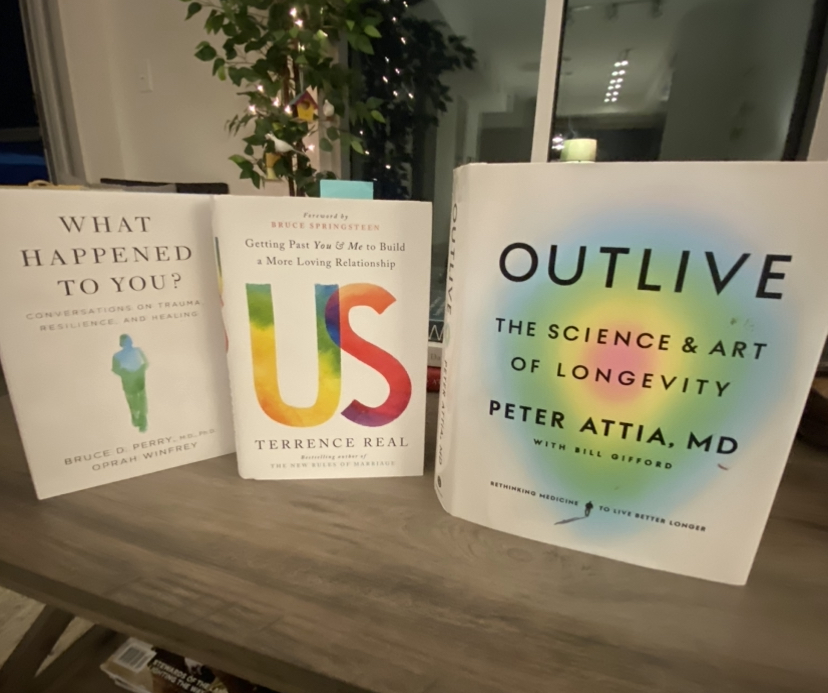
I’d like to give an enormous hat tip to Dr. Peter Attia for championing the integral role our emotional health plays in the overall quality and length of our life. He is shining a beacon on the many ways that our emotional health impacts our physical and cognitive health, our most treasured personal relationships and maybe most importantly — how well we actually know ourselves.

From the outside looking in, Dr. Peter Attia certainly seems to be a shining example of living the good life. He has a hugely successful career in medicine, is a renowned authority on the subject of longevity and good health, is in great physical and cognitive shape, and is married with three children. He practices what he preaches. In other words, he has checked all the boxes for a successful, happy life.

Yet in recent years, while writing his newest book, Outlive, Dr. Peter Attia became acutely aware that there was a gaping hole in the complete picture of longevity and quality of life — emotional health. What good is checking all the boxes that outwardly give the impression of success and happiness, if in fact inwardly we are miserable?

Yes, we can be physically and cognitively very healthy; we can be proactive with preventive measures and early detection to ensure we live longer — and possibly longer without illness, disease or cognitive decline. But if we are unhappy, discontent and lack emotional regulation, we will continue to be miserable no matter how physically fit or mentally sharp we are; no matter how many measurements of success we seem to have achieved.

This is a true fact for so many of us. We have a very big blind spot about how our emotional health has taken its toll on us and our families, all while we have been actively checking off the boxes.

We can be so unaware of the impacts of our emotional health that we will unconsciously sabotage ourselves over and over again. Dr. Peter Attia uses the metaphor of Formula One racing to help us grasp the magnitude of ignoring our emotional health:

Just a few short decades ago, Formula One racing had a very high rate of death among its drivers because of the risk factors. The cars were engineered for performance not safety. Today that risk factor for death and serious injury has been dramatically reduced. What changed? The cars are now engineered for safety first and performance second. Minimize risk.

As Dr. Attia points out, we use risk factors all the time to help us minimize the risk to our physical and cognitive health. We intervene early to prevent infection, illness and disease. Yet we have been ignoring emotional health all the while.

No one asks the questions — “What is your risk for poor emotional health and what are we doing about it?

It has become very clear over the past decade or two that it behooves us all to reflect on how the old parenting models impacted us — and especially our emotional health. The risk factors for our emotional health are imbedded in those old parenting paradigms that disconnected us from understanding and effectively utilizing our emotions. Our emotions are an integral part of our brain/body connection and we are long overdue for a major upgrade to our human operating system.

Just look at all the advances that we have made in modern medicine to fight genetically inheritable diseases. We have been blind to the generational inheritances of poor emotional health. And now our eyes have been opened – we have a brand new pathway to addressing the quality of our emotional health.

Not only are we able to intervene early for our own emotional health, we can begin to ensure that our children get a head start on a lifetime of good emotional health.

We are the change agents; the ones that will break the cycles of dysfunction that got passed unconsciously from one generation to the next. We will advance human evolution by proactively integrating our emotions with our complex, developing brains.

Dr. Peter Attia shared with Dr. Andrew Huberman in a recent podcast that for most of his life he got really good at drywall repair – because he was dealing with an unconscious inner rage from trauma in his childhood – and that anger often had him punching a hole in the wall. In fact, it was that same anger and strong urge to punch a guy in a parking lot that made him realize he had to get help for his emotional disregulation. He realized in that moment that he could have lost everything he had spent his whole life building — his reputation, his career, his marriage and family – because of unchecked emotional health.

I just have to say that Dr. Attia still packs a punch — a positive and very healthy one. He punched a big hole in our blindspots when it comes to emotional health and the integral role it plays in the overall quality of our life.

As I was reading Dr. Attia’s book, Outlive, I was delightfully surprised to discover that he had turned to two of my favorite resources to help him in his search and recovery process for emotional health — Esther Perel and Terry Real. I have long followed their work, participated in their seminars and read their books. It was Terry Real’s relationship summit in May, 2022 that prompted my blog post “Whatever He Has, I Want It” featuring Hugh Jackman’s journey with personal growth and emotional awareness.

Little holes have been being poked into our need to focus on emotional health from a diverse array of sources for several decades. Neuroscience has been paving the way as we make tremendous breakthroughs in understanding how our brains, bodies and emotions need integration in order to function optimally.

Changes are happening at a very fast pace now. Old methods once used for parenting, for treating trauma and mental health issues are being tossed out and replaced with protocols that focus on integration of emotions. Dr. Bessel van der Kolk even emphasizes that it is not necessary to go back and revisit all the re-traumatizing details of a childhood event. Instead, the focus and therapy becomes on how a person is feeling today, what they are experiencing in the present moment – and integrating that into more manageable responses to current experiences.

Dr. Attia explains that we can reframe this work as an “invitation to view our own young experiences through the eyes of our own child”. I wouldn’t be surprised if he learned that from Terry Real, who often says that the best motivation in the world for personal change is our children. Terry says that we might not change for our partners or ourselves, but we rarely resist change if we know it will help our kids.

Our emotional health is rooted in our childhoods. There is no doubt about that. It is crystal clear that we will be the change agents for breaking generational patterns of poor coping skills, unhealthy attachment styles, maladaptive patterns of behavior and lifelong poor emotional health.

Dr. Attia would encourage each of us to view our emotional health and its risk factors the same way that we view our physical and cognitive health. Dig into our family history, intervene early, develop healthier approaches and incorporate a daily maintenance program to support an ongoing healthy trajectory.

RECOMMENDED RESOURCES:

Develop a list of podcasts that become your “go to” playlist to support your emotional health. Here are a few of my favorites:

Turning Personal Growth on Its Head..

From Iceberg to Mountain Range

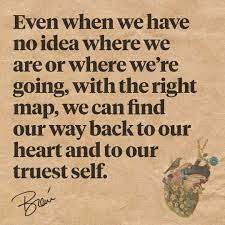
When Brene Brown launched her newest book, Atlas of the Heart, she offered this beautiful, profound insight:

For me, this quote captures exactly what my personal growth and self discovery journey feels like. I had no idea where I was going when I started. Seven years ago, I was leaning pretty hard on the quote “all who wander are not lost” which makes me laugh out loud…because I was indeed “lost”. I used a lot of maps to find my way – and I still do. Some of those maps are weathered and worn, some are pristine and folded neatly into a well scored rectangle, some are digital and some have ink so fresh it washes over the paper like a watercolor.

Initially I wanted the “how to” maps. I scoured the self help sections of libraries, bookstores and the internet. Over time I came to realize the most transformational way to go about self discovery and personal growth is to approach it more like looking for clues on a hidden treasure map and being open to discovery.

If I were to break out a gigantic three-feet long piece of butcher block paper, I could whimsically draw with chunky crayons what that treasure map looked and felt like for me. There would be volcanos, broken bridges, tornados and swampland…and a few fairies, leprechauns, trampolines and bungee cords, rays of warm yellow sunshine and a deep reflecting pool. I’d add in some glittery neon-bright fireworks to spotlight my “aha” moments.

It is only with the clarity of my “hindsight googles” that I can now truly appreciate all the trash and treasures I discovered on my ongoing personal growth adventure. My experiences are much like the one my grandkids have with one of those “shine a light” flashlight books where the hidden pictures are revealed when a focused beam of illumination hits them.

It occurs to me that so often when we talk about personal growth and self-discovery, the emphasis is on how hard it is. The images of peeling off the layers of our emotional onion, dumpster diving into the baggage we’ve accumulated and breaking old habits seem more like punishment than an appealing invitation to become a better version of ourselves.

Rarely do we hear the upside of embarking on the personal growth journey, at least not in tangible, realistic ways. We hear all those fluffy, gauzy accolades about finding our “authentic” self but it all seems as fleeting and surreal as dressing up in a costume and pretending to be Cinderella or Spiderman. Looks good…but what does it really “feel” like?

The greatest gift of personal growth work is how freeing and empowering it feels — once you get to one of the pinnacles in the process. That becomes the motivation to reach the next pinnacle. Each one creates more space for what we really want in our lives. We often are completely unaware of just how much we get in our way, until we start looking at our patterns and blind spots. As we lighten the load, the journey becomes a lot more engaging in a very positive way.

One of the most insightful moments in any self-discovery journey is when we realize just how far we’ve come. This is a big boost to our motivation to keep going — when we look back and recognize that we have actually made a lot of forward progress; that we are showing up in improved ways in old familiar circumstances.

Recently I was re-taking a self-assessment test with a friend of mine and expressed to her that I would have answered the questions much differently a few years ago than I do today. The same was true for my friend and she expressed her gratitude that over the past several years, I have often reminded her of all her forward progress. Both of us were well aware that we now move through our daily lives with greater ease, having discarded old patterns for better skills.

From my personal perspective, personal growth doesn’t have to be the “hard work” of a paleontologist digging through stratifications and fossilizations we’ve amassed for decades. We can turn this concept on its head and treat it as the fascinating adventure it truly is. What if we had a whole new, enlightened approach to how we enter and maintain personal growth and self-discovery?

Picture this: — we often use the image of an iceberg to help us understand all the baggage, beliefs, narratives and personal history we are dragging under the surface.

If we flip this image, we now have an impactful — and inviting — new way to look at personal growth, self-discovery and self-improvement.

This is a powerful transformational image….

We will get stronger physically, mentally and emotionally as we scale and explore; we will need a backpack full of supplies, resources, tools (and maps), it’s a great idea to have a buddy system for a host of awesome reasons (safety, shared experiences, a boost or tether, meaning and memory making). We will get fresh air, fresh perspectives and see the bigger picture.

We can re-write the guidebook for living our best lives. What if personal growth became a “call to adventure”. What if we “preloaded” all the resources and practices we really need to meet life in a skillful way?

The truth is that we are now spending an incredible amount of our time and energy undoing all the damage caused by old paradigms, old parenting models, old stereotypes, outdated methodologies and therapies – not to mention a complete lack of understanding about the value of emotions, empathy, and meaningful connection with others.

We have a growing mental health crisis, too many distractions for our attention, and a deficit of awareness (our own as well as “other” awareness). We keep throwing ideas and challenges at the problems. The big PIVOT is to look at the root causes.

All throughout my exploration of a wide variety of resources and modalities for my own personal growth, there was one common thread.

Regardless of the resource, the compass always pointed back to childhood: childhood narratives about who we are, behavioral patterns and protective armor we developed in childhood, our childhood attachment styles, our beliefs and how we make meaning from our emotions and experiences. There is a lot to unpack from our childhood BEFORE we can even begin a successful and meaningful adult life journey.

Once I discovered this overarching theme, it dawned on me that we can do better. Our children are sponges for learning — and we can equip them for life in transformational ways by “resourcing” them in powerful new, healthier ways.

Neuroscience, psychology, neurobiology and epigenetics are all converging in astonishing ways to shine a light on so much of what we did not understand, or got wrong, and can do better.

In upcoming blog posts, I will be unpacking what we are learning about the old childhood framework that did not provide healthy scaffolding for life. Together we can learn about the importance of secure attachment styles, how a child’s brain develops and how adult brains can be rewired, teaching emotional literacy and healthy coping skills, how we can keep our brains “updated and upgraded” thanks to neuroplasticity, and the importance of integrating our nervous system with our executive functions.

In just one generation, we can break cycles of dysfunction, addiction, insecurity and inauthenticity. At this very moment in time, we have more substantive research, more accurate knowledge, and unbelievable access to meaningful resources than ever before. Significant changes in what were ground-breaking, Nobel prize-winning discoveries 15 or 30 years ago are happening at a very rapid pace. Children are learning faster and differently than they did when we were kids. Even us adults are learning faster and differently in some arenas than we ever have before.

When I began my personal growth journey in my early 60’s, I did not realize that it would lead me to children – and I am ecstatic that it did. So many of us enter parenthood with hopes and dreams of giving our kids a good life, possibly a better one that we had. With all the new research, enriched skill sets and tools we now have, we can equip our children for life as smartly as we equip them for their favorite hobbies and sports; have you noticed that we now put helmets on those little developing brains for good reason?

RECOMMENDED RESOURCES:

BEING WELL PODCAST: Listen to this relatable AND mind-expanding conversation with Dr. Rick Hanson and his son, Forrest, on the Keys to a Great Relationship. Rick has a brand new book out as well that offers fresh perspectives on his many decades of counseling and his own personal growth work.

https://www.rickhanson.net/being-well-podcast-the-keys-to-a-great-relationship/

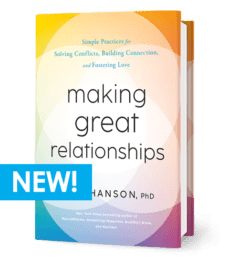
Learn 50 simple practices for solving conflict, building connection and fostering love.. Read Dr. Rick Hanson’s newest book – Making Great Relationships.

Broken Spirits

I have often shared how it was a broken heart that put me on the path of personal growth. The truth is that I also suffered from a broken spirit, one that was decades in the making. It was my fragile, broken spirit that needed to be healed first. I just did not know that at the time.

This morning I was reflecting on those first few weeks of being on my own after that painful breakup — how I wrote in my journal that I wanted peace, to feel safe and to be free to be myself. Ironically I thought that living alone was the best way for me to achieve those three things. What I should have been asking myself is “why were you not finding these things within your relationship?”

An inventory of both past and present relationships might have revealed some truths that required further investigation. It dawned on me that when I am behaving and feeling most authentically myself, then I am both at peace and feeling safe — both alone and within my relationships. No one else is responsible for ensuring those core values are ever present but me.

What became very evident was that I need to untangle myself from a complex combination of childhood trauma, learned behavioral patterns, exhaustion from hustling for my worth, and a heavy trunk of unprocessed emotions. It was this complex combination that had been breaking my spirit, slowly and consistently over time. I was completely unaware of the toll it was taking — on me, on how I showed up, how I reacted, on the dynamics of my most cherished relationships.

One thing became crystal clear to me. Those times in my life when I felt most at peace, safe and my buoyant, resilient self was when I was with people who saw past my flaws, who recognized my potential and who mentored me through role modeling and coaching.

My young broken spirit was often mended by my beloved Aunt Betz, my church choir director, a high school teacher, a cherished friend. These are the marble jar people that Brene Brown talks about — those who are so trustworthy that we feel safe to take refuge in their care. These earth angels give us little footholds to help us tap into our innate worthiness and foster our growth. I don’t think that I would have been able to cope with all the chaos in my family’s dysfunction without the help of these incredible people. They not only gave me a safe place to land for a while, they gave me wings to fly a little higher than my circumstances. When I was young, they were helping to untangle me from the baggage that was breaking my spirit.

As I dug deeper into personal growth work, two things really began to gel for me. One was that it is our responsibility as adults to do the work of untangling ourselves from outgrown narratives and old baggage. The second was that even the most dedicated practitioners also get snagged on their past, and fall into unconscious, unhealthy patterns from time to time. It is often in times of high stress, great loss or adversity that trigger us to fall back.

Much as I would like to pretend that this did not happen to me in my 60’s, it did. I fell back into old uncomfortable but very familiar pattern reminiscent of my childhood without even being aware of it. I slipped into the role of helper extraordinare and then followed that unhealthy path down a rabbit hole into enabler and co-dependent. Completely unaware of my blind spots, I became the one who was instrumental in breaking my own spirit. The warning signs of resentment, stuffing my emotions, and feeling so uneasy that I was jumping out of my skin at sudden noises only fed an old story line that I was not good enough, not worthy, falling short –again. Unbeknownst to me, I had drifted into the very unhealthy end of my enneagram spectrum. I was in a strange and complex paradox of trying to get my needs met while accepting behaviors that were in direct conflict with those needs.

To add to my confusion, while I was falling so short in that relationship, my friends and family members saw me as an easy going, cooperative, optimistic and encouraging person. How was it that others could see those good parts of me but my partner could not? This paradigm is common actually — as I discovered through long conversations with friends. Could the answer be in how we “show up” differently without so many deep rooted emotional entanglements clouding the waters. If so, what is it about ourselves that we do differently in our closest relationships that contribute to this conundrum?

For me, it was the fear of making things worse by bringing up something important to me. The tap root of my unwavering need for trust that was broken repeatedly in my childhood. So often when I would speak up for me and my brothers, the consequences were far worse than the initial event.

This pattern began to appear in my relationship and I got hooked on old insecurities. Trust unraveled and my spirit took a hit. I did try to explain this to my partner once but I was clumsy about it. It is a textbook example of why we need to get skilled at having hard conversations — both in the way that we articulate our truth and how we listen to learn.

The better we understand ourselves as well as our basic needs and desires, the healthier our relationships can be. I only wish that I had been introduced to the enneagram earlier in my healing journey. You see, the enneagram sheds a lot of light on childhood roots of learned behavioral patterns and what it is that we each need in order to feel fulfilled, loved, valued and safe. The enneagram is truly one of the most valuable self-awareness and self-discovery tools we can access. A companion resource for the enneagram is Brene Brown’s powerhouse book, The Gifts of Imperfection. This book illustrates so well the armor that we choose to protect ourselves from the core motivations and fears that the enneagram reveals to us.

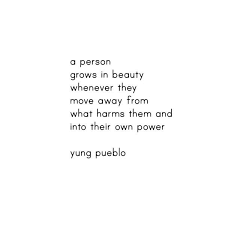
Check out Yung’s deeper explanation of this wisdom in the Recommended Resources at the end of this post.

As I was working on my draft of this blog post, the above quote from Yung Pueblo landed in my inbox. It was so timely and his accompanying insights dovetailed with my own experience and the wisdom I’m striving to impart. While Yung Pueblo leans heavily into his meditation practice to peel back the layers of his patterns, I turn to the enneagram for course correction. When I find myself feeling off kilter, I know I am drifting into the unhealthy end of my spectrum. I heed the warning signs of resentment or feeling unappreciated as cues that I have overcommitted myself or failed to set a boundary.

These examples really just scratch the surface of all that you can learn from the enneagram. Perhaps one of the greatest gifts is helping us to see others in a whole new light. When we understand that each of the nine types has a dominant way of showing up in life, it releases us from taking things so personally. That creates a bridge to understanding and empathy. We can begin to recognize the bids for connection that others are making even when they might be clumsy about it.

When I reached the point of being able to trust myself enough to know what I needed to feel at peace, safe and valued, I knew that I was making meaningful strides in my goal of being my authentic self. Admittedly this was hard work and requires ongoing practice. Shedding the armor of being a people pleaser or shape shifter to feel like I fit in or was liked has been the equivalent of shedding unwanted pounds. It is easier to express my emotions and my needs now without all those old entanglements getting in the way.

This brings me back to broken spirits and broken hearts. Everyone experiences broken spirits and broken hearts in their lives — and sometimes that brokenness takes a very long time to heal. So often we do not realize just how much another is hurting, in need of empathy, compassion and trust. Sometimes we project our pain onto others because we lack self awareness. Sometimes we take things too personally because we ourselves are fragile. When we are not skilled at having hard conversations, we can inadvertently shame or blame others. This is why I believe Brene Brown’s work on vulnerability is crucially important. Self-awareness and vulnerability are two of the strongest gifts we can give to ourselves and each other. Deeper, more fulfilling relationships are cultivated in these rich spaces of trust, honesty, acceptance and understanding.

RECOMMENDED RESOURCES:
Yung Pueblo — Author of Clarity and Connection. Follow him on Instagram and Facebook for daily insights on personal growth, maturity and growth mindset partnerships.

Being Well Podcast with Dr. Rick Hanson and his son, Forrest Hanson

https://www.rickhanson.net/being-well-podcast-how-to-create-a-relationship-that-lasts/

Sharing this episode from the Typology Podcast with Ian Morgan Cron about the Gifts of Self-Awareness. Spoiler Alert: Amy Porterfield not only shares my name, but my enneagram Type 2 also! https://www.typologypodcast.com/podcast/2021/07/10/amyporterfield

Constant Companion

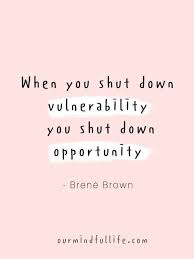
Vulnerability is a fine precision tool that drills small openings in our armor, our fears and our awareness. A series of tiny. little openings allowing light to fall into the “what matters most” center of our being. It is the continual “breaking open” process that nourishes our life.

The very word “vulnerability” conjures up images so far from the truth of its strength, courage and tenacity. Against all odds, it is our vulnerability that protects us most and often is the jettison force needed to take action. Vulnerability is a constant life companion.

Vulnerability whispers in your ear when you are crying, heartbroken and empty. Vulnerability whispers that you don’t need to stay any longer. Vulnerability says “I will help you pack.”

Vulnerability reaches into your heart and makes space for your newborn as you craddle him in your arms, so tiny and fragile. Vulnerability places gifts of patience, resilience and resourcefulness you’ve never known possible in that heart space. You will operate on too little sleep and a deep well of love for many years. Vulnerability is your constant companion and your reservoir as you parent for the rest of your life.

Vulnerability embraces you and holds space for you alone for days, as you absorb the diagnosis. Vulnerability sits patiently as you tumble through an emotional vortex without judgment. Vulnerability listens to unspoken words, watches in silence as you envision all possible and impossible scenarios. Vulnerability hugs you when you have made your decision days later. Vulnerability becomes your invisible strength partner on your journey no matter the outcome.

Vulnerability sits with you weighing the pros and cons of pursuing a bigger dream. Vulnerability views the sacrifices, the risks, the rewards, the long hours and renewed sense of purpose. Vulnerability rarely misses a detail in the complex decision making process and still offers a nudge to seize the moments. Vulnerability smiles with you as you take that first step forward into a long-time dream.

Vulnerability never leaves your side when you are fraught with worry over a loved one though you cannot change a thing. Vulnerability listens to your heart, your fears, your prayers. Vulnerability helps you discover new depths of your love and faith.

Vulnerability urges you to call a trusted friend when you are falling apart.

Vulnerability reminds you it is ok to ask for help or state a boundary. Vulnerability holds your hand while you hold your breath waiting for a response or a reaction.

Vulnerability will wash into every corner of your very being when you fall in love — with your partner, with your grandchild, or with a passion. You will learn more about yourself than you ever knew possible.

Vulnerability’s best friend is courage. Vulnerability drills those little openings to break free of what holds us back and courage pulls us into a different direction, or back into life, or launches us on a growth spurt.

People who live wholeheartedly lives have come to understand that vulnerability is a strength for it opens our hearts to ourselves and to each other. Vulnerability enables us to get in touch with our deeper human emotional connection. Vulnerability makes no promises about rosy outcomes or happy endings but it invites and encourages us to not let fear hold us back from love and belonging or from pursuing dreams and passions.

The most valuable lesson that vulnerability taught me was that my heart can be broken but not irreparably. My heart will expand in all the places that it was broken and my capacity to love and be loved will grow exponentially. Love is a renewable source of hope, inspiration, comfort, peace and joy. Vulnerability encourages me to go bravely forward for there remains much to be learned from all of life’s experiences.