
Do you take daily supplements to support your physical health? Most of us do and we know that they make a meaningful contribution to overall wellbeing. It’s nearly impossible to get all of our vitamins and minerals from our food alone; thank goodness for supplements and the ease with which we can give our bodies and brains the boost they need.
The same is true for supplements that support our psychological, emotional, cognitive and relationship health — which is why I launched my Daily Gummy of Wisdom over a year ago. My commitment to publishing a Daily Gummy everyday was recently refueled by Ryan Holiday, author of the Daily Stoic. Ryan shared that reading a “page-a-day” book is an invaluable source of encouragement and support for our ongoing personal growth and self discovery.
Having that daily practice of reading a “page a day” of words of wisdom, insight and inspiration helps us to get our day off on the right foot – and can serve as a reminder of our intention to do a little better than we did the day before.
As James Clear, author of Atomic Habits, reminds us – it is the small, consistent practices we commit to each day that compound over time and yield remarkable transformational benefits. I can attest to the fact that reading several “page a day” books over the past few years has had a big impact on me in the most positive ways.
Over the past year, I have been delightfully surprised by the number of times that a reader would reach out to me and share how a Daily Gummy of Wisdom landed at just the right time for them. I have marveled at how many of the Daily Gummies were forwarded with personal commentary revealing just how relatable they are.
Today I am going to unpack what I am discovering as I put in to “daily practice” what I am deriving from my daily gummies of wisdom and insight.

A Daily Gummy About Boundaries:
I surely wish that I had learned about the many benefits of boundaries decades ago. What an indispensable tool for navigating relationships and experiences in a safe and practical way. Boundaries are just like the guardrails on a highway — they help us all navigate safely.
My “go to” approach in the past was to sugarcoat or disguise the fact that someone had crossed a line in our relationship. If I had been disrespected or a behavior was unacceptable, instead of addressing it directly, I would tell a story about a friend who was struggling with a similar issue. My blind hope was that the person who had overstepped a personal boundary with me would see themselves in that story and self-correct. Not only was this approach totally ineffective, it merely created a detour around an important issue. No one saw themselves in those stories. It was the equivalent of building an off ramp to nowhere.
The big pivot in setting and holding boundaries came to me when I learned that boundaries do not require the other person to do anything. I had been going about it all wrong. A boundary is the easiest way to let another person know what is acceptable to us and how we wish to be treated.
When others are having trouble being respectful or controlling their behavior, a boundary is how we say “I see you are having difficulty navigating this, let me help you with that.”
Brene Brown reminds us that “clear is kind”. Reframing a boundary as a clear and kind guardrail for relationships is a game changer. Being clear about unacceptable behavior and the action we will take if it occurs, puts us in the driver’s seat. We can navigate to a safer place and safeguard what matters most to us. It does not require the other person to do anything — but it does provide an on-ramp if they choose to take it.
Very few of us grew up learning about this invaluable tool. We were given ultimatums, threatened with a punishment, or told to go sit in isolation and figure things out by ourselves. Even today, many people believe that these outdated approaches are boundaries, but they are merely off ramps to nowhere. No one makes forward progress.
Boundaries are how we help ourselves and others build healthy relationships with mutual respect and clarity in how we communicate with each other. Clear is kind and consistency is strong reinforcement. That’s the materials that build healthy boundaries.
This Daily Gummy reinforces the ease with which we can help others navigate our relationships safely. Using clear and consistent boundaries is a much more productive way than skirting the real issue. Look for this Daily Gummy in your inbox on July 31, 2024.

A Daily Gummy about Perceived Weaknesses:
Anyone who is familiar with the Enneagram or a skills assessment personality test, will attest to the fact that we often view our weaknesses as fatal flaws. Imagine my relief when Adam Grant, author of Think Again, recently shared that we should “rethink” our attitude towards weaknesses. Adam’s research reveals that our weaknesses are often just overused strengths.
As a reformed people pleaser, I confess that my weakness was in fact a much over-used strength; one I learned very well in childhood. I was always told to “be the helper”. I was an over-achiever in the helper category, and by all means “over-used” the strength. The problem with helping too much is we make others feel incapable, can contribute to a chronic condition of learned helpless, or become enablers. It was through Ian Cron and his Typology podcast series that I discovered we can turn our weaknesses into strengths with healthy reframing. Reformed helpers can become coaches, mentors, cheerleaders and field guides for others.
Take some time to reflect on what you perceive as a “weakness” and see if you too can recognize that it might be an overused strength. If you are hyper-vigilant, you may take all the fun of spontaneity by doing a deep dive into risk assessment. If you are prone to perfection, you might wear yourself and others out with your attention to detail – when “good enough” might actually be perfect. If you perceive yourself as a fierce protector, you might actually be going to battle for someone who prefers to handle things on their own.
Some additional food for thought: It is not uncommon for us to assume that what appears to be a strength in others must be a weakness in us. We look around at others and compare ourselves — often wishing we could be a little more like a friend who seems forever fearless and takes big risks; or the one who is highly educated and speaks with authority in their field. Yet the reality is that our own perceived “weaknesses” might be hidden strengths in a variety of circumstances.
For most of my life, I was envious of friends who held very strong opinions and spoke with authority about those opinions. I believed that my inability to put a stake in a strong opinion was a weakness of mine. It was only in recent years that I came to appreciate the gift of being open-minded and innately curious. I thought my lack of ability to form and hold a strong opinion was a weakness; Malcolm Gladwell and Dr. Ellen Langer showed me a different perspective.
Malcolm Gladwell has long been a proponent of holding our opinions loosely. While he is comfortable with having an opinion he always adds the disclaimer — “for now” or “subject to change”. Malcolm has reflected on his own lived experiences as well as our collective ones and stands at the ready to pivot and re-assess — because change is the only constant. He often shares colorful stories of the many reasons he has changed his opinions or theories on things. He’s actually made a career out of it.
Dr. Ellen Langer, Harvard professor of psychology, and lifelong researcher of mindfulness, fully embraces her natural curiosity and ability to curate a plethora of opinions on any subject. In fact, she encourages us to greatly expand our own capacity to do the same. She considers this an update to our incredible brains and wants us to tap into its full creative capabilities. She invites us to practice becoming more open-minded by steeping ourselves in a variety of new experiences, having deep conversations with people who are different from us, read a new genre, discover new music or artists and challenge our own long-held opinions. I often envision Dr. Langer using a kaleidoscope as her lens on life.
So my takeaway from both Malcolm Gladwell and Dr. Ellen Langer was that my nature is not to form strong opinions – and that is more than okay. Viewing my “weakness” as a strength now enables me to engage in richer conversations with others who do hold strong opinions – for I have much to learn from listening to understand. Instead of being envious, I am now embracing curiosity and leaning in so as to cultivate the raw data my brain craves.
Watch for this Daily Gummy on weaknesses as overused strengths to drop on August 14, 2024.
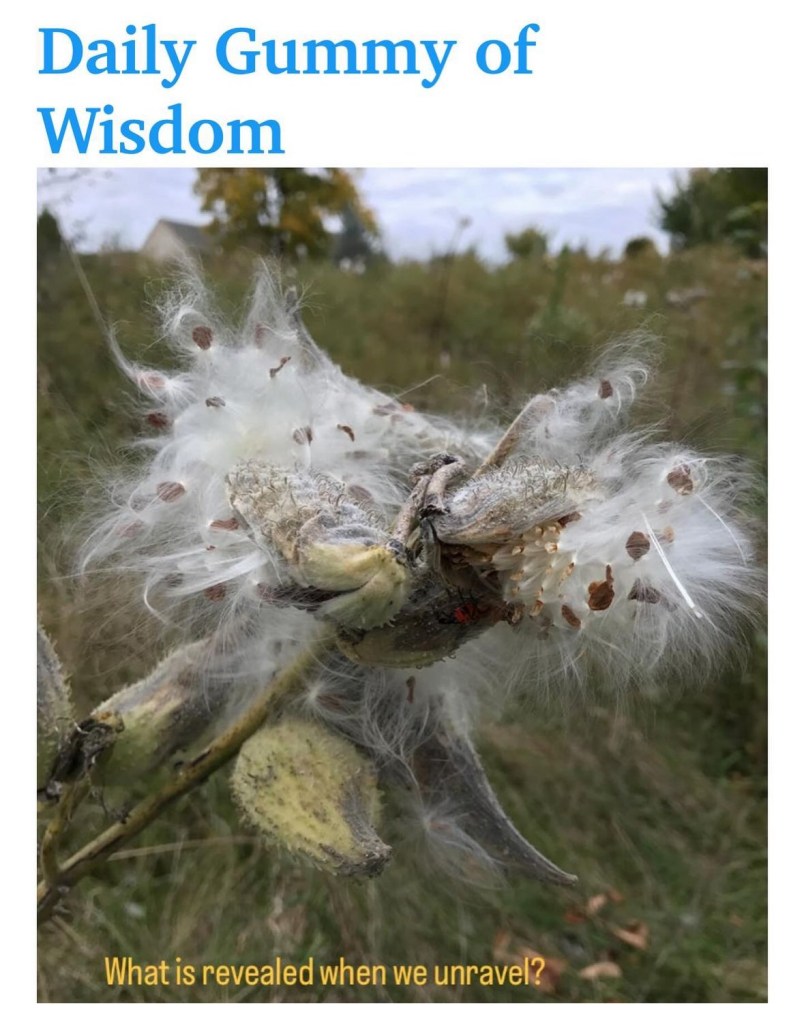
We all unravel — sometimes it is a mid-life unraveling and other times it is a small, everyday of unraveling where we can’t seem to catch a break.
The unraveling that naturally occurs in life is yet another example of “I wish I knew then what I know now.” How different we might approach an unraveling if we were taught to pay attention to wear and tear in our lives, just as we are with our cars, our appliances, our clothes.
What if we were to reframe “unraveling” as a “revealing”? When we hit a breaking point or rock bottom, we take stock of what isn’t working in a much more realistic and accepting way. We can no longer ignore the places where we are coming apart at the seams. It becomes the time to mend our ways.
Perhaps one of the most transformational pivots about the psychological tool of reframing is how quickly it changes our perspective and allows us to see what had been long hidden in plain sight. What does the unraveling reveal to us? Now unraveling becomes a reset opportunity,
When we view an unraveling as a revealing exercise, we are able to meet these moments in our lives with greater courage; with more curiosity and less fear or shame. We can see the “wear and tear” we are putting on ourselves and our relationships with more honesty and clarity through the lens of self-reflection.
When we unravel, we do open up. Like it or not, it is the opening up to both reality AND possibility; it is as natural as this milkweed breaking open to reveal its seeds. Our own seeds of awareness move us toward acceptance of the places where we have room to grow or need improvement. We may need to ask some hard questions, but it is far better to do that than blindly wait for hard times.
We can become better at reevaluating our “unraveling” moments as a chance to discover what is being revealed to us when we recognize signs of wear and tear. We can also become more skillful at supporting others in their moments of unraveling. We can use the tool of reframing “coming apart at the seams or hitting rock bottom” to help others explore what is being revealed to them. We can become good listeners and strong support systems — for ourselves and each other.
This unraveling Daily Gummy was published on June 28, 2024. I heard from several friends how helpful this reframing concept was at that very moment. This is how the seeds of change not only get spread around – they get planted and watered as they are passed along.
The Daily Gummy of Wisdom is my daily newsletter that pops into your inbox each day bright and early. No scrolling necessary. It’s a page-a-day supplement for your personal growth, self discovery, emotional and relationship health. Click this link to sign up for the no-cost supplement to support your well being: https://inspired-new-horizons.ck.page/3381cf137f

 Inspired New Horizons