My Zoom book club has taken a summer break and I am missing the camaraderie of good friends taking deep dives into rich conversations about life. Perhaps it is why listening to Brene Brown and her twin sisters, Barrett and Ashley, discuss the ten guideposts of the Gifts of Imperfection has been such a treat. I totally marinated myself in the realness of these three sisters having those big conversations. Honestly, you would never have guessed that this was a public podcast. It just felt like being part of a no-holds barred girls getaway.
Brene and her sisters used the Summer series of Unlocking Us to talk about how they use the 10 guideposts in their own lives. Mostly they talk about how challenging it is to break old habits and integrate new ones; how helpful it is to unpack how they developed learned behaviors earlier in life that aren’t serving them so well now. They took those deep dives into two of the ten guideposts every week. There was a lot of laughter, some very serious aha moments and a warm wash of being heard and valued that felt like a cozy blanket and a hug.
They used the Wholehearted Living Inventory as a starting point for each week. Brene offers this tool on her website and encouraged her listeners to take it before they listened to the podcast. Brene’s approach is to consider using a gas tank analogy for each of the 10 guideposts — measuring how full your tank is on each of the life skills. This is so much better than viewing it through a strength and weaknesses lens. That mindset alone makes such a difference. It is also a relatable and relevant way to look at how we are showing up in life.
As the three women talked about having just a half tank in some of the areas, it opened up a lot of really good dialogue about awareness and change. It was a safe and inviting space to do that exploration and excavation.
And….the reality is that even when we have the best of intentions, it is really hard to have a full tank in all ten of these guideposts at one time. To me, it is the interweaving of these guideposts that creates a strong framework for personal growth. When we only have half a tank in one area and we might have 3/4 of a tank in another. That combines to lift us up — to a better version of ourselves. It is the natural rhythm of life, an ebb and flow of our emotions, events, energy and intentions.
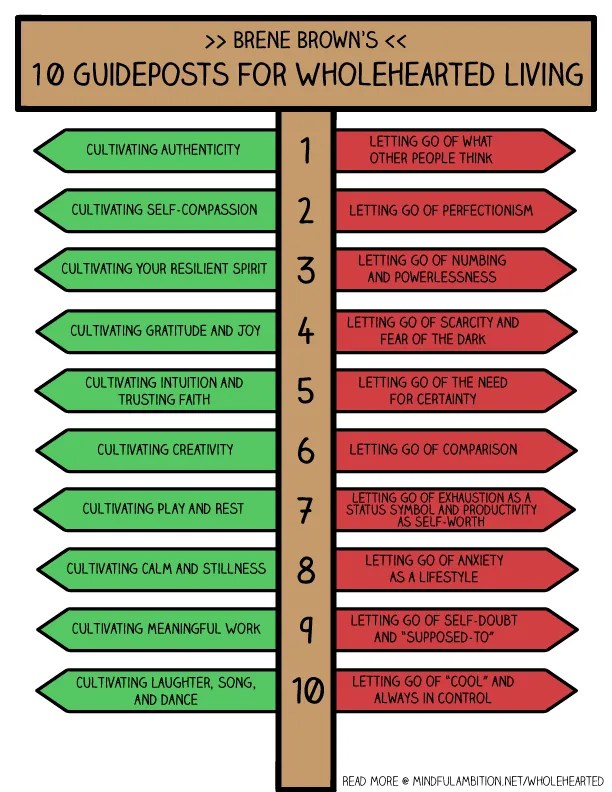
Check out this awesome diagram for the 10 guideposts. The left hand side in bright green are the qualities to cultivate. The right hand side in “stop this” red are the things to work on releasing.
Brene and her sisters use a lot of the same tools that I do to help them integrate the guideposts into their own personal growth journey. The enneagram is a great resource for understanding our core motivations for some of our learned behaviors and best of all it helps us recognize our blind spots. The enneagram also uses a measurement approach similar to the gas tank analogy — it is a spectrum, from healthy to unhealthy. When we move to the healthy end of enneagram type, we are using our gifts and talents in the best ways possible. We find more joy and fulfillment in life and others enjoy being in relationship with us. When we start operating on auto-pilot and act more unconsciously, we move to the unhealthy end of the spectrum. Often this is when we begin to have relationship issues, are prone to numbing to avoid painful emotions and make poor choices.
Being a big believer in both the enneagram and Brene’s work, it was so beneficial for me to hear how using these tools in tandem were so meaningful to Brene, Barrett and Ashley.
Another area that really resonated with me was the candor with which these three siblings could talk about their childhood, the experiences that shaped them as they were growing up. Brene is the oldest and she assumed the role of protector for her younger sisters. Like so many of us, their childhood also had dysfunction weaving through it and this set them up for many of those roadblocks that are in that red column above — being a control freak, having a need for certainty, always comparing ourselves to others who seem to be doing it right, working ourselves to exhaustion to prove our worth.
As they discussed these experiences and how it shaped each of them, they also revealed how they were coming to know their parents in a whole new light — mostly as messy, flawed and big-hearted human beings doing the best they could at that time. This is one of the gifts is truly a blessing that goes both ways — adult children gaining a deeper perspective and parents being given space and grace for all they navigated, often with little support for their overall quality of life. This is where we often discover the root causes of so many of our unconscious behaviors that are listed in that red zone above. Brene research shines a light on the armor we use from one generation to another to be protect ourselves. Getting our family skeletons out of the closet is just like mom or dad shining a flashlight under our bed when we were young, confirming that the monster was mostly a figment of our imagination.
I see a lot of overlap in the discussions that Brene and her sisters had and my Zoom book club. We are taking what we are learning and applying it to our lives — past and present. Applying it to the past fosters healing. Applying it to the present frees us to live authentically. We are helping each other along the way through honesty and vulnerability.
I’m also part of several Facebooks groups that revolve around Brene’s Dare to Lead teachings and Glennon Doyle’s game changing book, Untamed. For the most part, the women and men in these online discussion groups are strangers. Yet there is a clear understanding that we are there to support each other with respect, kindness and empathy. The outpouring of stories, questions and a need for supportive help is profound. Every single day, there are a handful of stories that look and feel much like pages in the book of my life. It is incredibly uplifting to read the touching, encouraging responses. It is even more profound to see how many people have overcome tragedies and adversities and now are shining beacons of hope for others.
So there it is — Brene’s podcast, my Zoom book club and these online discussion groups — all taking that leap of faith and sharing their imperfections and vulnerabilities — and inspiring each other to keep going, keep growing and lean in to those who care.
RECOMMENDED RESOURCES:
Check out the Wholehearted Inventory Assessment in the Gifts of Imperfection Hub. Listen to the Summer Series if you’re looking for motivation and inspiration for integrating the 10 guideposts for Wholehearted Living in your life. https://brenebrown.com
Glennon has evolved through many chapters of her life, often sharing those experiences in great detail in her books. In this one, Untamed, she really pulls the layers off the onion, offering poignant self-examination stories that many of find so relatable.
Please check out Nedra Tawwab — especially if you want some solid footing when it comes to setting healthy boundaries. I discovered Nedra through a Being Well podcast with Dr. Rick Hanson and his son, Forrest. I follow her on Instagram and absolutely love her Nedra Nuggets! https://www.nedratawwab.com
Visual images are some of the most beneficial aids in my mindfulness toolbox. Today’s post is chock full of my “go to” images that I depend upon to keep me present in the moment and showing up in an authentic way. Even if I’m feeling really strong emotions (mine or others), these helpful tools keep me from impulsively reacting to big feelings.
About 20 years ago, I met the most incredibly calm and benevolent young woman. She was the instructor for my 5:30 a.m. hot yoga class. She would start our practice with a visual image: planting our bare feet firmly on our mat, we were to envision small roots growing into the ground, anchoring us in our yoga practice for the next 90 minutes.
When I was gaining a little traction with my meditation practice a few years ago, I recalled that image from yoga class and thought about how I could create a similar visual to help me take my meditation “off the cushion” and into daily life.
My visual image is of dropping my anchor into my very core of calmness — that place I find when I can let thoughts go and focus my attention in the present moment. In meditation this is returning to my breath. In real life, it is staying present with the situation at hand — and most importantly, not getting attached to my own emotions or those of others. I can make better decisions when I am calm. I will be much more likely to act in alignment with my true nature when I am calm. That mental image of dropping my anchor de-escalates things for me pretty quickly.
A wise mindfulness teacher once said that most situations are benign — they are neither good nor bad. It is how we respond or react to them that makes them positive or negative. What is a big deal to one person may not even get on the radar screen of another. Staying calm and paying attention to how others are feeling, helps me get a grasp on why a situation may be a big deal or a small one for someone else. Often this is more relevant than the actual circumstances.
This may be one of my personal favorites — the visual image of holding a brightly colored spool and letting out a little extra kite string, watching that kite dance a little higher in the sky, adjusting to the currents and gaining fresh perspective.
Sometimes we are just too afraid to let go, even just a little. We chase what we think we need or want so badly. We might micromanage our lives or others. We can be prone to hover or smother, be needy or greedy. We can let fear hold us back from trying new things, or taking that leap of faith.
At this stage of my life, I use this visual image most often when it comes to relationships, especially adult children and extended family. Letting a little kite string out means that I am holding space for others, recognizing that their lives are busy and that they want to solve their own problems. I don’t need to be tugging so hard for attention or to be the one they turn to for advice. I just…..let out a little kite string.
I credit Malcolm Gladwell for this visual. If anyone can look at a situation from a ga-zillion perspectives, it is Malcolm Gladwell. And he does it with a child-like curiosity and unabashed wonderment. To me, this is how it feels to look through a kaleidoscope, twisting and turning it with pure delight, fascinated by the changes.
So often, we view things from our same old vantage point. The fact is that we are changing all the time, and oddly enough so are those chronic ongoing situations in our own lives, in our communities, country and globally.
Listen to a few episodes of Revisionist History podcast with Malcom Gladwell and you will witness a big shift in perspective when a situation is viewed from all angles, and through the experiences of everyone involved.
Remember the old adage, one man’s junk is another man’s treasure? This visual is a little like that for me. I envision myself holding a smooth cylindrical kaleidoscope that has a little weight to it, placing it in front of my eye, and watching the problem present itself in a myriad of ways. It’s a reminder to withhold judgment, get out of my box, stay curious — and make sure I am actually looking at the real problem. (Credit goes to Michael Stanier Bungay and his book The Advice Trap for this wisdom. Far too often we jump in to problem solve so fast, we “solve” the wrong problem).
When I first discovered mindfulness, I had a little cork that I placed in a small clear vase on my kitchen window sill. I would see it every morning when I poured my first cup of coffee. It was my reminder not to get bogged down in rumination, disappointment or sadness. I had read an article in Mindful Magazine that talked about how freeing it is to let go of getting caught up in the negativity bias. The image of letting one’s cork float effortlessly through the flow of life was inspirational to me.
I didn’t know at that time just how much I was actually tethered by old behavioral patterns, my life history and the disappointment of a dream disintegrating. Over time, with awareness and daily practice, I freed myself from those weights and found that I really did feel lighter in many ways. Today when I feel myself growing a little heavy in spirit, I think about that cork on my windowsill. It’s a reminder to look for the good.
The little things that unfold in our daily lives offer buoyancy to us if we are paying attention. Make eye contact with someone when you are having a conversation — you will feel your cork rising when you see it in their eyes that they know you are really listening to them. It’s magic and it’s rare….because too often today our faces are gazing at our phones and not each other. Call a friend or your sibling instead of texting — hearing each other’s voices adds the spice. Don’t be surprised if you learn so much more than you expected. Think about someone who makes your life better — and send them a card or a text expressing your appreciation. Smile more. Laugh out loud. Listen to the sounds of nature. Read a good book. Listen to your favorite music. Dance in the kitchen. Take a break.
Just holding on to those little moments of joy for ten seconds releases happy hormones and that will definitely let your cork rise and buoy your spirits.
I hope you enjoy reading about my visual images. I do love sharing them. Sometimes a simple mental image that is all we need to bring us back to the present moment.
I’ve often shared how a relationship breakup put me on the personal growth path in my 60’s. While moving on from a broken relationship was challenging by itself, trying to understand why I ignored red flags and held on so long to an unhealthy dynamic proved to be the hardest part. It also became the most profound pivot of my life.
Today as I was listening to a Being Well podcast, I found myself feeling so “heard and understood” by Dr. Rhonda Freeman. Learning how the brain is impacted in our relationships explained a lot of the mystery that kept both me and my partner in unhealthy cycles. Repetitive patterns and the release of brain chemicals that “reward” us play significant roles.
Turns out that Dr. Rhonda Freeman also went through a similar relationship and breakup as me. She had the same experience afterward with friends and an unhelpful counselor that I did. She also had a strong desire to learn from the lessons which resulted in her turning to personal growth resources to find her healing. Dr. Freeman discovered that this foundation in her very own field of expertise — neuropsychology. While her main focus had been dementia, she now applied the science and tools to healing from a dysfunctional relationship.
While I did not have that field of expertise, I did have a keen fascination in neuroscience as well as a budding interest in mindfulness — and that led me to discovering Dr. Rick Hanson. The profound pivot for me was turning my attention inward and committing to some major changes. For most of my life, I’d always been about helping others, so this was a complete 180 for me. It was Dr. Hanson’s book, Hardwired for Happiness that jumpstarted the process.
Listening to the podcast today revealed the complex impact of an emotionally dysfunctional relationship on the brain. Suddenly a lot of pieces started to fall into place for me as I gained clarity about red flags and why my healing from that relationship took several years. I found Dr. Freeman’s honesty about her own relationship experience to be comforting and reassuring. She too had missed the red flags. She too had kept doubling down on efforts to salvage a fraying relationship. There is such a strong influential pull in romantic relationships fueled by our innate need for belonging and connection, that we can often override and overlook what should seem obvious.
Even Dr. Hanson confessed that he was once “talked into” following a cult-like group at one point in his life and in spite of his background, he too was completely affected and bamboozled by the influential power of the group. He pointed out that because we humans are by nature empathic and compassionate, we are also vulnerable to being influenced and drawn into relationships with others that are not so healthy. Sadly, emotionally dysfunctional relationships are all too common these days.
It’s not that unusual to have blind spots to the red flags. We may just dismiss them or explain them away. It can happen to anyone. We get flooded and overwhelmed by strong influences. Dr. Hanson cautions us to have a deep appreciation for the power of social conformity, acceptance and openness to being manipulated by others.
Once the conversation established how we find ourselves getting pulled into unhealthy relationships, it then turned to what is needed in the aftermath. How do we heal? What lessons do we learn and how do we develop our awareness and attunement to red flags and our own unconscious patterns?
Dr. Rhonda Freeman explained the double whammy of recovering from dysfunctional relationships. Not only do we have to heal from the pain of an emotionally dysfunctional relationship, we also have to address the shame that accompanies it. Shame we put on ourselves for allowing ourselves to be pulled into such a dynamic and shame from others. Very often well-meaning but misguided friends will also shame us. “How could you get into this relationship? Why did you accept that behavior? How did you miss those red flags and long-standing behavioral patterns? “
As I listened to Dr. Freeman’s stories about her friends who took a “tough love” stance and told her to “get over it” and “just move on”, it resonated deeply with me. The tough love approach can do more harm than good and often only causes additional heartache. Now I understood why I felt so awful back then and even avoided friends who doled out their tough love advice or thought I should dive headfirst into a new relationship.
As Dr. Hanson pointed out, you need a trusted friend to fill the emotional void that is inevitable after a breakup. This is a key element to healing — because it is the emotional void that can cause rumination, longing and extended suffering. It is much more supportive to have a trusted friend who will hold space for you and be willing to listen without judgment. You need a reliable friend who can curl up on the couch with you and watch a movie, make you laugh, offer grace to you as you take time and space to reflect, to recover.
While this was not covered in the podcast, it was only through a lot of deep introspective work that I realized some aspects of my former relationship had triggered memories and emotions buried deep in me from my childhood experiences with my mother. Oddly enough, this started to come out in my journaling. I would have missed many opportunities to go deeper with my personal growth work had I not stuck with it. The breakup actually served to be quite cathartic for me.
Once I was more aware of those old emotional layers, I committed to healing them as well. It is why I now have a daily practice for my mental health and well being. In fact, there have been many aspects about my former relationship that became gateways to learn more about how the brain functions, childhood trauma, depression, emotional intelligence, addictions, neuroscience and the enneagram.
While my partner may not have had narcissistic issues, I believe that emotional disregulation and old behavioral patterns contributed to relationship dysfunction that feels remarkably similar to what was discussed in this Being Well podcast. He often described himself as a delicate flower — and I now understand that this was how he felt about the fragility of his ego. I often felt like I was walking on eggshells around him, never knowing what passing comment would trigger him. This led to more guarded conversation than light-hearted banter.
Our approaches to life’s challenges were quite opposite –I’d head for a walk in nature to clear my head and he’d curl up in bed, in the dark, for hours and often emerge heavier and sadder. I’ve come to understand that his enneagram characteristics predisposed him to hang out with deep dark emotions, often ruminating about the past. It was his comfort zone – a soothing mechanism that did not serve him well.
I’d been traumatized as a 4 year old when my mother locked me in a dark attic as punishment for running home from pre-school after an incident with a bully. So the last place you will find me is in a darkened room if the sun is shining. Since I did not understand his innate preference for sitting at length with his heavy emotions in the dark and he did not understand my need for sunlight and energy, we were both blind as to why our responses to adversities were so different. He felt unsupported because I could not stay in the dark where I unconsciously felt scared and very uncomfortable.
At the onset of our relationship, I mistook his deep pool of emotions for vulnerability and a capacity for empathy. I have subsequently learned from enneagram educators who share his type that this is a common misconception and a frequent cause of relationship issues. HIs self-focused actions often caused me and others hurt and confusion. It was his lack of remorse and understanding about his impact on others that baffled me the most. Surely if he himself could feel emotions so deeply, he must be able to understand another’s feelings. There was a disconnect about what he needed and what he was able to reciprocate. I chose the word “able” intentionally here. I know he was “capable” but I believe that unconscious behavioral patterns created his blind spot.
I’d seen the poor coping skills early on in our relationship, but chalked it up to the aftermath of a troubled marriage that ended in divorce. Especially because it often seemed to be most apparent whenever he and his ex had a disagreement about matters relating to their children. He was a doting dad who cared deeply for his children. But over time, I witnessed his struggle with emotional regulation and poor coping skills cropping up in many areas. It seemed that he really struggled to make any distinction between what should have been a 1 or 2 on the radar screen. Everything got a response as though it were a 10. This was an exhaustive pattern for both of us. I urged him to work on it so that we would have some reserve for the bigger milestones and adversities that life would surely bring us. This conversation sent us back to couples counseling.
Recently I have learned through Dr. Bruce Perry how the bar for our emotional stress regulation gets set in childhood. While I do not know my former partner’s full family history, I have some clues that might explain why he innately struggled so much with emotional regulation. While I did implore his family members to learn more, no one seemed to really have any answers, just the observation that ” he’s always been that way. ”
The very thing that brought us together — golf — was the final blow in our relationship. Instead of us having fun and enjoying our mutual passion for the game, each round was filled with his drama, poor sportsmanship and blaming others over bad shots.
That was when I took stock of the bigger picture and recognized that the behavioral patterns I experienced were not confined to our relationship. They were prevalent in his men’s golf groups, some friendships, with a prior girlfriend and at the very end, even with a cherished family member. It was in that moment that I asked him if this is how he really wanted to live his life. A few months after we broke up, he moved a new partner in with him.
Here is why I think that it is imperative to share as much information as possible about the tools and research that support mental health, self-awareness and personal growth. During our relationship of 6 years, we saw 5 couples counselors. We never made any significant and sustainable progress. Looking back, with the knowledge I now have, I can see where there were some big clues disclosed by each of us in our sessions, but no counselor ever picked up on them or suggested that we do some solo counseling. My partner was also treated for depression but again it was limited to dispensing medication. Even his long time friend and family doctor would just shake his head and say the he was the most complex guy he ever knew. The stress overload he carried surely contributed to a string of serious health issues.
We have to find better ways to support people who have healing to do from childhood trauma, who need help to rewire their neural pathways so they can be free from rumination, chronic low-grade depression, high levels of anxiety and PTSD. Unresolved trauma or loss can be so overpowering that it affects the quality of our lives. Dr. Bruce Perry explains that unprocessed trauma and poor emotional regulation will stay with us all through adulthood and will result in a cascade of relational problems and serious health issues. I’ve witnessed this reality in my own family and this relationship.
It is the very reason that I have shifted my focus to broader outreach and awareness of mental health for both children and adults. I will continue to share resources, research and tools to support each of us in healing. As I recently heard on a podcast with Dr. Dan Siegel — “it is not our fault that trauma happened, but it is our responsibility to recognize how it impacts us and others.”
RECOMMENDED RESOURCES:
Being Well Podcast – Recovering from a Relationship with a Narcissist
One of the things I have thoroughly enjoyed over these past six years, is recognizing when I have had a growth spurt. Not the kind that shows up on the number of candles on my birthday cake, or the way a favorite dress fits differently. It’s the growth spurt that I feel — about who I am and about how I am showing up in my life — for myself and others.
It has been quite the journey and I could not have done it without some remarkable support from my family and my most trusted long-time friend, Judy. I’ve recently come to the realization that there has indeed been a big transformation in me. By turning my attention inward and pulling back all the layers that I have carried with me over my lifetime, I have shed old behavioral patterns like unwanted pounds and I do feel lighter, yet more grounded than I have ever been.
I can tell you what that actually feels like in the midst of most any situation now.
It feels like I am being the person I always longed to be — calm, respectful, helpful and understanding. I am untethered from old triggers, of feeling overwhelmed by others emotions or actions, of feeling helpless or hopeless. I am finally really understanding what Brene Brown has been teaching for so long about how my “armor” got in the way of living my most authentic life.
If you haven’t been around me for a long time, you may not be able to discern this subtle but significant shift. It is true that in the past I put up a pretty effective “front”in the midst of crisis or conflict, but the truth was that I was just very skilled — and far too comfortable — with stuffing my emotions or powering through them. It resulted in me being numb to my own feelings and needs or becoming a powder keg down the road.
It has been a few years now since I have experienced either one of those former, very familiar uncomfortable outcomes. What a relief it is to no longer find myself getting “pulled” into a situation and reacting from a place of bottled up old emotions because my “reservoir” was so low. To come away from a present day tense situation and recognize this positive change in myself is both a reward and an affirmation for a doing the “inside job” of self-awareness work. Awareness is the real key to my growth spurts which I will unravel for you now.
A counselor once told me that I was “too patient.” At the time, I had no clue what she meant. I thought being patient was a strength of mine. However I have slowly come to understand what she meant — I accepted a lot of behaviors from others that I should not have. She was encouraging me to discover and voice my personal boundaries. I surely wish I had learned this lesson ten or twenty years ago. I did eventually get there though it was at a turtle’s pace.
Here’s the thing about boundaries that I had to understand. I often showed respect to others even when they didn’t necessarily deserve it, but I rarely respected myself enough to call someone out or to simply say no. I wanted to be sure I was operating from a place of my own integrity so I’d be generous with my respect of others. Somehow I had forgotten that my integrity also served me — as an anchor for self-respect. I had to learn to respect myself enough to pause when I would get that internal nudge and then choose to state my boundary. This is where Brene’s words “clear is kind” really came to life for me. Calmly stating my boundary clearly is the kindest thing I can offer to someone else. There is no mystery or guess work about what is important to me. I free myself to stand firmly in my ground without drama or long explanations. It puts the onus of respecting my boundary back on the other person.
This brings me to anger. Just typing that word can send shivers down my spine. For far too many years, I did not do “anger” well. Like most of us when we are pushed to the limit and anger flares, I’d raise my voice, say things I would quickly regret and be prone to slam a door on my way to anywhere other than where I was. Honestly I have been afraid of anger since I was a child. It seemed that nothing good ever came of it and that was the lesson I took to heart based on a lifetime of personal experiences. Anger might as well have been a lit stick of dynamite in my hands — I was terrified of it and instinctively reacted on that fear rather than what anger was actually trying to tell me.
So I had to change my understanding of anger and my relationship to it. Anger often showed up when I failed to set a boundary. So it served as my warning light to feel the anger and redirect my attention to the real issue — which often was boundaries. Did I make my boundaries clear? Were my boundaries ignored or dismissed? The answers to these questions quelled the anger and gave me footing for a better response.
Anger would also show up when I was overdoing the “helping” I can be prone to do. My exhaustion would be accompanied by my disappointment from the lack of positive results for all my well-intentioned efforts. Anger was telling me I was resentful of working so hard doing things that no one actually asked me to do. It would be the equivalent of showing up with six bags of groceries and two casseroles when a friend needs a plumber for a clogged drain. Yep, that is just how far off base things can get for us consummate “helpers.” Again, understanding that my feelings of anger were actually my own doing became a huge catalyst for meaningful change.
Once I began to understand that anger can be very healthy and that it does have a place in a well-rounded life, I relaxed a bit and even ventured so fas as to invite it in….just for coffee though. My safest place to explore anger these days is on these coffee dates, just the two of us. I find myself saying “tell me more” quite often. Turns out that anger is pretty wise and not nearly as volatile as I once believed. Anger reminds me that I am a woman who values fairness and accountability. Anger makes its case that many a good cause has a been fueled by a healthy dose of outrage. (Consider MADD – Mothers Against Drunk Drivers for starters).
I now have a very deep awareness that I cannot and should not attempt to fix everything that goes wrong in life, especially for others. Where I once rushed in to clean up a mess, solve a problem or take someone else’s consequence on as my own, I have learned that my most meaningful response is to “hold space” for others. Others may need a shoulder to cry on or a safe, soft place to land when they are broken. They do not need or want me to fix things. I respect that now.
The Enneagram has been such a helpful resource for me by shining a big spotlight on how I often “rescue” others in an effort to feel valued and needed. I am learning the distinction between “I need help” and “I am needy”. When someone needs help and they ask for it, I am all in….but in a healthier way now. When someone is needy and just wants someone else to fix the problems they are creating, I am able to recognize it and back away.
The next logical step in this process of self-awareness is an invaluable one — it is simply “letting go”. Yet there is nothing simple about actually doing that. At least not when I was first striving to do it. But with a lot of practice over a few years, I have actually gotten so much better at this.
Early on in my mindfulness journey I learned about “not being attached to the outcome.” While I liked the sound of it in theory, I quickly discovered that I was quite often not only attached to an outcome but I was working pretty hard to get my own desired outcome. While I never considered myself a manipulating or controlling person, I began to see how my comments or actions felt like that to others. Letting go of expectations, letting go of wishful thinking, letting go of control — these are all incredibly hard to part with — and yet, it is so freeing to do so. It is quite simply accepting reality. It is accepting that other people may make choices that might be hard to swallow. Letting go often involves forgiveness, offering grace to others and trusting that they are doing the best they can, and embracing space for reflection and healing.
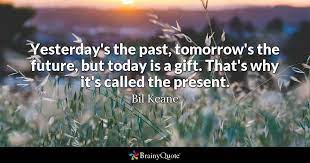
Letting go and not being attached to the outcome did require a lot of practice. Fortunately life never fails to provide ample opportunities for this needed practice. So I dipped my toes into this concept with minor matters, making the best decision I could in that moment with the information I had at hand, and letting go of any preconceived ideas I might have about the outcome. I found out that no matter what transpired, I could handle it. Often times the result was even better than I might have imagined. When it came to relationships and what I was hoping for, I found that letting out a little kite string was all that was really needed. If the relationship was genuinely mutual, our kite would soar. If the relationship was more one-sided, it was bound to hit the ground. Inspirational life quotes that have long resonated with me began to take on a much deeper meaning:
I began my focused personal growth journey by learning about, and embracing, mindfulness. Mindfulness led me to meditation. Meditation reignited my keen interest in neuroscience. Over these past six years, there has been growing overlap of personal growth tools and the teachers who guide us. And all of it is rooted in awareness.
Becoming skilled in awareness is the best practice of all. It provides a broad and fresh perspective to reframe things that literally are right in front of our eyes, but are often obscured by racing thoughts, rumination about the past, magical thinking, and dreaming of greener pastures.
Awareness of all the places where I was triggered by my past.
Awareness of my weariness or resentment growing to a boiling point.
Awareness of own value and strengths and not allowing others comments to diminish them.
Awareness of how others showed their love and respect for me. (hot tip — sometimes we are actually getting the love and respect we want but we fail to realize it because we want it in a certain way)
Awareness to offer myself grace and acknowledging I will always be a work in progress.
These are just a few of the many insights I gained from awareness. The self discovery journey has allowed me to get untangled and unstuck from experiences and emotions that clouded my vision, muffled what I was able to hear, and it opened my heart in ways I would have never thought possible. I found peace. A peace that I carry with me everywhere and one that I trust I can ground myself in when life gets turbulent.
I also found a deeper capacity for being aware of how others are feeling and reacting. Judgment has been replaced with a genuine interest and curiosity about what is beneath all of that. All of us have stratifications of the anxieties and vulnerabilities that we’ve accumulated over the years. I find myself understanding that about others and it serves me well as I hold space for them and listen fully. So often clues are embedded in those deep conversations. I now focus more on the other person. Its so much easier to do this now that I have cleared my own emotional landmines. My mind, my body and my heart isn’t competing for my attention. Instead, I can lean into what I have learned about myself and find greater compassion and encouragement for others.
My dear friend Judy and I have done a lot of this work together over the past few years, acting as confidantes and cheerleaders for each other. We were so fortunate to be able to compare similar life experiences and learned behavioral patterns we developed as coping mechanisms. We also shared a deep love of helping others and offering encouragement to those who are on a similar journey. What we have noticed in our improved energy levels, our discernment, and the people we are attracting into our lives is nothing short of miraculous.
Our family members and our friends have noticed our transformation and freely tell us all the positive attributes they are witnessing. They are experiencing how we show up differently in our own lives and in their lives too. This concrete evidence of the work we have been doing has become a guiding light for others in a much healthier way than our old approaches ever did.
When my daughter tells her friends that I am the most mindful person she knows, that goes straight to my heart. Who knows me better than her after all these years and who sees the consistency and continuity of all my positive changes?
RECOMMENDED RESOURCES:
Chopra Meditation Center – Getting Unstuck: Creating a Limitless Life (How limitless awareness can help you overcome all obstacles — 21 Day Meditation Program offered for free)
Typology Podcasts with Ian Cron (available for free on YouTube) I’m sharing this episode with renowned Enneagram authority Beatrice Chestnut who is like me, an Enneagram 2.
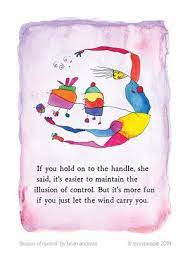
I am a longtime collector and affectionate of StoryPeople — and I bought this one over two decades ago. No matter how much I tried to maintain some sense of control over my busy complex life, balancing parenthood, career and marriage, there were more than a few times that I just enjoyed letting go of the “to do”list and the human “doing” and trust fall into a strong wind like a carefree child. I had no idea just how insightful these words would be to me later in life when I learned the liberating feeling of “letting go” of outcomes and expectations.
I’m pulling a thread from my last blog post about “evolving” and how I witness personal growth blossoming from one generation to the next. My inspiration comes from my daughter and the book she recently gave me entitled Inward by Yung Pueblo as well as the most endearing “present moment” comments from my 3 year old grandson.
My 3 year old grandson, Tank, was in his happy place — a dirt filled construction site with a small mountain of freshly turned soil, a Tonka dump truck and a bright yellow excavator assessing the big job. I overhead his conversation to himself. “You can do this Tank. You’ve got this.” I turned to my daughter who was nearby and said “wow, that is great self-talk.” At that point he looked at me and said — “I am just telling my brain, Gigi.” Out of the mouth of babes, right? It seems so natural and so easy — assess a challenge and feed your brain the positive messages to tackle it.
One day he was playing in the same construction sight, his little leg outstretched in the cool dirt. He was busy digging away, filling a truck with soil, when he looked at me and said “I love the warm sun on my skin, Gigi.” “You know, buddy, that is one of my favorite feelings too,” I replied. That moment really touched my heart since I often share my little present moment delights with him — the happy chatter of the birds, a welcome cool breeze on a hot afternoon, the rich colors of the sky at sunset. Perhaps I have nurtured his awareness of his own little present moment treats. I hope so, because it is the moments when we are not distracted but fully steeped in the experience that enrich our memories. Children seem to learn so much by osmosis — which is really just observing us and where we focus our attention.
My daughter discovered Yung Pueblo a few months ago and read his book Inwardwhile she and her family were on the road for a few months. When we reunited recently, she handed me her copy of the book saying I think you might like this, mom. She was right — I loved it. Yung Pueblo offers wisdom that comes from his own personal growth journey, his activism and life experiences. You’d think he was my age but this remarkable inspirationalist is only 32 years old! For young people like my daughter, he is relatable — and he leads by example. I am so delighted that she has found her very own resource for inspiration and learning. Here are just a few of his insights shared on his Twitter account in recent weeks:
Maturity is realizing there is a big difference between what you think you want and what you actually want. Your cravings can twist your mind and make elaborate fantasies that seem good but in real life they aren’t worth all the trouble. Align with your goals, not your cravings. –Yung Pueblo
Are you being yourself or are you being your past? Immediate reactions are often old patterns. Real authenticity is removing the power away from the immediate reaction and giving it to the intentional behavior that aligns with how you actually want to show up in the world. — Yung Pueblo
Find a partner who realizes how their emotional history impacts the way they show up in your relationship. They don’t need to know themselves perfectly or be fully healed, they just need enough self-awareness to see when their past is getting in the way of loving you right. –Yung Pueblo
A few days ago, my daughter came home from running an errand, eager to tell me about a podcast she had just listened to with Yung Pueblo on “radical authenticity.” Just like the moment with my grandson and his awareness of the warm sun on his skin, I found myself soaking up this moment. I often listen to podcasts while running errands or out walking — and I am usually excited to share some nugget of incredible insight when I return. Now here I was — the benefactor of something remarkable my daughter was discovering through her own resources.
Little does she know, but that brief conversation we had about radical authenticity was such a gift to me. As a parent, I’ve strived to foster all the goodness and potential I see in my children even though they themselves may not fully see it. My 33 year old daughter is now both my child and a mother of her own children. Through her own parenting lens, she is exploring more fully all that she wants to instill in her own children.
Some of my greatest growth spurts happened during my 30’s and 40’s and they were borne of the desire to be at my best for my children. I wish that I had discovered a “Brene Brown” to help me back then. What I know for sure is that I often was not my “authentic self” as I navigated my marriage, parenthood and my career. It took me til my 60’s to realize that people pleasing, conflict avoidance and pushing myself to the point of exhaustion were some of the roadblocks to being my authentic self.
I am elated that my daughter is embracing radical authenticity and allowing that big-hearted personality of hers to shine. She strives to bring her best self to her children every day — the real and honest version of herself. The conversations that she has with her young children touch my heart in a very deep way. They do not shy away from hard conversations and the realities of life. (This past year of pandemic and quarantine made this a necessary part of life.). They honor feelings, no matter what they are. They explore these emotions and how best to respond to them in healthy ways. They work out problems together with respect and understanding. Often when the kids are playing alone, they naturally use these whole-hearted skills to solve an issue with a dispute over a toy. My daughter stays out of it and allows them the space to put into practice what they are all learning through their interactions with her.
I marvel at the self-awareness that my young grandchildren already possess at the tender ages of 3 and 5. They can describe very accurately their body’s responses to emotions and situations. They are being taught to trust their intuition and make choices that are best for them. They recognize their individual differences and are learning to just accept that what causes a strong emotional response in one simply doesn’t hit the radar screen in the other.
When they offer an apology, they also explain what they wanted and how they were feeling. Just this morning I heard my grandson tell his sister that he was sorry for pouring water on her. He explained he was upset because he was excluded from her tea party. She accepted his apology and said very plainly “There are better ways to get an invitation, Tank.” What I love about this interaction is the framework my daughter has given them for a sincere apology. They acknowledge their actions, explain their frustrations and respect how that affected their sibling. It’s often just a matter of minutes til they’ve resolved their issue and are enjoying each other’s company.
In my generation’s childhood, we were often dismissed or even punished for expressing our emotions. As a result, we developed coping mechanisms that were more problematic than helpful. Brene Brown has taught us that all this armor we use to protect ourselves just gets in the way of being our beautiful authentic selves. My generation’s parenting style evolved where we often tried to soothe hurts with ice cream, and rescue our children which often meant they didn’t get a chance to solve their own problems. I don’t think we fully understood that though our intentions were good, we were still impeding the process of living authentically.
My generation did not have the tremendous influence and social pressures of social media to contend with either. Constant comparisons and a high demand to portray a “perfect life” on Facebook and Instagram just create more pressure and roadblocks to being present in the moment and being your authentic self. Brene reminds us that living authentically means embracing all of life — the messy, complicated stuff as well as the happy, lighthearted share-worthy moments.
It is a source of great comfort and inspiration to me and my friends to watch our adult children evolving in their own lives and in their parenting skills. They are doing a better job than we did in many cases and it gives me great hope that future generations will not be bogged down with baggage, armor and ineffective coping skills. Imagine harnessing all their energy in creative, resourceful, compassionate and respectful ways. The future we all hope for begins in the home, with our family and what we teach each other.
Recommended Resources:
Let Your Inner Truth Shine: How the Children in our Lives are also our teachers: click the link below for this Mindful Magazine’s Weekly Wakeup:
Inward is a collection of poetry, quotes, and prose that explores the movement from self love to unconditional love, the power of letting go, and the wisdom that comes when we truly try to know ourselves. It serves as a reminder to the reader that healing, transformation, and freedom are possible.
Every parent knows the importance of equipping children with the intellectual skills they need to succeed in school and life. But children also need to master their emotions. Raising an Emotionally Intelligent Child is a guide to teaching children to understand and regulate their emotional world. And as acclaimed psychologist and researcher John Gottman shows, once they master this important life skill, emotionally intelligent children will enjoy increased self-confidence, greater physical health, better performance in school, and healthier social relationships. Yung
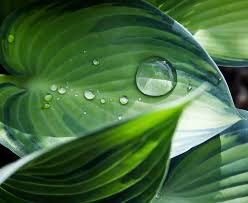
Many who know me, know that I am an avid gardener. My love of gardening started early in life and has brought me so much joy over the years. One of my greatest pleasures is taking an overgrown jungle and turning it into a lush, textured and colorful retreat. Years ago, I nicknamed one of my shaded garden paths Nature’s Chapel for it was full of majestic Jack in the Pulpits and large-leafed variegated hostas that held raindrops like sparkling jewels. That graceful garden offered both calm and wonderment. Gardening has always been therapeutic for me. It brings me joy and a deep sense of satisfaction to transform an eyesore into a treasure for the senses.
Over the past few days, I have had to sit with some heavy emotions from my past. The images of my many gardens kept intertwining with my thoughts. Suddenly I realized that there was a meaningful metaphor emerging. I recalled a piece of raw land covered in thorny brambles and thick underbrush. At first sight, it looked like a daunting task to clear it all. But my vision of a lush garden with blushing pink bleeding hearts and emerald ferns spurred me on to tackle the clearing process. It took nearly a week of manual labor, blood (in spite of thick gloves), sweat and even a few exasperated tears. Eventually I was gazing at that thick rich composted soil, eager to plunge my fingers into it and inhale the promise of a dense flourishing garden.
I used this gardening metaphor as my anchoring point to revisit an old emotional wound. It has had a profound impact on my mindset to continue on — digging deep and clearing away thorny emotional brambles. I know that it will be hard work, but in the end I will have a clear, clean healthy space in my heart and life story.
Perhaps one of the most revelational transformations that happened during this clearing is that I am able to use tools I did not possess at the time of origination of the painful emotional trauma. It could have been one of many incidents in my childhood where a parent shred any hope of trust and protection through uncontrollable abusive responses. It could have been occasions when I was pleading for help for myself or my daughter and was completely ignored, even dismissed. It could be the innumerous times a former partner stripped me of self esteem and self-worth in spite of facts that proved otherwise. In those moments, I was not strong, lacked confidence and believed I was unworthy. Too young and insecure, too mired in dysfunctional circumstances others were unconsciously creating for me, for us.
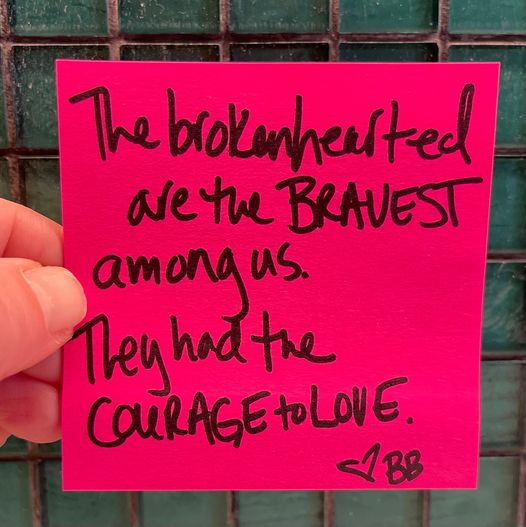
Today when I stand facing the thorny brambles of revisiting those old traumas, I am an older, wiser and more self-compassionate woman. My tools are knowing my own value and self-worth. I recognize that I have overcome some really painful, challenging life experiences and am still standing. I also know that in spite of mean, spiteful and deeply hurtful actions of others, my tender heart remains unchanged. My loving heart may be bruised, scarred and creviced, but it is capable of deep love and true warmth. In fact, I am certain that my brokenness is what allows more light and empathy into the deepest part of my very being. I have an innate understanding of the human condition precisely because of the pain I have endured.
In some ways, it is like having a crystal ball. I envision my crystal ball look as a snow globe. I can look at my young granddaughter as though she is in a delicate glass snowglobe, shake it and watch the fairy dust of snowy white sparkles drift over her. I can hear her laughter and I can wrap her in my arms when life hits her hard, offering comfort and assurance that she is loved, safe and protected. My wish for her, and all my grandchildren, is that this is their true foundation.
My improved self-awareness in my 60’s means that I am a better advocate for my innocent and vulnerable grandchildren. Of course, I will not be able to protect my grandchildren from life’s hardships, but I will hold space for them, I will honor their true feelings and I will be a source of comfort and strength. Awful things happen in life — how we show up for others in there hour of need is paramount. This is how we help our young people grow their character, their values and their resilience.
I am a crusader for my grandchildren. I will never watch silently as an adult carelessly and unconsciously strips a child of their worthiness or their need to feel safe and protected. While much of life’s challenges and heartbreaks cannot be changed, how we treat others is fully within our power. I have zero tolerance these days for adults who expect more from their young children than they do themselves. How can you expect a little one to have emotional regulation and patience if you are not role modeling that for them? Let’s face it, we are all imperfect and we will make mistakes but even then we have precious teaching moments and an opportunity to restore trust and worthiness. Our greatest tools in these moments are personal accountability and sincere apology.
These transformational tools must be used swiftly. I cannot stress this enough. We can circumvent serious emotional damage and development of unconscious protective behavioral patterns by owning our mistakes and hurtful actions and offering a sincere apology. Not just I am sorry, but a true commitment to change.
Imagine a fiesty preteen girl being told by her birth father that she’d be pregnant by the time she was 16. For three years she’d carry this in her heart like a heavy rock weighing her down. On what should be a very happy milestone 16th birthday, she bounds down the stairs and asks her mom if she should call him and tell him he was wrong — very wrong — about her on so many levels. It is caustic, toxic actions like this that plant the seeds of unworthiness in an innocent child. This young woman will carry this with her all her life – it is her emotional baggage packed and handed to her by a careless adult.
This is another example of a sliding door moment in life. That birth father could have realized what an awful thing he said to his daughter and he could have immediately apologized. Perhaps he was angry about something else and directed all that pain at his daughter. But years go by and he’s long forgotten he ever uttered those words to her. Yet she carries them buried in her heart and they will shape her through the years. She will always have a nagging inner voice telling her she is “less than” and there will be days she believes it. When people let her down, she will see it as proof of her own unworthiness. It will make recovery from life’s blows all the harder. When she becomes a mother, she will make every effort to ensure her own child feels completely loved and accepted, just as she is. It will take this woman years to undo the silent messaging that she is unworthy of love and belonging. And this is precisely why swift action is needed when we screw up.
I do believe that each generation becomes better at parenting in a healthy way by learning from our own parents what we do not want to repeat. This has been a guiding principle for me and many of my friends, and we are seeing that unfold with our adult children as they raise their own families now. I am also grateful for the work that Brene Brown has done to bring out into the wide open just how these very real life experiences impact us emotionally and psychologically throughout our lives. Which is precisely why we need to do our own “clearing and excavating” work. In my viewpoint, Brene has been a leading catalyst for making very public the critical need for all of us to dive into self-discovery and to support each other in a wholehearted way when we find the courage to do so.
It is my hope that my gardening metaphor will become a strong visual for consideration should someone ask you to help them as they are pulling weeds and emotional brambles from their own stories.
Almost a year ago, my lifelong friend, Judy Chesters, told me that we still had a lot of deep diving to do into our work of “emotional excavation”. Admittedly she caught. me by surprise because she and I have worked so hard for over 5 years supporting each other through a lot of processing of archived traumas and self-discovery. All I can say now is that she must have had a crystal ball of her own — for after a year of pandemic and unprecedented uncertainties she was so very right. Both she and I have gone much deeper into our own stories. The healing and empowerment that we have gained is almost hard to explain but how we both feel is much more grounded, expansive and light. I shared with her one day that I describe it as “rare air, deep water.”
When I am in that space of “rare air and deep water”, I let my imagination run free and wild. I envision my grandchildren traveling through their incredible lives without emotional baggage and scarred hearts — no limitations on their creativity, worthiness and ability to live authentic wholehearted, free-spirited lives. I imagine a world where we give to each other an enriching environment and nurturing support to be our best selves. —Amy Davis

















 Inspired New Horizons