Better Scripts, Better Stories

What if we all had access to an incredible library of rich, engaging reference material for the stories we tell ourselves?

Instead of rummaging through old baggage accompanied by a judgmental inner critic telling ourselves stories that usually aren’t very helpful, we could flip the script.

We could build a dynamic database of reference material that could be repurposed time and again to write relevant stories that truly help us rather than restrict us.

Better scripts. Better stories.

If the stories we tell ourselves throughout our lives keep us trapped in small versions of ourselves, snagged on shards of shame, fear or insecurities, and limit us from seeing valuable context clues for building the life we want — we will miss the golden opportunities that are often right before our eyes.

If we are constantly second guessing ourselves and worried about other people’s opinions, we will never be able to fully tap into our own dynamic and unique character development. We will write ourselves as supporting cast members instead of taking the leading role we should have in our own personal development.

Knowing ourselves well and having access to our ever-evolving inner database of rich raw material cultivated from our experiences, emotions and mentors will be the giant transformational step in the better stories we tell ourselves all throughout our lives.

Ethan Kross, author of Chatter; The Voice In Our Heads and Why It Matters, recently shared that we are at a pivotal inflection point right now. His latest book, Shift, is an open invitation to embrace this transformational reframing of the voice in our heads and the database we all have in our bodies and brains as a resource not a roadblock.

How do we turn a centuries old paradigm on its head? The one that had us believing our inner library was just a dark, dusty basement full of stuff we’d rather forget?

We do a major renovation – that’s how. No more dimly lit basements or scary attics. We build greenhouse libraries instead!

Sit with that image for a few moments and feel just how inviting it would be to linger in that welcoming greenhouse — to explore your own personal growth in a warm, well lit, inviting environment with a vast library of inspiring stories of courage, creativity and curiosity.

No more inner critic curmudgeon constantly saying “I told you so” while opening the creaking lids of old baggage rummaging for proof that we’d never measure up. No more donning old protective armor or hand me down behavioral patterns.

Out with that crotchety inner critic stuck in the past who keeps us entangled in an unpruned past. In with an insightful, inspiring inner voice instead – one that continually reminds us how far we’ve come, what we are capable of and all our unexplored hidden potential yet to be discovered.

Our inner voice would be he head librarian and life coach of our personal greenhouse library — an effervescent mentor with a knack for using intuition and gut instincts as a guide for the best reference material suitable for our present day adventures and obstacles.

This is the major undertaking that we are all being encouraged to embrace thanks to neuroscience, psychology and vastly improved parenting models. This is the very inflection point that Ethan Kross tells us has arrived. We are long overdue for this healthy, space-clearing renovation and modern upgrade.

Each and everyone of us has the opportunity to write better stories that we tell ourselves. For many of us, it does mean that we have to clear out that metaphorical attic and basement in order to make room for the personal growth databases we can maintain in our greenhouse library.

For our younger generations, we can help them build their own greenhouse library from the get go. Tear down any shaky foundations currently under construction for that misguided inner critic and storing of unhealthy emotional baggage. Make room for a new tenant – a strong, flexible and resourceful inner coach and a vast, continuously updated library of worthy reference materials.

This is how we pivot from a harsh and unhelpful inner critic who restricts our growth to a dynamic personal life coach — an inner voice that is trustworthy, truthful and has been trained to help us set ourselves up for success.

The second major pivot is to reframe our past experiences, processed and unprocessed emotions and prior stories as history lessons, rich raw material and sources of inspiration and motivation. We can write and re-write better stories to tell ourselves when we view our internal database as an endless resource library for our lifelong personal growth.

Let’s get a sense of how it would feel to tap into an inviting database to explore creative new ways to tackle a problem or make the most of an unexpected opportunity.

In that old cob-webbed model, your crotchety inner critic would be jumping erratically on your shoulder playing the same old broken record on a loudspeaker – “you can’t do that or you don’t have what it takes.”

In the new updated and integrated model, your personal life coach and supportive mentor meets you where you are. Your inner voice takes your hand and validates that what you are experiencing is hard. Your calm inner voice asks you “what does help look like right now?” Your inner life coach reminds you that you can do hard things. That inner life coach can show you all the places from your past where you did overcome adversity, met challenges and set your sights high.

Are you beginning to “feel” the marked difference between a debilitating inner critic and a supportive inner coach?

Are you able to imagine that your backstory, lived experiences and knowledge you’ve gained along the way have created a dynamic personal reference library (and not a musty, dusty storage unit of things best forgotten).

The inflection point that Ethan Kross talks about is this pivotal shift from inner critic to inner life coach. Ethan encourages us to accept the invitation to shift our thinking and to use our emotions as data points they are for helping us live a balanced, rewarding and generative life.

Adam Grant, organizational psychologist, echoes what Ethan Kross is promoting — and he adds that one of the best ways to quickly integrate this transformational new way of using our inner voice is to teach it. In his recent conversation with Dr. Becky Kennedy, the parenting expert that has built her practice on this modern model of emotional integration, they both acknowledged that shifting into inner coaching is how we fast track ourselves and our kids into this better human operating system.

Dr. Becky points out that we can “re-parent” ourselves while we are teaching our kids all about emotional intelligence and emotional regulation. We help our kids build a massive emotional vocabulary and as we are doing that, we are updating and rebuilding our own.

As we teach our kids that emotions are not scary, not to be avoided and are actually incredible data points for getting to know ourselves well, we are also reinforcing this messaging for ourselves.

As we become more familiar with our inner greenhouse library reference material – and we let our inner voice guide us as a life coach would — we will naturally be role-modeling how easy it is to access helpful internal information. Now we get the benefit of osmosis to easily facilitate our kids building their own personalized internal resources.

What we once relegated to the dusty basement is the core operating system in our greenhouse library: Emotional Intelligence.

It is precisely why Ethan Kross entitled his newest book Shift: Managing Your Emotions So They Don’t Manage You.

It is also why Dr. Becky Kennedy tells us that punishments don’t work. We need to be teaching our kids how to process and manage their emotions. They cannot learn that and acquire the skills and tools they need for emotional intelligence by being punished. Punishments only result in the old baggage stored in dusty, dingy basements with the scolding inner critic.

If you don’t have kids or are not a grandparent, don’t feel that you are missing the boat of this transformational inflection point. We all have family members and friends to support. And Adam Grant’s principle applies here too: We can reinforce our own learning by teaching. As we integrate emotions, expand our emotional vocabulary and get betting at regulating our emotions, we can share what we are learning with others.

Let’s consider the impact we have on others when we rely on an inner critic, old baggage and unhelpful stories we tell ourselves.

When we are inconsistent in how we show up for our kids, our spouses, siblings or parents — we pour out a lot of mixed messages, confusing signals and big margins for error. Especially prediction errors. Our inconsistency in controlling our emotions and reacting to common everyday occurrences really messes with everyone’s ability to do the two things our brains are naturally hard-wired to do: make predictions and make sense of what is happening by finding meaning.

Did you know that psychologists point out that our inner critic is comprised of the voices and messages we heard most often in childhood. Parents, siblings, grandparents, caregivers and teachers contributed to that inner voice that helps us co-author the stories we tell ourselves.

Our inner critic has such a loud voice that it often drowns out what our inner self is trying to tell us. How can we trust our gut instincts and intuition if we can’t hear it?

When we put this into perspective, it helps us shift out of our reactive, driverless auto pilot. We become more cognizant that we are training those inner voices of our loved ones to hear better scripts. In turn, they will be able to tell themselves better stories. Just like AI, we are providing input to others that will either help or hinder them in the future. Do we want to develop a loud, harsh inner critic — or a dynamic, inspirational life coach?

Our most important roles in life are that of parent, partner, sibling and friend. We are real life coaches for each other in each of those roles. After all, our learning and growing is a lifelong process, not one that stops when we reach our full height or our brain has fully developed (which doesn’t occur til our mid-twenties). We all need life coaches to help us navigate life with healthy skills, tools, inner resources and strong support systems.

Just imagine if we all accepted the invitation to pivot as Ethan Kross suggests? We are at a major inflection point in our human evolution thanks to science-backed evidence of how our brains, our emotions and our inner voices are intended to work as an integrated team.

Wouldn’t you rather trust yourself to make the best decisions throughout your life than a harsh inner critic? Wouldn’t you love an inner voice who often sounded most like reassuring, encouraging and supportive parents who kept you safe? Wouldn’t you love an inner life coach that was an amalgamation of parents, grandparents, teachers, coaches and mentors who scaffolded you through some of your most remarkable life experiences?

Better resources, better skills and tools. Better stories we can tell ourselves.

P.S. I credit my young grandson for the image of a greenhouse library that he offered to me. He said he would build me one some day. He already has.

Ethan Kross not only explains why all that chatter in our heads is disruptive, he gives us great tools to harness it. A very informative and relatable read.
Ethan’s newest book comes out in early February, 2025. He has been promoting his latest book on podcasts. It was his conversation with Dr. Laurie Santos on the Happiness Lab that contributed greatly to this blog post.

A Mindfulness Community

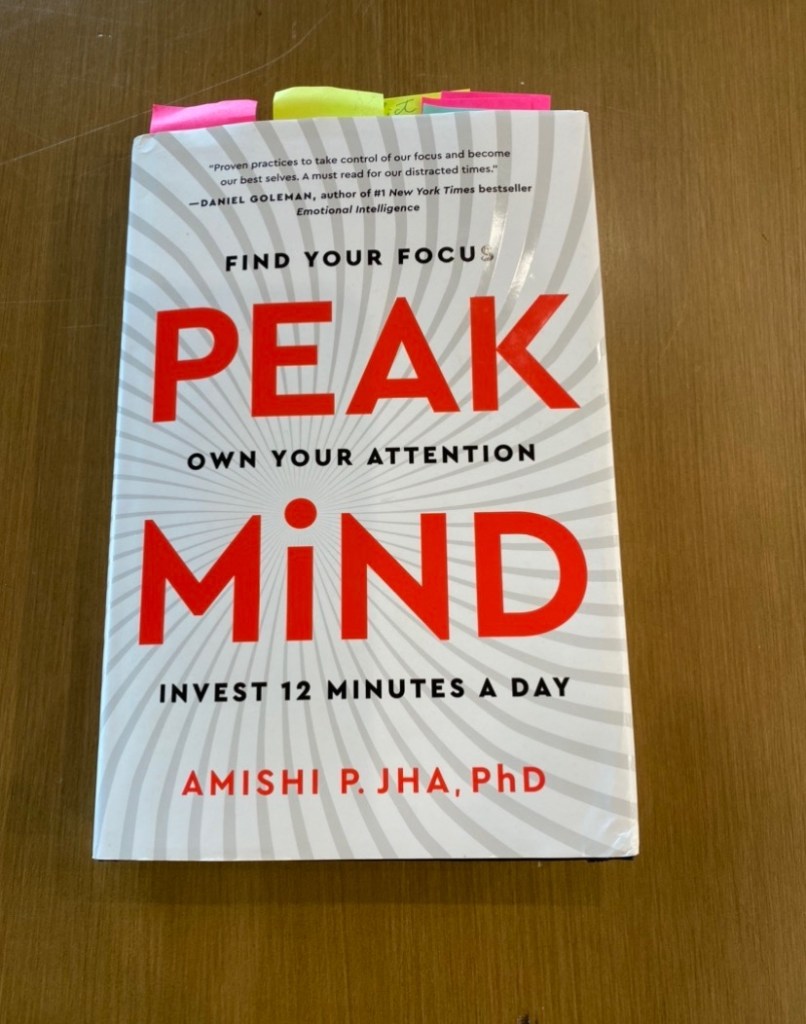
Sitting comfortably in my cozy chair in front of the warm glow of my crackling fireplace, I was curled up with a cup of tea and my newest favorite book, Peak Mind. Each page revealed such fascinating stories to support the research on mindfulness that neuroscientist Dr. Amishi Jha wrote about.

I knew from personal experience that mindfulness and meditation were game-changers for my own life over the past 5 years. Yet reading these compelling stories about the dynamic impact mindfulness practices had on military leaders, as well as medical and business professionals had fully captivated my attention.

My mind drifted (with my permission) to another book, The Four Pivots; Reimagining Justice, Reimagining Ourselves by Dr. Shawn Ginwright. The four transformative pivots are: Awareness, Connection, Vision and Presence. His book is grounded in cutting-edge research and Dr. Ginwright’s insight and lived experiences. He addresses the power of doing our own mirror work to help us uncover hidden biases and discover new perspectives. He stresses the importance of our need for connection with each other.

These same attributes are found in mindfulness – they are the very premise of Peak Mind. It was becoming more evident with each page of Peak Mind that “owning our attention” through mindfulness practices could bring about dramatic results not only in our personal lives, but also in our communities. Dr. Ginwright’s book and Dr. Jha’s book fit together like puzzle pieces for what is possible — and what is so urgently needed.

I allowed myself to “mind wander” imagining communities where skillful practitioners of mindfulness were woven into the fabric of our neighborhoods, schools, hospitals, businesses, law enforcement, etc.

I returned my full attention back to my book to make a most surprising discovery.

At the bottom of page 251 of Peak Mind, Dr. Jha begins to unfold the story of Sara Flitner, a strategy and communication consultant who decided to run for mayor in 2012 — in Jackson Hole, Wyoming. For those of you reading this who are not aware, I live on the other side of Jackson Hole, across the Grand Teton Pass, in Victor Idaho.

My curiosity went on high alert — what is Sara Flitner’s story? If she is featured in Dr. Jha’s book, mindfulness must be a key component of her story. Is it possible that someone running for mayor in a neighboring community had a transformational mindfulness experience embedded in her story? My full attention was captured. I read on.

Here’s the excerpt from Peak Mind that begins Sara’s story:

Sara Flitner enjoyed running her own company, and she loved applying her skills, like critical thinking and empathy, to solving complex problems. She saw a lot of issues in her community –Jackson Hole, Wyoming, which is adjacent to the tourist meccas of Grand Teton and Yellowstone National Parks. Jackson had one of the highest socioeconomic divides in the nation, and with that came issues of high rates of depression and substance abuse, homelessness, high stress and more. Sara thought she might be able to make a difference through her leadership and by influencing policy. She felt passionate about trying to move the needle from inside the system. Her goal, she says now, was to “infiltrate positions of power with compassion, civility, and basic decency and regard for fellow humans.” (Excerpted from Peak Mind)

I stopped reading to let all that wash over me. I allowed myself a little “mind wandering”…..

In my creative imagination, I conjured Sara Flitner calling Brene Brown at some point in the past and over coffee and a few hearty laughs, they brainstormed a new kind of leadership. While Brene Brown didn’t publish Dare to Lead; Brave Work, Tough Conversations, Whole Hearts until 2018, it certainly seems as though both Sara and Brene were on a similar wavelength about a growing need for a daring new approach to leadership.

Sara Flitner decided to test the waters with her mindfulness-based approach to leadership — and she won the Jackson Hole mayoral election in 2012.

When Dr. Jha was researching Sara’s story, she asked the pointed question — “how did it go?” Sarah laughed, “I walked right into the eye of the storm.” She discovered the reality of just how divisive politics are, even on a local level.

It seems evident that the community (the voters) wanted the same things that Sara offered in her platform. Perhaps they were using their own imaginations to envision something better for their community, their neighbors, their children. Maybe they did have a deeper realization of the interconnectedness of everyone that contributes to making Jackson Hole and Yellowstone a “bucket list” destination for the millions of tourists who visit every year. There may have been a growing awareness that socioeconomic disparities could no longer be ignored.

I’ll interject that when you live here, you come to personally know the young people who comprise a large percentage of those that make our successful tourism sector run so smoothly. These enthusiastic hard workers operate ski lifts, provide childcare, give ski and snowboard lessons, are the clerks, wait staff, maintenance and cleaning staff of stores, restaurants, hotels and more. In the summer months, they are outdoor activities guides and national park employees. We know from conversations that these young adults struggle with limited affordable housing, rising gas and food prices. Our interactions expand the awareness of the disparities right in front of our eyes within our communities.

In her book, Braving the Wilderness, Brene Brown urges us to move closer to each other and says that “people are hard to hate close up”. I’d add that people are hard to “ignore” close up. I’d like to think that this was happening organically here in Jackson Hole when Sara Flitner ran for mayor. That there was a growing awareness of how interdependent the entirety of the population was and how it was possible, even necessary, to do better.

Yet a big roadblock to implementing change was the impediment of politics. Does a loyalty to party and resistance to change create blindspots to common ground and civility? Or could it be that not using our incredible brains to their fullest potential is the real roadblock?

“It’s heartbreaking to see the kind of suffering we’ll lay on each other when we act like there’s some kind of budget for compassion or empathy. We have this attitude of “I’ll save my compassion for the people I like, not for you. It’s primitive brain reasoning, when we have — right here in our own heads — much more advanced technology available to us.” — Sara Flitner

Throughout her two year term as mayor, Sara relied heavily on her mindfulness practice to help her navigate through painful, difficult and disillusioning times. She shared with Dr. Jha that “her mindfulness practice threw her a “lifeline” because of the way that it helped her connect with others and get things done – especially when those interactions were adversarial and fraught with conflict.”

Sara Flitner was on to something big when she recognized that “primitive brain reasoning” was a major roadblock. This is profoundly true not only for the community challenges we face, it is emphatically true for us as individuals. We are often unconsciously “stuck” on the default mode of our most incredible brains.

To fully unpack the default mode of our brain and how our implicit biases get embedded in long term memory — and how quickly they get retrieved when we are in high stress situations — I urge you to read Peak Mind. Here are some key takeaways:

The brain is in “simulation mode” at all times. Simulation mode gives us the mental models that guide our thinking, decision making and actions. The key ingredients of simulation mode are memories of events of our past, fragments of those memories, plus everything else we have learned and remembered. Then we add our capacity to think, reason and forecast! All of this happens fast — in the moment as events are unfolding.

Dr. Jha explains that part of the reason our simulations (i.e stories) are so powerful is that they become a kind of shorthand for framing a current situation or problem. This shorthand efficiency frees up cognitive resources to do other things. BUT these simulations/stories constrain information processing. They capture and keep our attention locked onto a subset of data. The result? Our perceptions, our thinking and even our decisions are constrained.

Why does this matter? When our simulations/stories are wrong, then our resulting actions and decisions can be skewed wrong too — because of the way our simulations/stories interacts with our attention.

One final caveat — our simulations are so effective that we get fused and persuaded by them. If a key ingredient of our simulation is a stressful memory, our brains and bodies react as if it is a real and current event — and we will experience the release of stress hormones. We will actually begin to “feel” we are currently experiencing the simulated event.

If you let all of this sink in, you can comprehend how crucial it is for first responders, law enforcement, surgeons, military personnel, firefighters and others in high stress jobs to not get caught in “simulations.” The life-saving and life altering real life stories of these very types of professionals will have you on the edge of your seat when you read Peak Mind. One bad decision made because it is based on a wrong simulation can have devastating results.

It should be easy to comprehend how using our brains to their fullest potential — as the highly advanced technological operating system it actually is — would be a game-changer for our individual lives and for our collective problem solving.

The two biggest roadblocks to tapping into all the functions and features of our brains is (1) Being unconsciously stuck in default mode and (2) being unaware of how we are wasting our attention. It would be like having dynamic safety and navigational components in your new car and never using them.

The reality is that many of us are going through life on an outdated auto-pilot. Lots of tiny dysregulated emotional responses can erode our most valued relationship. They also spill out into our workplaces and communities.

As humans, we are hard-wired to co-regulate each other — and we are wired for connection. The key to getting us to operate at a higher and more rewarding efficiency level is to “upgrade” our most amazing brain. Neuroscience is providing us with the knowledge and the tools to install the upgrade. Mindfulness practices are the foundational core.

Over a year ago I blogged about how so many invaluable diversified resources were intersecting in the personal growth arena. It is becoming evident that those same resources are melding together to forge an evolving infrastructure for socioeconomic change as well.

I see this unfolding organically with my friends who are committed to personal growth, self-awareness and mindfulness. I’ve seen the positive impacts their inner work has had within their families, their careers, circles of friends and their community involvement.

It is also evident in the books and podcasts that feel like pieces of a bigger puzzle — each subject offering insights and knowledge that fit together with an improved framework for coming together to address complex, nuanced issues with clarity, compassion and creativity.

Right here, in my own community, there is yet another meaningful example of this positive change. Sara Flitner, former mayor of Jackson Hole, continues her mindfulness influence and outreach:

Sara founded Becoming Jackson Whole, an organization dedicated to training leaders across all arenas — community service, health, education, business, law enforcement and more – in the kinds of evidence-based mindfulness skills that help build resilience and enable people to thrive personally and accomplish more professionally. (excerpted from the book, Peak Mind)

The Becoming Jackson Whole website has a blue banner across the top that reads “We’re on a mission to make mindfulness second nature in Jackson Hole.”

A coordinating banner on the About Page shares this: “Helping our community respond to the challenges of our times with focus, compassion and resilience. Empowering leaders to create change.”

Guess who provided the training for these local community leaders? Dr. Amishi Jha, author of Peak Mind. I’ve come full circle with my story of how I discovered that a subject near and dear to me — mindfulness — was actually making a difference in my own community. It might explain why I’ve discovered so many people at the local book store and coffee shops who are reading similar books and who readily engage in the deeper conversations I thrive on. What I know for sure is that the more people become discerning about where they are placing their attention, and the more skilled they become at tapping into the full potential of their brains, the better for all of us.

RECOMMENDED RESOURCES:

Peak Mind will open your eyes to how you utilize your ATTENTION and how to take control of it.

The best primer I have found for revealing the incredible benefits of mindfulness and mindfulness practices.

The Four Pivots connects the dots between the personal growth work we do for ourselves and how it shifts our awareness and perspectives when thinking about — and engaging in — meaningful social changes

For anyone transitioning into a new chapter of their live, this insightful book will help you discover how purpose can be both a source of groundedness and fulfillment.

THIS IS PART OF MY LOCAL COMMUNITY — THE GRAND TETONS

Visit this Website – Becoming Jackson Whole https://becomingjacksonwhole.org/about-nav