Can you feel that little updraft in inner drive and determination that comes from a brand new year? There’s nothing like a brand new calendar, clean and pristine, to let our imaginations run wild with big dreams of how well organized and productive we will be. This psychological phenomenon is called the “fresh start effect”. It marks a clear delineation for our “out the old and in with the new” mindset. A brand new year is when we get to double dip in this fresh start effect — it’s not just a new month – it is a brand new year.
I confess that I love a Happy New Year fresh start and I prepare for it as eagerly as I do for Christmas. My desk has stacks of colorful, inspiring blank journals and brand new chunky, spiral-bound idea notebooks; along with an assortment of gel pens and varied sizes of neon post-it notes. And the real gem is that pristine 2024 planner. Thanks to my grandkids who gave me a generous gift card to Quail Ridge, I also have an inviting stack of new books I cannot wait to read. There is a rush of pure joy and an eager excitement every time I look at the endless possibilities that will manifest when I actually use all these tools.
It was in that moment, that it dawned on me that this was the direction I wanted to take my blog in 2024. This year, my blog posts and Daily Gummies of Wisdom, are going to become more relatable and digestible. This is the year where the “rubber hits the road”. I want to share more real life stories, examples and experiences that reveal how beneficial it is to be using better tools and becoming more skillful with them.
This is the year that I want my blog to help others stock their desks, toolboxes and backpacks with diversified resources for building the life they want and showing up more often as their best selves. It is an exciting time to be alive because thanks to science, we have taken a lot of the mystery out of old paradigms about emotional and mental health, parenting and relationships – and yes, even personal growth.
I love diving into groundbreaking and ever-evolving data. I also love distilling it in a way that is easy to understand and implement in real time. I’ve become a bit of a “reverse engineer” with 7 decades of life experiences to draw on. By sharing familiar and relatable real life stories, I can teach and role model how and why these much-improved relationship and life tools are meaningful game-changers.
There is another confession that I have to make: I am over the moon thrilled that it no longer feels necessary to keep self discovery and personal growth under wraps. The proof of this is in our current overuse of the word “normalize”. We toss that word out like a disclaimer reminding us that no one is immune to “feeling” their way through life.
No more cloak of secrecy when it comes to mental and emotional health — it is now fully mainstreamed! And, it is not only mainstreamed, we are making genuine progress in connecting the dots between our physical health and our emotional health. Our eyes are being opened to the many no-cost and low-cost steps we can take to proactively improve both.
The pivot I will be making with my ever-evolving blog will mirror the pivot that is being made in modern medicine, psychology and neuroscience. There is a shift from problem solving to prevention. Many fields, modalities and people are taking proactive steps to improve their physical, mental and emotional health to safeguard against future health and relationship issues. An ounce of prevention really is worth a pound of cure.
Food for Thought: This is a new element that I will be adding to my blog posts this year. I will wrap each one up with a little food for thought, something to reflect on and then consider putting into practice. The “food for thought” I offer today is to take time to look through – and reflect on – your planners and journals, camera rolls and playlists, on the biggest challenges and fondest memories of 2023. Before you toss them in the trash, or pack them in a box with birthday cards, archived bills and tax receipts — spend some time distilling what mattered most to you in 2023. Use that as a map for where you are headed in 2024.
RECOMMENDED RESOURCES:
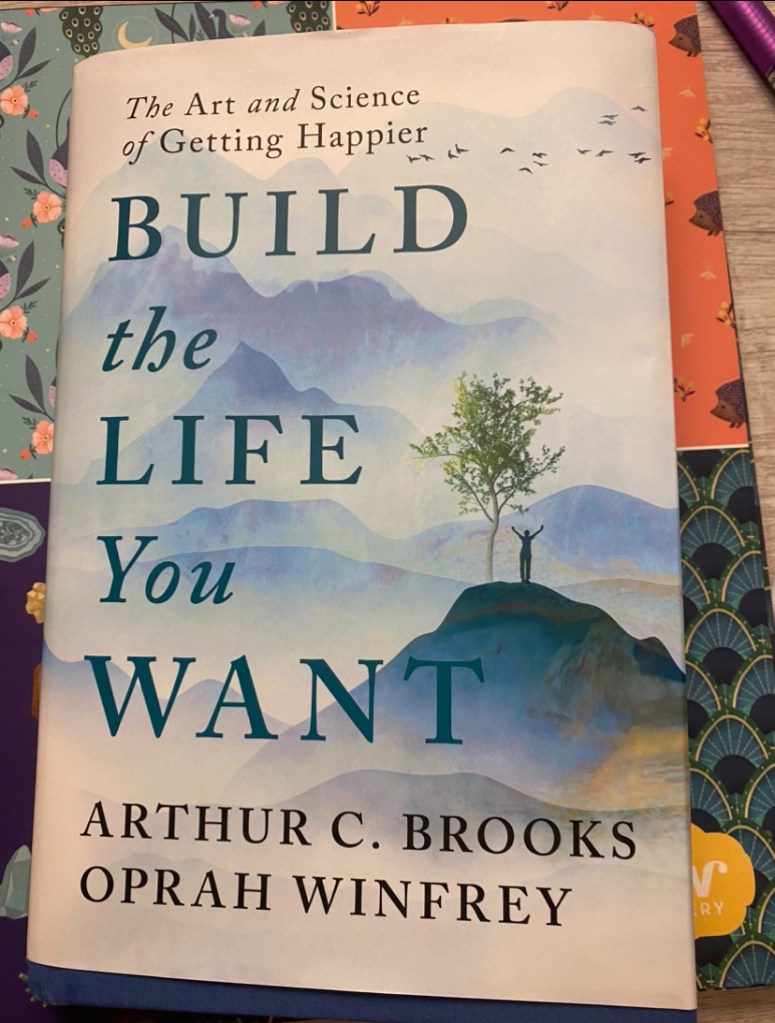
Arthur C. Brooks is a well known happiness expert. His last book was entitled “From Strength to Strength” and it had a big impact on me. That book was really meant for those of us who are transitioning from one stage of life to another. It was such a helpful guide for reflecting on past experiences and using it as a solid foundation for reinventing ourselves for the next chapter.
In this powerful new book, Arthur works his magic once again — and makes it easy to understand the latest breakthroughs in science and how to take that knowledge and weave it into your daily life. One message comes through loud and clear as you read this book – we need to put in the reps – we need daily practice with all kinds of situations and people for these new tools to stick.
THE RICH ROLL PODCAST: Treat yourself to a new podcast in 2024 – and check out the diversity and dynamics of Rich Roll and his inspiring guests.
There is a vast ocean of podcasts these days. It can be both time-consuming and overwhelming to sort through the catalog and find the ones that call to you.
There are times in our lives when we need a little extra knowledge about core physical health tools like quality sleep, nutrition and exercise. Other times, we need some encouragement to get through tough times. We also need to be inspired through other’s stories of how they used all these new tools we are learning about; stories from others help us digest and metabolize new information.
My recommendation is to listen to Rich Roll’s podcasts in chunks. Few of us really have the time to sit and listen (let alone pay full attention) to a lengthy podcast. But if we listen for 15 – 30 minutes at a time on our drive to work or while running errands, we can gain a lot. Instead of scrolling on your phone when you need a break, listen for 10-15 minutes to part of the podcast. This is how we put some really nourishing and healthy content into our brains.
There are so many subjects, modalities and tools to support our self-discovery and personal growth. What captures your attention? What do you want to learn more about? Rich Roll offered two podcast episodes at the end of 2023 that offer a diverse menu of choices. I am sharing the links for these two episodes, rich with guests that we all know and love – and full of inspiration to get you super-charged for the new year.
I’ve been blogging about my own personal growth and self-discovery journey for almost 8 years. Like most people, I probably believed in the early stages of this process, I would be able to identify the habits I needed to change and the skills I needed to acquire in order to check the self help box. Then I could move on into the next chapter of my life – happily ever after.
What I have come to more fully understand and appreciate is that personal growth, self-discovery and human evolution are in a constant state of change. As a direct result, we have to change our mindset about personal growth and self discovery.
The answers to our lifelong, puzzling questions about who we are and why we behave as we do are not to be found in a single book, podcast or workshop. We can’t earn a certification, degree or even a merit badge — and then move on as if our work is forever done.
Personal growth, self discovery, emotional health, relationship skills and mindful self-awareness are our life’s work. It is dynamic, integrated and evolving – because we are.
I’d understand if you were less excited, and more intimidated by this revelation, but take heart – it turns out that this work doesn’t have to be as hard and painful as we once made it. Thanks to neuroscience and the social sciences, we now possess evidence-based knowledge of how our brains work. The incredible discoveries that have been made in very recent years are helping us understand why all the old ways of addressing our behavioral, mental and emotional health were not working very well.
As we gain a greater understanding of how our brains actually work — and how our lifetime of emotions and experiences get created, stored and pulled out for reference — we can begin to see the evolving benefits of incorporating consistent emotional practices into our daily lives.
We don’t workout til we get the strength and flexibility we desire – and then stop. We maintain our physical health with daily commitments and practices. And now, we are learning that we must do the same with our emotional health.
Take a moment to think about the last time you lost your patience or your cool; or when you hit a trip wire and became so emotionally triggered by something pretty insignificant in hindsight. How might it feel to have greater muscle memory when it comes to emotional self control?
It’s the time of year when holidays are really amplifying the hard truth that we get tripped up a lot by unprocessed emotions and old family dynamics. Rather than cringing about having to deal with all this messy stuff, we can use it as an opportunity to become an emotions scientist – and to make some discoveries about how better emotional regulation would dramatically improve our quality of life and our relationships.
Let’s take a closer look at an emotion with which we are all familiar — good old fashioned envy. There’s no doubt that the holidays present us with more than our fair share of opportunities to compare ourselves to others in a whole host of ways. It’s human nature to find ourselves envious of others when we look around at the office party or family gathering, or scroll through the festive photos our friends post on social media.
We may feel that tinge of envy in our bodies as we compare and contemplate what others have that we don’t, or if we let FOMO (the fear of missing out) or FOPO (fear of other people’s opinions) take hold in our minds.
A few years ago, Brené Brown shared that comparison is the thief of joy. She was addressing how this exhausting hustle to keep up the with Joneses can lead us to a dead end (and quite often deep in debt – physically, emotionally and financially). In his latest book Hidden Potential, organizational psychologist, Adam Grant, digs a little deeper. He professes that comparison is not the thief of joy – envy is: “Resenting others’ success breeds misery and rivalry. Admiring their success brings motivation and learning. We all compare ourselves to others. A key to growth and happiness is focusing our comparisons on people who inspire us.”
Envy is an emotion; we feel envy. Comparison is a noun and it is simply a consideration or estimate.
It’s not the comparing that gets us in trouble; it’s the unchecked, disregulated emotion of envy. When our emotions are super-charging us, we tend to lose our perspective and our quite often our self control. Whether it becomes a cycle of rumination or an emotional outburst, we get derailed from our own present moment and we rob ourselves of joy. Sometimes our behavioral actions even rob others of their joy. It’s the collateral damage of us getting caught up in emotions we would rather not be feeling.
Until very recently, we did not fully understand that we actually are capable of much more emotional intelligence and self regulation than we realize. For far too long, we believed that the only way to tame emotions was to use sheer will power or “fake it til you make it.” These old strategies did not pan out so well.
Have you ever witnessed your young child having an absolute meltdown about a toy or a treat that their sibling has — knowing full well that your wailing child doesn’t even like that toy or treat? That is a classic example of unregulated, impassioned envy. A young child’s developing brain does not have the capacity yet….. to engage differently with their big emotions. As adults, we do have this capacity, but many just don’t know it.
As Adam Grant makes so obvious, it’s human nature to compare ourselves to others. The act of comparison is not likely to go away no matter how much we humans evolve. It’s when that comparison stirs up our envy that things actually do come apart at the seams. Now we “devolve” into the little kid who is melting down over something we may not even really want. We may have about as much success controlling our envy as a parent trying to reason with the toddler if we rely solely on sheer will power. We can’t arm wrestle our way out of big emotions any more than a child can.
What’s in that envy cocktail that we shake or stir? Resentment, disappointment, frustration, sadness, insecurity, anxiety – just to name a few.
Have you ever felt envious about a friend or family member but in reality you wouldn’t want to trade places with them in a heartbeat? We cannot make this distinction in the moment that envy has taken over – our brain’s negativity bias and the strong unchecked emotions make it nearly impossible.
If we stay stuck in envy, we become resentful, miserable, and angry; we may fall prey to bouts of superiority just to make ourselves feel better. We run the risk of projecting all we are feeling out onto others. This is the adult version of the toddler temper tantrum.
Adam Grant offers a tool to avoid envy robbing us of our joy: “A key to growth and happiness is focusing our comparisons on people who inspire us.” In other words, he is guiding us to become “discerning” about our comparisons. This makes so much sense because it keeps us grounded and helps us maintain perspective. Think of your inner GPS being your “inner adult”; the voice of reason.
Becoming “discerning” about who and what we are comparing ourselves to is similar to an effective distraction technique often used with young children to help them get out of an emotional spiral. We disrupt the brain’s runaway emotional train with a pause between stimulus and response, and then we use discernment to switch tracks. Simply put, we refocus where our attention is going.
There is another tool we can implement to super-charge self-regulation skills. We can “substitute” a better emotion, on purpose, and in real time.
In his latest book, Build the Life You Want, happiness expert, Arthur Brooks, introduces this dynamic new emotional practice with a very relatable metaphor:
“Most people use caffeine because they aren’t content with the way they feel naturally, and want better outcomes in mood and work. It does so through substitution of one molecule for another. Caffeine is a good metaphor for this principle of emotional self management: You don’t have to accept the emotion you feel first. Rather, you can substitute a better one that you want. ” — excerpted from Chapter 3, Build the Life You Want.
Think about what we are trying to accomplish as parents when our child is over-reacting. We want them to “substitute” a different emotion for the one they are currently feeling. In fact, we mindlessly offer this common refrain to our distressed child: “Oh honey, don’t feel that way” and then we offer them other choices. These choices are often rooted in gratitude — all the things they already have.
Are you surprised that you already possess this skill of “substituting” a different emotion — helping others to see that they can choose an emotion that is more constructive to “act” on? It’s so easy to employ this tactic with our child or friend — and one of the most challenging to rely on for ourselves.
Our Own Social Science Experiment:
Our labs will be well stocked with opportunities for us to practice the pause, discernment and substitution over the holidays. Our labs are our ourselves, our families and our interactions with others as we make celebratory preparations.
What might your hypothesis be about the tiny Petri dish that has no emotional regulation — yet.
What are your predictions about the middle sized Petri dish that ignites quickly and has only sheer will power to overcome the emotional wildfire?
What outcome might be revealed when the larger, more advanced Petri dish, uses a pause between stimulus and response, discernment to shift focus and attention, and emotional substitution — choosing the emotion they wish to act from rather than the emotion they initially feel.
Why Daily Emotional Skills Practices are Needed:
Emotional intelligence and skillful emotional regulation are the natural next steps in our human evolution. Neuroscience and social sciences are giving us the proof positive that our brains have the capacity and neuroplasticy to create new, healthier neural networks, especially when it comes to the complexity of our emotions. With the advent of all these new discoveries, better skills and practices are replacing old paradigms for mental health, parenting, education, modern medicine and psychology.
An Emotional Skills Workshop may provide us with a diverse array of emotional tools like being mindful about where we place our attention and substituting a better emotion — but without consistent, regular practice, we will either forget about them or atrophy our ability to use them skillfully.
As Arthur Brooks underscores: “emotional substitution is a skill that takes practice, not just an insight. With practice and dedication, it can become quite automatic, and you will love the results.”
What really resonates with me about Arthur Brook’s wisdom, is that we are trying so hard to parent our kids to be in control of their emotions but for generations we have gone about it all wrong. Intuitively we sort of know what to do when we are trying to help them, but we were never taught how our brains and bodies work, the mechanics of emotional intelligence and regulation. It’s hard for us to teach what we ourselves don’t fully understand; what we ourselves are not consistently role modeling because we are not yet skillfully practiced.
That old adage “practice what you preach” is more relevant today than ever.
Modern day parents have so many ways to protect their children than we older generations had. Baby monitors, car seats, safety gear for sports, sunscreen, well baby checkups and preventative dental care are some powerful examples. Now they have at their fingertips, scientific breakthroughs about happiness and fulfillment — it is emotional integration.
We can install emotional integration in our young children and we can teach them how to use their innate emotional intelligence in ways that actually support and protect them. We are entering the age of “meta cognition” and it is a game-changer.
Food for Thought:
The reason that a single workshop will never be the answer for personal growth and self discovery is that we are literally changing every single day. Emotional intelligence and skillful emotional regulation is not a quick fix or a workshop — it is a life practice.
Emotions are here to stay – and for good reason. They are the guard rails, channel buoys and lighthouses for our quality of life and meaningful connections with others.
We take our emotional past into our present and we build our futures with our emotional responses in the present moment. We bump into each other every single day, with our emotions, ideas, perspectives and experiences. When we change, others change. We need better life navigational tools and skills to do this in a way that matters most to those we love.
If you don’t want to dive into this big read just yet, listen to Dr. Lisa Feldman Barrett discuss emotions in the Huberman Lab podcast shown here. You will discover how integral emotional intelligence is for our children especially.
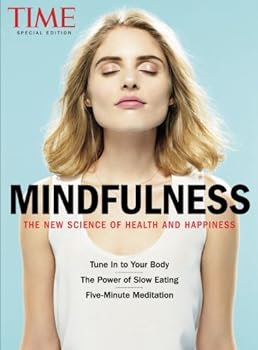
When I began my personal growth journey, the buzzword that was catching on was “mindfulness”. Time Magazine touted mindfulness as the new science of health and happiness in 2016. The message was clear — we are time travelers, often letting our minds wander to the past or future. We were being urged to find our balance and be more fully present in the moment.
It became very evident that in addition to time travel, our monkey minds were filled with an inordinate amount of chatter. So, meditation was introduced as the tool to help us stay more present in the moment. The internet was abuzz with “how to” practices and new meditation apps were hitting the market with a fury.
We were being reacquainted with something we take for granted — the power of our breath to regulate us. We were told to pay attention to our breathing and to use it as a grounding tool when we felt distracted or emotionally overwhelmed.
At the time, I recalled how I was taught the Lamaze method of breathing in my early twenties to help me through the labor and delivery process of my first baby. The seed had been planted that a few deep breaths could help keep me stay calm under pressure. Over the course of many decades and a lot of high stress parenting moments, I often told myself – and my kids – to take three calming breaths. I remember my dentist laughing when I shared with him that I used the Lamaze method more often in his office than when I was delivering my babies.
So, I had a lot of “buy-in” and actual experience when it came to the “breathing” component of meditation; but like most, I struggled with the traffic jam of racing, competing thoughts whenever I attempted to “meditate”. I could use my breath to slow my heart rate and calm my body. The next big step was learning how to manage the 60,000 thoughts create so much distraction every day.
That’s where mindfulness played a key role in what was touted in 2016 as the new science of health and happiness. Mindfulness was the buzzword and the trend that shifted our awareness. We began to cultivate greater “self” awareness.
Self-awareness helped us recognize when our minds had wandered off on a trip to the past or the future while we were playing a game with our kids, or enjoying a delicious meal with our family. Meditation practices helped us hone our focus and attention muscles. The goal was never to eradicate our 60,000 thoughts a day; it was to become more discerning about the ones we actively engaged with and to help us stay in the present moment with greater frequency.
The new science behind mindfulness was helping us to understand that time travel to the past often put us in negative ruminative loops and time travel to the future could make us worry and become anxious. We were missing out on gathering up and storing all the positives that were occurring in the present moment. The benefits of being present in the moment was being able to steep ourselves in moments of pure joy, delight and strong feelings of happiness. It was being more keenly attuned to gratitude – both giving and receiving it. It was also the recognition that this present moment may be the very one we had worked so hard to make come true. The science was telling us that our happiness is most salient when we live in the “now.”
Meditation was the term and the tool introduced to us to help us better understand all that our amazing brains are capable of doing when we choose to be consciously engaged in all its features. It became the gateway for learning about neuroplasticity and how neurons that fire together wire together; in other words, how we can create new neural networks throughout most of our lives. Our interest in meditation greased the wheels for us to take a deeper dive into learning how to care for our complex and incredible brains.
It was the Mindfulness trend in 2016 that put us on the path of greater access to the knowledge, tools and resources we have to do a much better job of caring for our brains and improving the quality of our lives as a direct result. Change-makers are coming onto the scene with relatable content, using layman’s terms and helpful metaphors to teach, getting us engaged and excited about all sorts of new approaches to parenting, relationships, education, counseling and therapy.
It is now the fall of 2023 – and the natural next giant step in the science of health and happiness has crystallized into mental health and emotional health. We now know, beyond the shadow of a doubt, that if we want to live longer, happier and healthier lives, we need to integrate emotions into our operating system and we need to take brain health and hygiene seriously.
Where we once believed that only those with very disregulated, dysfunctional families were predisposed to mental health issues, we now know better. We also know that being well resourced both physically and emotionally is how we build resilience, courage and flexibility for the inevitable challenges of life. Furthermore, we are just beginning to fully grasp the negative effects of disconnection and loneliness, especially in our teens and elders.
Let’s take a look at some of these change-makers:
PARENTING:
Scroll through your favorite social media platform today for parenting tips and you will most likely discover Dr. Becky Kennedy, a children’s clinical psychologist who made a big pivot from old school parenting and psychology to a vastly improved integrated approach to help children struggling with their big emotions and problematic behaviors. She transformed her practice when she and her colleague launched “Good Inside” in 2020. If you are a parent, grandparent or child caregiver, you will find Dr. Becky’s teachings invaluable; and you will be leveling up your parenting skills in a whole new way.
On her website, Good Inside, Dr. Becky offers insights about herself and her professional practice. It is proof positive that all that we have been learning about childhood development, our brains and bodies, and our emotional health are shifting how we approach age-old problems.
Dr. Becky introduces herself as a clinical psychologist, mom of three and founder of Good Inside. When she first started her career, she practiced a popular “behavior-first” “reward-and-punishment model” of parent coaching. She shares that “after a while, something struck her — “those methods feel awful for kids and parents.” She got to work, taking everything she knew about attachment, mindfulness, emotional regulation and internal family systems theory– and translated those ideas into a new method for working with parents.
“By focusing on the parent behind the parenting, and the child behind the behavior, we help families heal — bringing out the good inside everyone. ” (Excerpted from her Good Inside website)
What Dr. Becky came to realize as she transformed her methods and her professional practice is that we cannot teach what we do not know or skillfully use ourselves. Since none of us were taught about how the brain works or emotional integration and regulation, we were simply using the same parenting practices that keep perpetuating behavioral problems.
This is precisely why we reached a tipping point in our need to change our understanding and approach to mental and emotional health. Generation after generation had just continued down the same path, passing the baton of problems, dysfunction and disregulation to our children, until it reached a collective crisis level that could no longer be ignored. The children of each generation were surrounded by adults who did not know better. Parents, teachers, coaches, mentors, grandparents, siblings and friends — and even well intentioned counselors — were all coming at behavioral problems and addictions with the same outdated, unhealthy approach and model.
As the mental health industry began to recognize that many of the root causes of behavioral issues and addictions could be traced back to childhood, it became evident that the old parenting model and lack of emotional integration into developing brains and bodies were the core sources of our collective human problem.
We should be breathing a collective sigh of relief.
We can move forward from here with greater understanding and deeper empathy for ourselves, our parents and each other. No one is alone in doing the work that will help us live better, healthier and with greater inner resources.
Now you know why Dr. Becky’s following is growing exponentially. She has over 3.1 million followers and that number will surely swell with the recent release of her Ted Talk “The Single Most Important Parenting Strategy”. Today’s enlightened parents are clamoring for the improved skills and tools to raise their kids in emotionally healthy ways.
Dr. Becky is a change-maker for a growing parenting movement.
RE-PARENTING OURSELVES:
A few short years ago, I participated in a Relationship Summit with Terry Real, the highly regarded family therapist and author of I Don’t Want to Talk About It and his newest book, Us: Getting Past You and Me to Build A More Loving Relationship. During the Relationship Summit, Terry would often share real life examples from his couples counseling sessions. He made the keen observation that few spouses were willing to make any changes for their partners even when their marriages were on the brink of failure. However, when he asked a troubled partner about their relationship with own their children, everything shifted. As he helped his clients see their offsprings’s experiences through the lens of their own childhood, most parents were broken open. Spouses might not change for each other, but they can be deeply motivated to change for the sake of their children.
As Terry so wisely counsels — we need to care for our inner child and we need to reparent ourselves. This is part of that “healing process” that Dr. Becky promotes as well. It shifts us into raising our kids with the safety, security, acceptance, trust, guidance and respect we wished we had received. This is how we break disregulated generational cycles and shake off societal conditioning that negatively impacts our most cherished relationships. Many of us grew up believing that emotions were either good or bad; that anger was only ok for boys to show; that behavioral problems in a child should be punished. None of this is true.
Marriages are saved and strengthened when we no longer show up with all that childhood baggage and child-sized emotional behavioral patterns. Spouses who go for couples counseling often discover that the root cause of their marital issues came from their childhood experiences of marriage and family.
Here is where Dr. Becky’s work with children, and Terry Real’s work with couples really synch. Both are addressing childhood attachment styles, parental behavioral patterns, emotional triggers, poor coping skills and the long lasting impacts of internal family systems.
Couples who take this work to heart often find a lot of common ground in how they want to be parenting their children in a healthy and unified way. They can also find more common ground in their marriages and help each other in their own “reparenting process”. The places where we are most sensitive, needy and emotionally disregulated become opportunities for deeper connection and not the barriers to a healthy, happy and fulfilling marriage.
The truth is that we can do our inner work at the same time we are teaching it. It is a win-win situation since children give us such rich opportunities for real time, real life practice in dealing with a wide range of ever-changing emotions. Now that we know that our spoken and implied messages to our kids become their inner voice, we can be pre-load their inner voice to be an encouraging best friend, not a harsh judgmental critic. We can “re-parent” ourselves while we are teaching our children using this better parenting model. We can actually “feel” this loving, trusting reparenting occurring in our own bodies, when we are caring for our children as we had wished to be cared for when we were little.
In the recent Huberman Lab podcast series dedicated to mental health, Dr. Paul Conti, explained why we succumb so easily to auto-pilot for habitual, problematic behavioral patterns. When we were kids, we learned what patterns kept us safe and connected. We memorized these patterns for years. Anytime we feel those old familiar feelings, we replay the memorized pattern. It’s our “go to” move when we feel vulnerable. We unconsciously repeat our habitual patterns even though we now have agency to change them. This is the very reason that our emotional triggers from childhood can still have such strong impact even decades later.
With the new parenting model, and the science that helps us understand the “mechanics” of changing our brain’s memorized patterns, we will stop resisting the need to change our outgrown childhood behavioral patterns.
Terry Real is a dynamic change-maker, especially for older adults, who not only are saddled with outgrown childhood behavioral patterns, but are also constrained by old gender stereotypes and societal conditioning.
In this blog post today, I highlighted two “change-makers” who are making waves and making a meaningful difference because they have done their own inner work — and then found a way to take what they learned out into the world to share with others. The ripple effects are transformational for parenting and marriages.
There are multiple “movements” that are gaining traction as a direct result of the newest science of health and happiness because of breakthroughs in mental health and emotional health. In upcoming posts, I will be shining a light on these movements and the dynamic change-makers who are making these movements dynamic, relatable and impactful.
In the meantime, click the links below and get to know Dr. Becky and Terry Real.
Check out Dr. Becky’s GOOD INSIDE website — and be sure to sign up for her newletter. https://www.goodinside.com
Follow Dr. Becky on your favorite social media platform, including Instagram and Threads. Her short reels offer a daily dose of parenting reality with humor, relatability and a nugget of helpful advice.
Terry Real is a family therapist and founder of Relational Life Therapy- a revolutionary new approach to couples and individual counseling. Old counseling models kept us stuck in looking only at surface problems and not the root cause of our disharmonies. Click this link to go to Terry’s website and discover the plethora of resources he offers to help you build deeper, more rewarding relationships. https://terryreal.com/relationship-online-courses/
“Nothing is more important in our lives than our relationships. A great relationship boosts your immune system, opens your heart and keeps you vital and creative.” –– Terry Real







 Inspired New Horizons