A Wholehearted Emotion Revolution

My last blog post was all about the importance of unpacking our family and emotional baggage — and the remarkable opportunity we have to involve four living generations in doing just that. This post is going to start by unpacking how we got here.

It is all about this moment in time where there is a growing, diverse community of people who are committed to personal growth and emotional health. Some are far along on their journey, others are just beginning and there are many smack dab in the middle. No matter where we are in our journey, we are all reaching both forward and backward – asking for more help and guidance AND offering encouragement and resources.

We did not get here by accident or all at once. We got here because of collective yearning and learning.

Over the past two decades social sciences handed off the baton to neuroscience to help us better understand what was really happening in our brains, in our nervous systems and neurobiology, and through epigenetics. Incredible discoveries were made that brought us tremendous breakthroughs in our understanding and treatment of trauma, cognitive and mental health disorders, the connection between stress and physical health and so much more. So many fields merged together to reverse engineer what we got wrong.

Ironically it was about this same time that Brene Brown started her deep diving research into shame and vulnerability. Imagine how serendipitous this was?

Of course, no one wanted to talk about shame and vulnerability – those subjects were taboo and cloaked in secrecy. That should have been our first clue she was really on to something. Brene told a hilarious story of how she could shut down a conversation with a seat mate on a plane in under 30 seconds by revealing she was a researcher – of shame and vulnerability.

Flash forward to today and those very topics open up a two hour stimulating conversation between three strangers on a plane, who share vulnerabilities as readily as Biscoff cookies, and become fast friends by the end of the flight, swapping contact information and favorite personal growth resources. (Read my recent blog post Leapfrog for that story)

That is just one shining example of how far we’ve come….and how long it has actually taken. Two decades, multidisciplines and a growing longing we were all feeling but couldn’t quite put our finger on.

Brene started her shame and vulnerability research in 2001, right before 9-11. As devastating as that massive tragedy was, there was an also a collective unity that emerged from it, at least for a while.

A decade later, in 2010, Dr. Bruce Perry published his book, Born for Love, where he warned us about our growing empathy poverty. He was shedding a light in the correlation between an infant’s environment in the first year of life and their ability to emotionally regulate in adulthood. He was sounding the alarm for where we were headed if we did not offer safety, comfort and stability for our children. If you were to go back and read that book today, you would be amazed at the amplified realities of his dire predictions for all of us, and especially for our youth. Back in 2010, we had no clue the negative impacts social media and our political polarization would be having on our mental health and empathy poverty.

Also in 2010, Brene Brown’s infamous Ted Talk on vulnerability went viral. It still stands as one of the most viewed Ted Talks in history. It turns out vulnerability wasn’t such a taboo subject after all. It just took Brene’s courage to put it all out there for us. We may not have recognized that this was a massive “me too” movement as well. It was evident that at a very grassroots level, we were longing for answers to questions no one was asking.

In August of 2010, Brene released her book “Gifts of Imperfection” and invited us to join that grassroots “wholehearted” revolution by finding the courage to tell our truth stories. Mostly she was encouraging us to stop saying (and believing) we were OK when in fact, we were not. She grounded her research in the truth that we were born worthy of love, connection and belonging.

The very same message that Dr. Bruce Perry was also telling us.

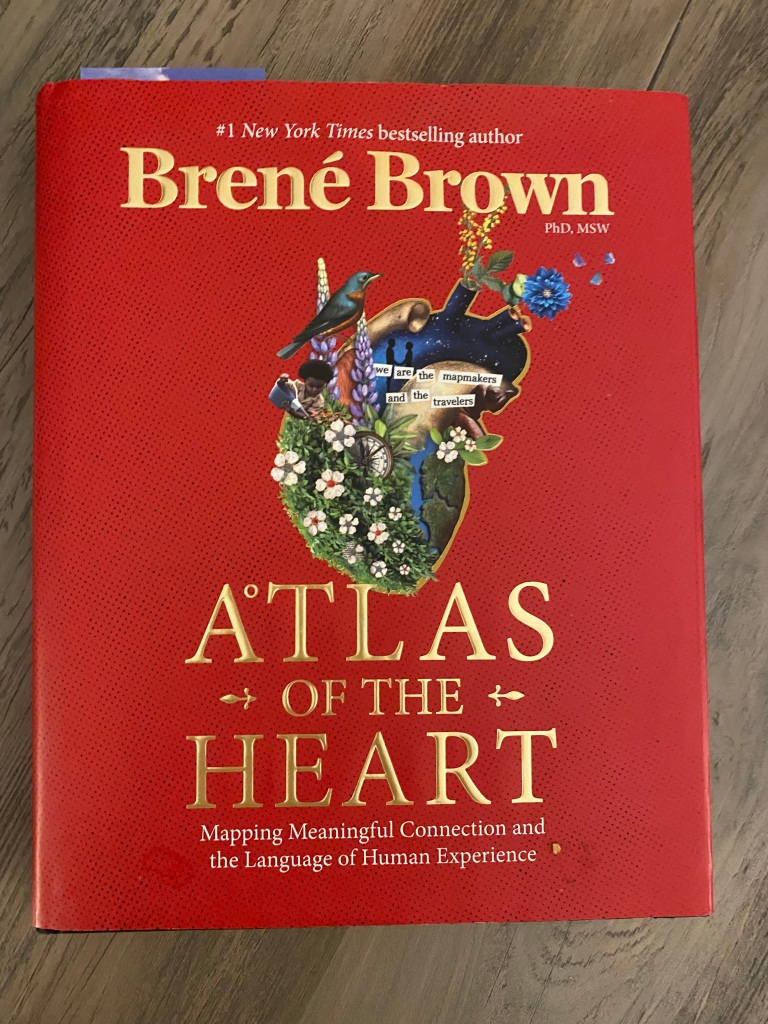
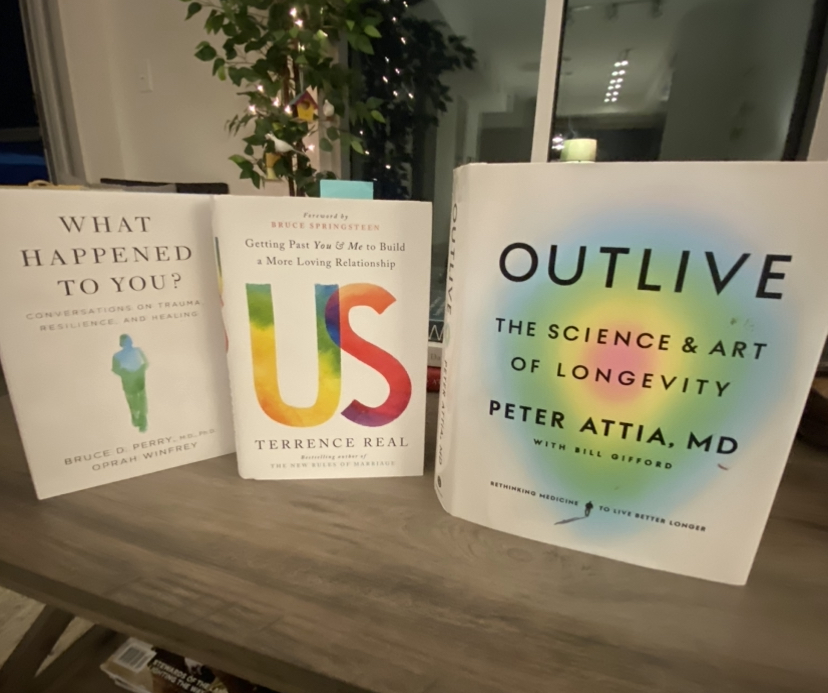
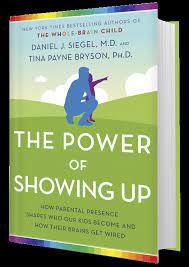
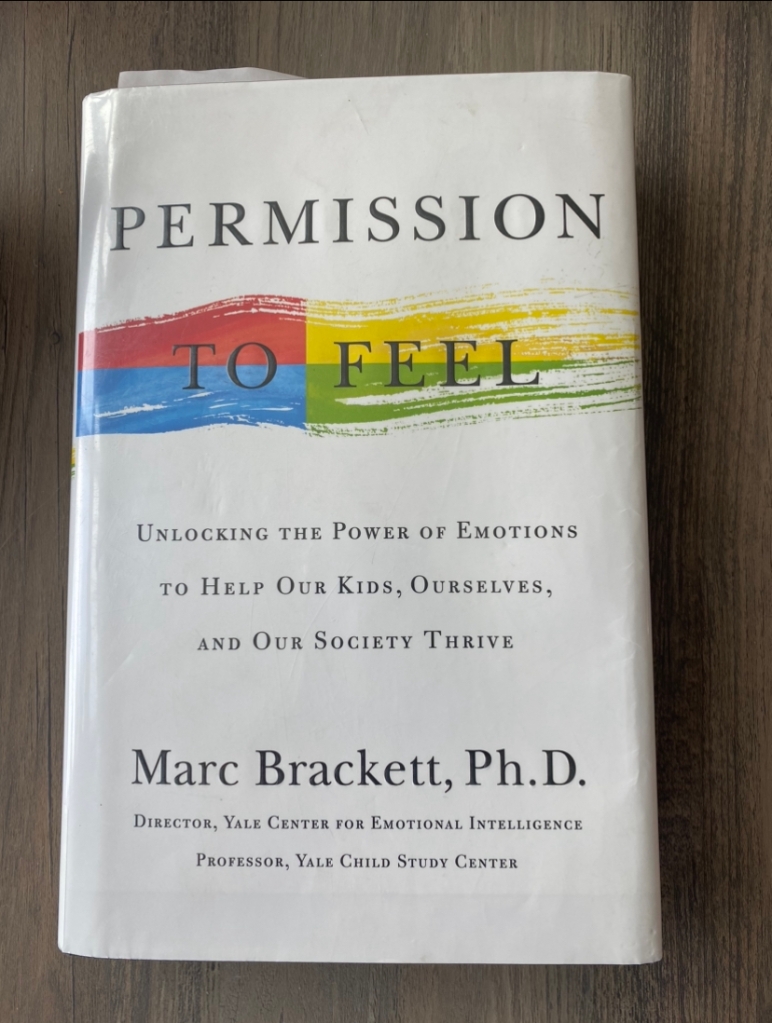
Over the coming years, Brene would publish more books including Rising Strong, Braving the Wilderness, Dare to Lead, and Atlas of the Heart. Dr. Bruce Perry co-authored What Happened to You? with Oprah Winfrey. Dr. Dan Siegel published Whole Brain Child, No Drama Discipline, Brainstorm: The Power and Purpose of the Teenage Brain and the Power of Showing Up(with Tina Payne Bryson and most recently he released Interconnected. Dr. Mark Brackett published Permission to Feel: Unlocking the Power of Emotions to Help Our kids, Ourselves and Our Society Thrive.

Rick Rubin, the renowned music producer and author of The Creative Act: A Way of Being, has a compelling way to make us stand up and take notice of what was happening in this grassroots wholehearted revolution. When an idea’s time has come, it will find a way to make itself known.

The seeds of this wholehearted, emotion revolution were scattered far and wide. They began to take hold not only in the research but within us. The self-help section of our favorite bookstores began to swell – from psychology and neuroscience, to the enneagram, to Untamed by Glennon Doyle and Clarity & Connection by yung pueblo (just to name a few).

Brene’s Netflix documentary, Call to Courage was released in April, 2019, where she invited us to choose courage over comfort in a present day culture that had us divided and disconnected. We should have buckled our seatbelts.

Less than a year later, just as Brene launched her two dynamic podcasts, Dare to Lead and Unlocking Us, the global pandemic was unfolding — and isolating us even more. Perhaps we were listening more intentionally to Brene’s guests and the deeper conversations because they were resonating on many levels.

What we had all been feeling individually for decades, was now also being felt collectively. It was becoming crystal clear that we are not only hard-wired for connection, we are inextricably inter-connected through school, the workplace, grocery store, supply chains etc.

Suddenly the topic of our emotional health was popping up everywhere. What once had only been discussed in the self-help and psychological arenas, was being mainstreamed into business podcasts, education, physical and cognitive medical fields. A magnifying glass was handed to us to see the impacts of emotional health on our children and teenagers; on all of us. Brene Brown confided in her sister series of her podcast that the pandemic puts strains on marriages and parenting we’d never experienced before. We were never meant to withstand long stretches of uncertainty without revealing our vulnerability and need for connection.

The wholehearted revolution that was afoot back win 2010, had been growing slowly. All revolutions take time to build momentum. Surely the global pandemic accelerated the swiftness of of this “wholehearted, emotion revolution.”

Dr. Mark Brackett, author of Permission to Feel, was one of Brene’s podcast guests and he shared so honestly what many already knew to be true: “The mental well being of our children and adults is shockingly poor. We have a crisis on our hands and its victims are our children.”

The warnings that Dr. Bruce Perry had offered in his 2010 book, Born for Love, stressed the importance of our community and relational scaffolding for our children. This wisdom could no longer be lost on us.

There has been a giant step forward and a big pivot in the right direction as we step back out into our new normal and begin reinventing ourselves from the inside out. The books and podcasts that are emerging now are speaking directly to the corrective actions we must take.

We must integrate our emotions in our brains and our experiences. We must unpack family and emotional baggage to stop the trauma cycles and give us space for better quality lives and health. We need to scaffold each other, especially our children, and cultivate growth mindsets. We need to shed the armor that we believed protected our vulnerability and discard outgrown behavioral patterns. We can build life skills, resource ourselves better, and rediscover our empathy and common humanity.

Brene Brown published Atlas of the Heart which helps us expand our understanding of 87 emotions and experiences. It is a family reference guide that supports us in helping our children and partners integrate their emotions.

Kristin Neff released Fierce Self Compassion (How Women can Harness Kindness to Speak Up, Claim Their Power and Thrive) which encourages us to treat ourselves as kindly and compassionately as we would a dear friend; and to break free from limiting gender stereotypes that has us all suppressing our emotions in harmful ways.

Dr. Gabor Mate published his phenomenal book, The Myth of Normal: Trauma, Illness and Healing in a Toxic Culture (a groundbreaking investigation into the causes of illness and a pathway to healing and better emotional health). His insights into how generational trauma get passed down through our family systems point directly to the need for us to unpack family and emotional baggage.

Dr. Peter Attia very recently released his incredible book Outlive, where he drives home the point that our emotional health is the most integral component of our lives. We can be physically health and emotionally unhealthy and we will be miserable. And in turn, we will make our families miserable. He unpacks the reasons why we’ve long heard the phrase “hurting people hurt people.”

Dacher Keltner, a renowned expert in emotional science, just released his book, Awe: the New Science of Everyday Wonder and How It Can Transform Your Life. It is the final chapter of his book, aptly entitled Epiphany, that really brings home the lessons that we have been learning over these past two decades. Dacher Keltner reflects on the work of Charles Darwin whose thinking about the evolutionary science of emotion was shaped as he cared for his 10-year old daughter Annie until her death. Dacher offers that we mimic nature as we move through our evolution (and emotional revolution); there is a decaying (shedding the old that no longer serves us), a composting (extracting the lessons and nutrients we need) and then a regrowth (which is where we are now).

We now possess better insights, research, tools and collective commitment than we have ever had before in this emotion revolution. Young people are hungry for mentors and author Arthur Brooks encourages the older generation to rediscover their purpose by stepping into that role. It is an exciting time to be alive — and be an active participant in such a healthy change.

RECOMMENDED RESOURCES:

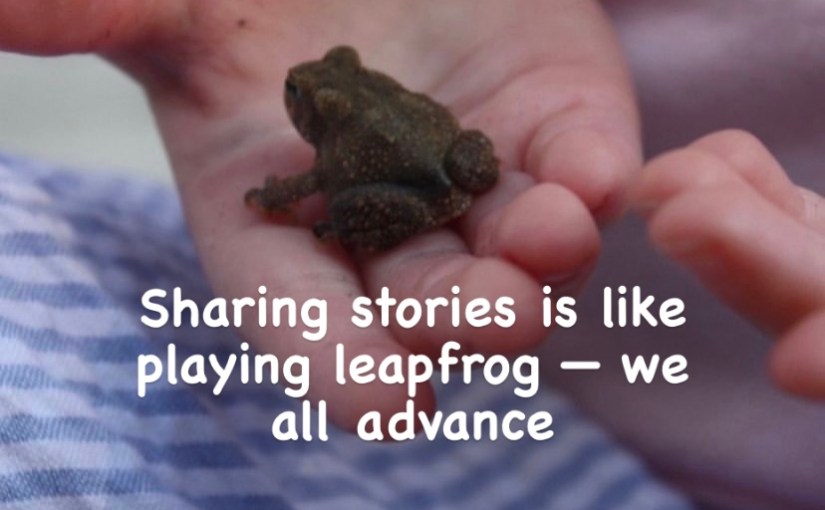
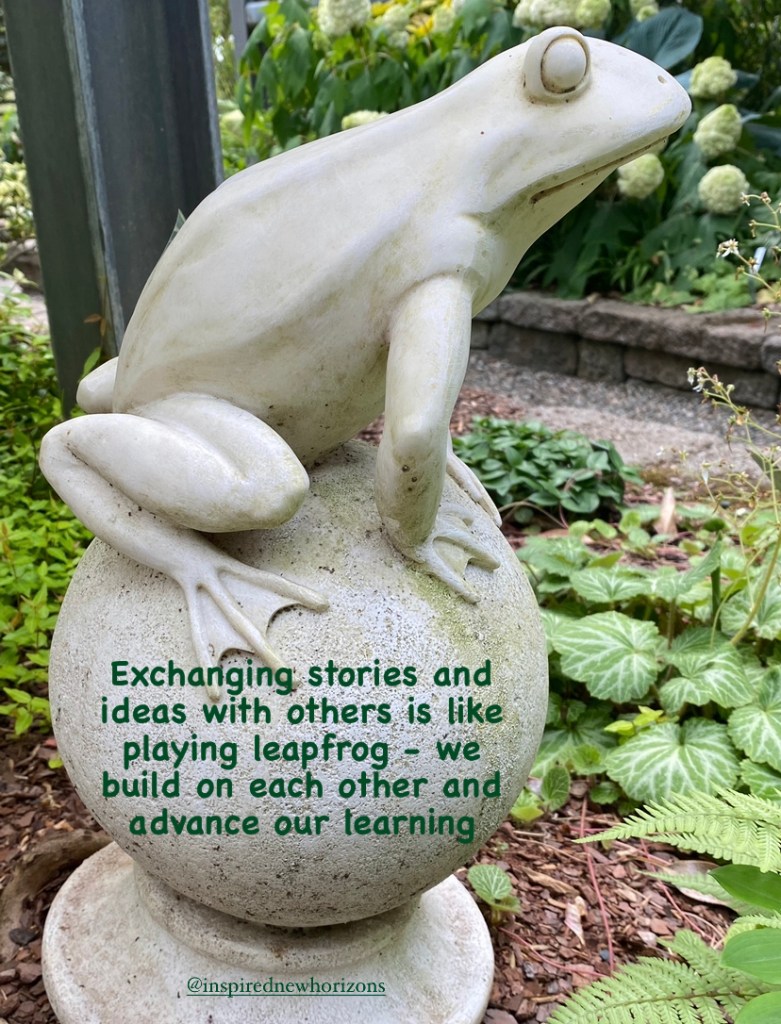
Gummies of Wisdom – Playing LeapFrog

It is truly remarkable how much we can learn about others and ourselves through storytelling. When we share our life stories with each other, we often find unexpected common threads — and we make discoveries that support our own learning and growth.

This is like playing leapfrog — where some part of our story or experience connects with someone else’s and our shared understanding gets ignited and amplified in the most enlightening ways.

We can each unpack the details of our experiences, the lessons learned, resources we found helpful, what our biggest challenges were and how we faced them.

Storytelling can turn strangers into friends in just one conversation or deepen a decades old relationship with revelational new insights. We come to understand that common, similar life events unfold for each of us and yet it is our personal experiences, resources, and interpretations that create the textured, contextualized unique stories of our lives.

The script doesn’t really change that much. What changes are our stories.

I recently sat with two strangers on a flight from Houston to Phoenix; an energetic, engaging young man probably in his late 30’s who is a husband, a father and an entrepreneur; and a soulful, inspiring woman in her 50’s who is an integral part of PacificHelps.org (a non profit organization founded by her husband to provide education and renewable energy to the Pacific Islands) Over the course of that flight, we talked and listened to each other’s stories with a sense of wonder and awe. So many similarities in our stories yet the backdrop, the cast of characters and the obstacles were vividly different. We connected through a working knowledge of the basic life plot — growing up, finding jobs, getting married, having children, marriage difficulties, divorce, remarriage, life threatening illnesses and financial challenges. So much common ground. We laughed, we empathized, we marveled. The human spirit really is undaunting.

The script and the plot doesn’t change much. But each of our stories were uniquely different at the same time. I viewed our stories through the lens of a 71 year old, excited for what the future holds for both of them because of what they have learned from their personal experiences and how they are proactively embracing their continual self discovery and personal growth.

In that young man, I can see my own grown children who are now in the throes of parenthood but so much better prepared and skillful than all the generations before them. At 71, I can look both ways now — I can look back at what we got wrong in old parenting models and I can also look forward to what is possible with vastly improved parenting and emotional skills.

The conversations and insights that the three of us shared about parenting and emotions would have never happened when I was in my late 30’s or early 40’s.

The ease with which we shared things about our own childhoods that shaped us and then later dropped us into our own self-discovery journey was nothing short of incredible. My generation stuffed our skeletons into closets. Today’s younger generation of enlightened parents are doing their personal growth work early to break generational chains of dysfunction and hand-me-down behavioral patterns.

We’ve come a long way since Dr. Spock. These parents are leaning on Brene Brown, neuroscience, whole brain parenting, the enneagram, Drs. Dan Siegel, Andrew Huberman and Peter Attia. Yes, I was in seventh heaven – both my seat mates were quite familiar with the same resources that I have discovered in the last decade. They are proactively putting into practice what they are learning — for themselves and for their children.

Moreover, they are incorporating greater relationship skills into their marriages, parenting and co-parenting. There has been a huge paradigm shift from unhealthy, contentious fallouts from divorce that often caused a lot of trauma for children, to an intentional focus on providing children of divorce the relational scaffolding they need and deserve. Joint custody is being anchored in healthy, respectful, cooperative co-parenting.

A few years ago, I had started to connect the dots about the intersecting of so many of my favorite resources for personal growth and self discovery — I blogged about it. Researchers, authors and podcasters began to reference each other in their books, and invited each other as guests on their podcasts. I noticed that the topics of the human need for connection, emotional regulation, parenting and relationship skills were being discussed even on tech, business and news platforms. I could feel that the very subjects I was passionate about were becoming mainstreamed.

And now, here I was, on a plane with two strangers and we were talking, laughing, sharing about all of it as easily as we once might have discussed the latest movie or hottest trend. It was one of those compelling “aha” moments that Dacher Keltner describes in his newest book, Awe. I got goosebumps – often. There were just so many similarities in parts of vastly different stories.

Do you know how it feels when you have a really great customer service experience? When you feel like someone has paid attention, gone the extra mile, and earnestly appreciated your business? Well that is exactly what this conversation felt like to me — it was a standout. The positive impact that personal growth work has on our ability to make meaningful connections was not lost on me.

I thought a lot about LeapFrog when I got off that plane. That remarkable two hour conversation had made lasting impressions on each of us. We each left with new resources to check out and inspiring stories to reflect on.

What struck me most was how much space we had created to really hear and engage with others by learning from our experiences. We were not so mired in our problems (and phones) that we missed this golden opportunity. Rich conversations like this are some of the best educational experiences we can get. We gain new perspectives and insights, are reinforced and encouraged about the path we are on, and we build good connections on common ground.

RECOMMENDED RESOURCES:

Who Really Pulls the Emotional Trigger?

I’m guessing that you know exactly how it feels when you’re emotionally triggered by something — it seemingly comes out of nowhere, sparks intense negative feelings and abruptly makes you defensive.

We get flooded with adrenaline and cortisol when we are triggered which only amplifies what we are feeling. The conundrum with emotional triggers is that they pull us back into the past while we are also experiencing the very present moment. It’s no wonder we are completely off-kilter when we are emotionally triggered.

It’s human nature to blame someone else for pulling our emotional trigger but the truth of the matter is that our emotional triggers are internal; they are ours alone. No one else is pulling that trigger. Most of the time, no one else even knows that we have a strong emotional trigger that has just been engaged. What they do imagine is that we are over-reacting, have lost control or lost our minds.

Many of our emotional triggers are rooted in our childhood, when we had very little agency. Unbeknownst to us, those strong negative emotions that we felt as kids (but were not acknowledged by our parents and caregivers) got lodged into our brains and imprinted with readily accessible information. So when we “feel” a similar experience even as an adult, our brain pulls out that file and reminds us we aren’t feeling safe. An emotional trigger is a red alert warning.

Give some thought to experiences that cause you to become emotionally triggered. What are you really feeling when a strong, uncomfortable, emotional reaction grabs you? Are you feeling misunderstood, abandoned, unwanted, unloveable, or treated unfairly?

These are all very common feelings for young children, especially if we were punished or banished for expressing them. Those experiences got bookmarked in our brains and we developed a sensitivity to be on the lookout for repeated events like this in the future. We were our most vulnerable when we imprinted these experiences. So it stands to reason, that we will become emotionally triggered when we are feeling vulnerable, insecure or irrelevant as adults.

An emotional trigger is defined as having a strong, uncomfortable reaction to a stimulus that wouldn’t ordinarily cause that response. With this framework, it is easy to see that when we are feeling emotionally balanced, a snarky comment or a misunderstanding doesn’t cause us a problem. We aren’t triggered because we have our emotional act together; we can remain flexible and resilient.

Now give some thought to past adult experiences where you were emotionally triggered — and see if you can recognize that you were feeling pretty vulnerable in those moments. Were you overly tired, consumed by anxiety or overwhelm; were you feeling invisible, under-appreciated? We are most prone to getting triggered when our emotional reserves are low. It’s really no different than our being more susceptible to catching a cold when we are physically run down.

The best defense is a good offense. This is a very good strategy to employ for both handling and overcoming emotional triggers. In his book, Permission to Feel, Dr. Mark Brackett explains that when it comes to being triggered by our emotions, we have to “take responsibility for our actions rather than shift the blame elsewhere. ”

“It may not feel like a choice, but it surely is — we decide how we will respond to life’s provocations. Don’t want to explode in rage when your child is disrespectful? Come up with a better way to respond. Clearly the old way, matching nastiness for nastiness, doesn’t work.” –Dr. Mark Brackett, author of Permission to Feel

We don’t judge ourselves when we are physically run down and know we might be more likely to catch a cold. We make a mental note to get more sleep, stay hydrated and wash our hands more often. The best defense is a good offense.

We can take this same approach when we are emotionally depleted. We can make a mental note that we will be more susceptible to knee jerk reactions than skillful responses. We might even make an announcement to our family members that we just don’t have the emotional bandwidth to deal with unnecessary drama. Again, the best defense is a good offense.

We should be normalizing the fact that regardless of our age, we are all humans with similar emotional needs and changing emotional capacities. This is really invaluable to be teaching our children. Dr. Brackett shares that when we try to shield our children from this reality, it has an unintended result. Children will have a hard time acknowledging adults’ feelings, let alone respecting them.

Emotional triggers are an integral part of our self discovery process. They help us identify what is most important to us and what our current needs are. Once identified, we can free ourselves from the “strong, uncomfortable emotional reaction” to something that really shouldn’t set us off. Instead, we can be more skillful with our emotional regulation and more clear about our needs.

If we are on overload because we have been caregiving on steroids all day, one unintended disrespectful remark from a friend or family member is likely to cause us a twitching trigger finger. Dr. Brackett reminds us that we can take preventive measures for moments like this.

When we offer ourselves some self-compassion, we are acknowledging that we are on overload and are susceptible to losing our cool. We can remind ourselves that if we weren’t so physically and emotionally drained, we would not overreact to an insensitive comment. If we weren’t so worried out, we might even have the dexterity to banter about it.

Does the comment hurt? Of course it does. Let’s not dismiss that either.

But here’s the pivot. An emotional trigger never really addresses our true needs. It gets in the way of expressing ourselves in a way that can be heard and taken to heart. Others just react to our “overreaction” and our basic need is lost in the smokescreen. It’s hard to hear a whispered “I could use a little help here” when there’s a lot of yelling or threatening going on.

Have you ever noticed that emotional triggers can also set off a chain reaction? It is not unusual to hear phrases like “you never listen” or “you always do this”. A lot of baggage is often attached to our emotional triggers, so it’s easy to tap into all those previous experiences and dredge up old grievances. Whatever small incident has set off the emotional trigger now cascades into something much bigger.

Instead of being able to focus and attend to one small and manageable issue, we are now knee deep in triage for a major emotional pileup. It’s hard to assess which issue was the catalyst and which one requires immediate attention. All too often, the one small incident that set off an emotional trigger gets lost and never addressed. But it does get baked into that old imprint of the childhood emotional trigger; logged as yet another example in the bulging file.

In a recent blog post entitled Learning What We Need to Teach, I shared how important it is for us parents and grandparents to be the emotional “training wheels” for our children. The best preventative measures for our children is to integrate their emotions into their experiences; to help them name and process them as they are unfolding. The more we are able to do this in real time with our children, the less likely it is that they will enter adulthood with a lot of challenging emotional triggers of their own.

By now, you probably don’t really need a bigger impetus to get serious about attending to your own emotional triggers, but there is something important that you should bear in mind. Our children’s developing brains take a long time to fully develop and integrate. We protect those little noggins with helmets, but we often overlook the impact our emotional reactions are having. Dr. Mark Brackett writes extensively about this in his book Permission to Feel. In the chapter entitled “Emotions at Home” he devotes a lot of time to emotional triggers; and especially how parents get triggered by their kids’ reactions and behaviors.

He reminds us that when we get “triggered” by our kids, our compassion switch gets turned off. We’ve all experienced this – and we’ve often quickly regretted how we did not show up so great in those moments. We can take comfort in Dr. Dan Siegel’s teachings that “rupture and repair” is normal in human relationships and can actually strengthen our bonds with our children, as long as we apologize quickly and sincerely; with a promise to do better in the future.

Which is why Dr. Mark Brackett urges us to get serious about attending to our emotional triggers before they become a chronic reality. Extreme emotional reactions, over the course of time, can actually alter the brain structure of our children. The effects of frequent extreme emotional reactions can cause our children to have emotional regulation issues of their own and a lot of complexities in their adult relationships and quality of life.

A child’s brain is still plastic, meaning that the structure is always changing. The minute parents start regulating their emotions better, their children’s brains will change to reflect that. If parents start regulating their emotions now, and help their children to regulate theirs, then there’s hope.” — Dr. Mark Brackett, Author of Permission to Feel.

Emotional triggers are a by-product of the old parenting models that did not integrate our emotions into our developing brains when we were kids. When we do our own self-discovery work and identify why and how we get triggered, we are detangling ourselves from the past and owning our agency as adults. We accept that we have choices in how we respond to the things in life that provoke us.

The stuff that initially provokes us is usually pretty minor in the bigger scheme of things. But we can make a mountain out of a molehill with our over-sized reactions. We can meet these moments with greater emotional regulation and dexterity. It will be so much healthier for all our brains — and so much more beneficial for our families.

RECOMMENDED RESOURCES:

My “Starfish on the Beach” Moments

As many of you already know, I recently launched my Daily Gummy of Wisdom email program and it has been met with so much interest, encouragement and compelling conversations. I wanted to take this time today to highlight a few of the gummies that have really landed with people and the stories they have shared with me. This is exactly what I had hoped would come from the creation of my Daily Gummy of Wisdom. Together, we are all getting better at self awareness and “each other” awareness; we are finding new approaches to old, familiar problems; becoming more skillful in our own emotional regulation and in turn, we are supporting others with their own emotional health — especially children.

I launched the Daily Gummy email program to help those who were dialing back their social media consumption. The Gummy gets popped into your inbox at 6:45 a.m. each day. You can start your morning with this engaging food for thought and find that you just might tap into it for an interaction at home or work. Some are using the Daily Gummy as a mindful break mid-morning or mid-afternoon. A little pick me up and that “refresh” that music producer Rick Rubin says is so invaluable to keep us attentive and engaged with our daily life. Others find it a great way to wind down at day’s end. That’s the beauty of the Daily Gummy — you can use it when it best works for you. Our emotional health can benefit from a supplement morning, noon or night.

Think of the Daily Gummy that lands in your inbox as the physical health supplements you store in your bathroom or kitchen cabinet. It’s on the shelf, readily available, and you can take it when it best works for you. No need to wade through a barrage of social media content.

What has so pleasantly surprised me is how the Daily Gummy is being shared with others. Some of my subscribers have created their own expanded email list of family and friends — and they forward the day’s gummy with some thoughts of their own. A few like to print them out and discuss them with the family at dinner or over coffee with friends. Sometimes they get printed out, tucked in an envelope with a personal note and placed in a teen’s backpack or sent to a family member across the country. They are used to seal a yoga practice, as a prompt for writing classes, to open discussions in support groups, and even incorporated into a pastor’s Sunday sermons.

Sometimes I am the recipient of a Daily Gummy.

A subscriber will write to me and share how a certain gummy landed at just the right time to help them reflect on something that is weighing heavy on their heart. My friend, Diane Brandt, has often said that when we support others, the blessings go both ways and this is exactly how I feel when I hear the stories and learn more about what people are navigating. A mother reached out to me when one gummy was particularly helpful for her in supporting her 10 year old son and his emotional triggers. My photo really spoke to his heart; the image has become a touchstone for him.

When I was in my twenties, the starfish story really resonated with me; that image of a little boy walking on the beach tossing stranded, parched starfish back into the sea. An old man passed by him and questioned why he bothered. There was no way that he could possibly save them all. “Why does it matter?” he asked. The little boy responded, “It matters to this one.”

And that is exactly how I feel about my Daily Gummy of Wisdom. If just one person’s life is touched in a meaningful way by a photo and some insight, it matters. If, in turn, that person can reach out and support someone they love in a tender, compassionate and more skillful way, just imagine the impact it will have — the ripple effect.

Not every Daily Gummy lands at just the right time, but some will.

We are most definitely at the tipping point of remarkable breakthroughs for our emotional health. Quite a few of us are those proverbial stranded, dehydrating starfish on the beach. The more we know, the more we notice. This is how attending to our own emotional health not only helps us improve our quality of life, it raises our awareness of how we can support others in truly beneficial, impactful positive ways.

Here are a few of the Daily Gummies that have landed in recent weeks:

Asking “what the matter” limits our ability to gain real understanding of what another person is feeling — and it often ignites a strong desire in us to fix things right away.

Let’s be honest, how often do we utter “What’s the matter?” with a tone of voice that feels judgmental? Yes — a lot.

Think of asking “what matters to you?” as a much more skillful diagnostic tool. A way to probe a little deeper into discovery and be truly helpful in a meaningful way.

So often, we stay on the surface level of an issue, stating frustration or disappointment, but the real problem causing those emotions is tangled up in misunderstandings, miscommunication, differing opinions or scales of importance. Real problem solving is only possible when we drill down into core issues.

If you want to discover how powerful this diagnostic skill really is, try it for yourself. Next time you are feeling frustrated or annoyed – ask yourself “What matters to me?” Your honest answer will reveal a lot.

One of my close friends reached out to me about this Daily Gummy. She is very active in her community as a leader, a volunteer and a musician. Like me, she is a born helper. She confessed that she often rushes in to fix things, clean up a mess or solve a problem — and quite often without even asking out loud “what’s the matter.” She can see what’s the matter very clearly. (She just described me to a “T”). It dawned on her that quite often she was jumping in before she really understood what was really going on. She often found herself overcommitted, slightly resentful and puzzled why nothing was really changing.

My friend shared that re-arranging words and asking an important question differently, shifted everything. When she enters a situation now, she asks “What matters to you” and listens to learn. As a result, she is accomplishing a few things on her personal growth to do list. She is catching herself before she rescues others; she is becoming a good story steward and listening without judgment and pre-conceived ideas; she is able to set healthy boundaries for her time, energy and interests. And most importantly, those people she loves to help are feeling a deeper and more supported connection with her. Just look at how much positive emotional and relational change occurred by one dynamic question: “What matters most to you?”

Have you noticed how your mood changes throughout the day? It is truly astonishing how much our mood swings around and how little we pay attention to it. Why does it matter? Because our mood influences everything.

When we are in a good mood, we tap into our best natural resources. We are resilient, flexible, creative problem solvers. It’s like sporting a Teflon jacket — nothing negative sticks — not the traffic jam, the spilled milk or someone’s snarky comments. In fact, most events seem less like “problems” and more like “opportunities”.

But a bad mood — yikes! We trade the Teflon jacket for a magnetic catcher’s mitt. Our brain’s default negativity bias looks for — and finds — everything that’s going wrong. That same traffic jam was created just to make us late; the spilled milk is evidence we are doomed for a bad day; the snarky comment sets off a chain reaction critical self talk.

Mood swings can take us on a wild ride. And our mood impacts others. We rarely get the response and support we want when we are surly.

A new subscriber sent me an email with some adorable emojis to thank me for this image and the gummy which she is using in her conversations with her kids. She is helping them to see how a bad mood in one child can take the joy out of something her other child is having in the moment. Evidently they have had some hilarious discussions about being on the “mood swing”. She is so grateful for this image which really resonated for her young children; and how it gave them a way to openly express what they are feeling in the moment with both levity and honesty.

We are in a continuous flow of emotions throughout the day. Just like a whitewater rafting adventure, we never know what lies ahead in our emotional river.

As if it isn’t enough to navigate our own emotional flow, we are often in the same boat with others — each having their own unique experience. It’s a miracle that we can stay afloat!

That is why it’s so important to not “rock the boat” with unnecessary drama and out of control emotions. Every person’s experience is unique. Someone may be lamenting the adventure is coming to an end; and another relieved that it is over. One may be in awe of the expansive view; and another is reading a troubling text. One is tense, another is so relaxed.

The guide plays a key role. He is grounded, calm and has a deep rudder (i.e. skillful emotional navigation). Can you be that guide for others when emotions run high? Staying calm, being skillful with your own emotional flow and helping others with theirs — now that’s earning your emotional fitness badge.

This Daily Gummy reminded me of my life in my mid-40’s, when I was juggling a career change, two teenagers and a five year old, health issues and life in general. Bills to pay, meals to make, vacations to plan, holidays, boo-boos and the many overlapping needs of family members. I used to tell my friends that I was in the white water rapids of life without a paddle. I didn’t know much about emotional health at that time, so I would push through a lot of hard stuff without processing it. I made everyone else my priority firmly believing that if I took care of them, I too would be just fine. But I began to notice a pattern. I could push through for about three months and then I would be in a state of exhaustion that would land me in bed for a few days trying to recover from bronchitis or the flu. I’d recover and jump right back into the white water rapids, powering through and making up for that lost time by overcommitting. A few months later, I’d be tossed out of the raft into the level 5 white water rapids and I’d be sick again. My own version of rinse, repeat.

Besser van der Kolk tells us that the “body keeps the score” – and that is just one of the big lessons I learned the hard way. My body was trying to tell me that I could not stay afloat if I did not attend to myself. A big pivot for me was taking this to heart — both physically and emotionally. Busy parents can struggle a lot with self-care, emotional regulation and work-life balance.

The metaphor for me is that we cannot be skillful guides if we aren’t taking care of ourselves. We are not only better for our partners and children when we take care of our own needs, we are role modeling for our children and grandchildren the importance of physical, cognitive and emotional health for their own.

The white water rapids of life will be ever present. The change occurs when we become skillful life guides, with a bouyant flexible raft and a deep rudder.

I hope you have enjoyed discovering a few new things about my Daily Gummy of Wisdom and that you will sign up for the email program. Click this link to be added to the growing group of folks who are making their emotional fitness an integral part of their well being:

https://inspired-new-horizons.ck.page/3381cf137f

RECOMMENDED RESOURCES:

Feeling Our Way Forward

When I was a teenager, I stood in my grandmother’s sunlit kitchen watching this tiny spry woman skimming cream from the top of a quart glass milk bottle. The bottle was as weathered as she was, no longer crystal clear glass, but almost opaque from the innumerable times it had been filled at a dairy, topped with a cardboard stopper, packed in a crate, delivered in a truck, placed in a metal silver box on the front door step, retrieved before the sun rose, its contents separated — cream for coffee and milk for oatmeal. My grandmother was about to turn 68 — for the 5th time according to my calculations. She preferred to stay lodged at 68 rather than admit to entering her 7th decade.

This confounded me. I marveled at the fact that someone could live to their mid-70’s or beyond. (Remember I was only a young teen and even 40 seemed old to me at that time,) Yet what transfixed me even more was all the changes that my grandmother had seen in her lifetime. I was so eager to hear her stories, to find it incredulous that her electric refrigerator had once been an icebox! Imagine having ice delivered to your doorstep just as the familiar milk was now delivered. She drove a big black Buick now, but what was her first car or mode of transportation? And that black and white TV that was the focal point of her tiny living room — what was it like to experience a TV for the very first time?

My grandmother rarely stopped her never-ending forward momentum to pause and reflect on these wonders. She’d wave her wrinkled hand at me as though swatting at a fly, smile and tell me to set the table for breakfast. I do believe my grandmother possessed a lot of wisdom from all that she had witnessed and experienced in her seven decades, but she was reluctant to reflect. What’s done is done was her motto.

Now I am the grandmother in her seventh decade. My six year old grandson held my gaze as he marveled “Gigi, it’s amazing that you lived in the olden days and you are living in the here days now.” Unlike my grandmother, I am equally in awe and I melt at my grandson’s observation. I will be an open book for any questions that my grandchildren have about all that I have witnessed and experienced in my life.

The truth is that I am so grateful to not only witness, but to be actively engaged in the profound changes unfolding in my lifetime that will be transformational for generations to come.

My own personal growth journey, started about 8 years ago, had me unpacking nearly 6 decades of emotional baggage, rummaging through long-forgotten but pivotal events that occurred not only in my life, but in the lives and experiences of my family’s prior generations.

As I was steeped in this personal development work, I began to notice correlations and coalescence of the sciences, psychology, modern medicine and mental health along with Brene Brown’s research on shame and vulnerability, Kristin Neff’s work on self-compassion, and Carol Dweck’s work on growth mindset and neuroplasticity. Suddenly things were beginning to feel very inter-connected and the common denominator was emotions.

Did you know that we never really studied emotions until the late 1980’s? This startling revelation blew my mind.

For all the discoveries, advancements, inventions and societal changes we have witnessed for centuries, the most transformational evolutionary breakthroughs are happening in this very moment – and it has everything to do with integrating our emotions into our human operating system. Nothing could be more impactful for all of mankind.

My grandmother’s generation, like those that came before her, knew next to nothing about the integral value of our emotions. “Psychological science was firmly entrenched in a “cognitive revolution” reveals Dacher Keltner in his latest book, Awe.

“Within this framework (of cognitive science), every human experience, from moral condemnation to prejudice against people of color, originates in how our minds, like computer programs, process units of information in passionless ways. What was missing from this understanding of human nature was emotion. Passion, Gut Feeling. What Scottish philosopher David Hume famously called “the master of reason” and Nobel Prize winner Daniel Kahneman termed “System 1” thinking. — excerpted from Chapter 1 of Awe by Dasher Kellner (renowned expert in the science of human emotion)

That old saying that “hindsight is 20/20” really rings true as I reflect back on how emotions were banished from one generation to the next. Old parenting models reinforced that “cognitive revolution” so we just kept stuffing our skeletons in the closet, and filling our human basements and attics with old baggage and unhealed emotional wounds.

We compounded the problem when we banished emotions from our human operating system. All those unprocessed emotions and related traumas got passed along from one generation to the next into our genes. So not only did we grow up witnessing and then modeling dysfunctional behavioral patterns, we actually carried generational emotional baggage in our genes. We were predisposed to perpetuate dysfunctional patterns. Here are salient pivot points that we are learning about our genes and their generational impact:

Epigenetics is the study of how your behaviors and environment can cause changes that affect the way your genes work.

Unlike genetic changes, epigenetic changes are reversible and do not change your DNA sequence. But they can change how your body reads a DNA sequence.

Consider this: The first human disease to be linked to epigenetics was cancer, in 1983.

We are witnessing the big reveal right now — as our emotional health has hit the charts in revelatory ways. In just a little over three decades, we have advanced the ball on human evolution by recognizing that we got emotions all wrong.

Human beings are hard-wired for connection. The critical component of our motherboard that facilitates and integrates that lifelong need for connection is emotions.

Without this integral component, we have faulty, dysfunctional operating systems. Our immune systems malfunction and we get physically and cognitive sick. We have poor emotional regulation because we never got an owner’s manual. We struggle to make and keep relationships healthy and strong. We cannot teach our kids because we don’t know what we don’t know. They mirror us and we get mad, frustrated, discouraged and weary.

It should not be surprising at all that our teens are struggling with loneliness and depression. Imagine how many generations of unresolved emotions and trauma they are carrying in their genes. Technology and social media has exacerbated the problem as we become more socially disconnected while staring at our addictive screens instead of each other.

The bottom line is that we can all participate in this emotion revolution by embracing the need for integration of our emotions into our human operating system. We don’t think twice about upgrading our phones or devices. And when we get our children their first phone, we are not giving them a wall mounted rotary dial model. Why then would we have them operating on a partially installed top shelf brain/body/nervous system?

In prior blog posts, I have shared how inspirational it is to have prominent, respected younger men and women taking the lead by being so real and vulnerable in their podcasts, books, Ted Talks and social media platforms about their own emotional health journeys. There is a lot of generational baggage being unpacked these days to make room for a much healthier and more connected way of living.

Yes, it is incredibly sad to hear about the traumas and dysfunctional emotional underpinnings that people have endured. It is also not surprising to discover that these stories are not as uncommon as we think and have been the root cause of addictions, broken relationships, chronic and life threatening health issues and poor quality of life.

What I do know is that this is exactly how the healing begins and the evolution takes root. Unpacking unprocessed emotions is like having a splinter. We know it’s there. We can ignore it, but we will feel the pain every time we bump up against it…and over time it just might get infected. When we pull that splinter, we may still feel a little residual pain, but the reality is that the healing has already begun.

When my grandson tells me that it is amazing that I lived in the old days and I am here now, living in these present days, I can look at him and see him growing up in a world where he is a fully integrated human being, experiencing life with emotional meta vision and a self awareness that simply was not possible before. Oh yes, I have seen and experienced a lot in my lifetime, but just you wait — the best is yet to come.

RECOMMENDED RESOURCES:
LISTEN TO THIS MARCH 3rd 2023 EPISODE WITH LEWISHOWES – Prepare to be amazed at what you learn from Lewis about the profound benefits of unpacking emotional baggage and trauma – and then helping others do the same. https://podcasts.apple.com/us/podcast/the-peter-attia-drive/id1400828889?i=1000602927831

Emotional Fitness

I admit it — I stole the title of this blog post from Simon Sinek. He believes that we should change the nomenclature from “mental health” to “emotional fitness” and I couldn’t agree more.

We have been using the phrasing “mental health” mostly as a catch-all for anything and everything that offers a shoulder shrug explanation for someone’s problems or society’s crisis. There is such a debilitating stigma that is associated with the label of mental health that it less uncomfortable to just ignore it. It reminds me a lot of the stigma we had around breast cancer just a few decades ago. There is a correlation from what we have learned about breast cancer and what we are now learning about mental health. Early detection and preventative measures are game-changers.

The solid truth is our mental health is of integral importance to our quality of life and to our physical and cognitive health. It is time we normalize that. It just might start with a more acceptable and accurate descriptor — emotional fitness.

As we are coming to realize, many of us struggle more than we should with attending to our emotional fitness because we were not taught how to integrate our emotions with our developing brains when we were kids. As a result, we can have a very confusing and unskillful relationship with our emotions.

And it is not only our own emotions that we wrestle with, it is the emotions of all those we are in relationship with as well — most significantly our family members.

Here are some compelling reasons why we need to push emotional fitness to the top of our list for achieving our best overall health:

  • Poor emotional health contributes to inflammation, increased anxiety, depression, suppressed immune systems, cardiac and cognitive problems (just to name a few)
  • Poor emotional health negatively impacts our quality of sleep; sleep is one of the most beneficial factors for our overall brain and body health.
  • Poor emotional regulation negatively impacts the quality and deep connectedness of our most treasured personal relationships (i.e. secure attachment styles)
  • Poor emotional health taxes our energy, our ability to be clear-headed, and limits our capacity for resilience, problem solving and empathy
  • Poor emotional health is a carrier — we simply perpetuate dysfunctional patterns of behavior and hand them down to our children.

In other words, emotional fitness is the giant umbrella that arches over every other aspect of our quality of life. We can be incredibly physically fit and be emotionally miserable. We can be sleepwalking through our present moments causing collateral damage left and right and be oblivious to the harm we are causing to others with our unchecked emotional reactions. We may be prone to frequent colds and viruses, have chronic asthma, insomnia, indigestion, aching backs and migraines. We can numb our pain and simultaneously numb our joy.

The reality of how our emotional fitness impacts our daily lives and our families is undeniable. Take stock of how each member in your family handles their daily mood swings. If you created a graph and plotted each family member’s emotional highs and lows throughout the day, what correlations might you find?

There is no standardized way that we human beings respond to our emotions and experiences. Even shared family experiences will land slightly differently on each member. We each respond in a variety of different ways to very similar circumstances — and here’s the plot twist: how we respond changes in direct correlation to our emotional tides.

Our emotional states play a huge role in how we respond to unfolding events in our daily lives. One day we are resilient and can let things roll off our back; the next we are unmoored and have no bandwidth to handle even minor skirmishes.

Lots of things contribute to our mood swings. Some of those are external factors. Many are our own internal factors such as coping strategies, flexibility or rigidity, self compassion or harsh inner criticism, emotional triggers and personal preferences.

What is often invisible to us is that we are all contributing in some way to the emotional well being and level of emotional fitness for those we love the most. Yes, we know that our lives are inextricably connected but we are often not consciously aware that our nervous systems and emotions are equally intertwined. We get plugged in to each other’s emotional energies and it happens incredibly fast.

Just witness for yourself how the energy shifts and emotions rise or fall when one member of your family loses their cool, or breaks into spontaneous laughter, or sulks out of the room.

Have you ever held your breath as an emotionally intense situation unfolds and your mind immediately conjures up what the most probable reaction will be? You brace yourself for the worst, your body tenses and you get ready for the impact of strong harsh emotions. And then the unexpected happens, there is no anger — there is laughter. It takes more than a hot minute for your body to register this phenomenon and slowly you begin to feel the tension leaving your body. Now think about all those emotional gyrations you just experienced in under a minute. Not to mention the chemicals and hormones that were released and are still being processed in your body and brain.

In the above scenario, when you found yourself bracing for a bad outcome fueled by anger, that is what “conditioning” feels like in your body and brain. If you had a lot of those types of anger fueled, high intensity emotional events in your childhood, you are “conditioned” to prepare for the worst. Your body and brain braces for a negative emotional impact.

Think about how many times that conditioning is reinforced over our lifetime. Not only are we well-practiced in a reflective response intended to protect us, we get taught at the very same time that it is normal for adults to react this way. And the next thing we know, we are in fact mimicking that reactive behavioral pattern in our marriages and in our parenting. The childhood conditioned response and the adult unchecked behavioral pattern go hand in hand.

When we lack the ability to ground ourselves before we respond to present day situations, we only reinforce bad emotional fitness habits. Those unhealthy emotional fitness habits are costly; to ourselves and to our family members.

We have a lot of devices these days that help us monitor our physical activity, our heart rates, how much and the quality of our sleep, keep track of our caloric intake and remind us to hydrate or move our bodies. But we have not devoted as much time, awareness and discipline to our emotional fitness.

Dr. Peter Attia often uses the image of a pyramid with a broad, solid base at the bottom to stress the importance of a core foundation for our physical strength. The top of that pyramid is the peak, where we can really distinguish ourselves often in short bursts or for competitive events. Perhaps we can use that same pyramid image to help us develop healthy emotional fitness.

That broad solid base at the bottom of our emotional fitness pyramid constitutes how we ground ourselves, in the present moment, in alignment with our core values, our family values and our goals for our emotional health. It only takes one or two deep cleansing breaths to anchor ourselves there in that foundation. It is that pause between stimulus and response that serves as a potent reminder of the goal for our emotional fitness. Choose responsibly.

The more we commit to building a strong emotional fitness base, the easier it will become to implement better responses on a daily basis. We will smooth out a lot of emotional bumps and turbulence for ourselves and our family members. An added bonus is that we will be much more emotionally skillful in those “peak” moments too — those times when something really adverse occurs and we are emotionally challenged in a very big way. We can become the rock that our family needs in those highly intense emotional adversities.

Just like any physical fitness regimen we have, it is the practice that brings results. We have to stay committed to attending to our emotional fitness. Yes, we do skip the gym from time to time and we do overindulge in comfort food occasionally.

We are going to slip up and we will show up with some unhealthy emotional fitness — that’s life. Let’s turn to Dr. Peter Attia once more for some advice on damage control. Dr. Attia has become one of the biggest advocates for emotional fitness and he stresses the importance of “repair”. Let’s be honest, we know when we haven’t shown up as our best selves; we know when we have lashed out too harshly or lost our patience without forewarning. Owning it and apologizing swiftly is the key. That’s emotional damage control.

Dr. Dan Siegel, author of Whole Brain Parenting, reinforces the value embedded in those times of emotional “rupture and repair”. It becomes the superglue of trust and respect for our most valued relationships. It is how we demonstrate a true commitment to our emotional fitness to ourselves and our family members.

The Wrap Up:

There is no doubt that our emotional health and emotional fitness is fast becoming a mainstream subject. One that is long overdue. We are witnessing a coalescence of neuroscience, psychology, epigenetics, modern medicine; along with mindfulness, meditation, self compassion, gratitude and self-awareness.

The tap roots for so many of the mental and emotional health issues we face today are integration and connection. We need to integrate our emotions with our amazing, complex brains and we need to attend to our hard-wired basic need for human connection.

For far too long, we humans have been operating without that emotional integration. As a result, we became disconnected from some of the most integral parts of our core operating system. However our emotions did not relegate themselves to the back seat no matter how much we tried to ignore or override them.

Our emotions hopped right into the driver’s seat and took us off on a wild ride, sometimes going full throttle and other times slamming on the brakes. Our emotions can barely see through the windshield and occasionally love the chaotic slapping of the wipers on high. They play tug of war with the steering wheel, beep the horn wildly and push all the knobs and buttons on the console.

How is that working out?

The answer is — not well. Our emotions have a vital role to play but they are not skillful drivers and seasoned life navigators. They are invaluable warning lights and the occasional alarm system.

We can take back control, put ourselves in the driver’s seat for our quality of life and the direction and places we wish to go. Rather than ignore, dismiss and override our emotional signals, we can pay attention and address important operating issues with preventive maintenance and early detection.

Let’s turn this whole well being concept on its head. Let’s start with our emotional health and ramp up our emotional fitness.

RECOMMENDED RESOURCES:

THE IMPACT OF STRESS ON PHYSICAL & EMOTIONAL HEALTH with ROBERT SAPOLSKY, Ph.D – This conversation is rich with insights from birth to old age…a very worthwhile listen
https://podcasts.apple.com/us/podcast/the-peter-attia-drive/id1400828889?i=1000610372028

CHECK OUT THE EPISODE WITH GRETCHEN RUBIN AND HER NEW BOOK ON THE 5 SENSES TO REDUCE ANXIETY, INCREASE CREATIVITY AND IMPROVE YOUR RELATIONSHIPS https://podcasts.apple.com/us/podcast/ten-percent-happier-with-dan-harris/id1087147821?i=1000608994488
LISTEN TO THE LATEST EPISODE WITH DR. SUE JOHNSON ON EMOTIONALLY FOCUSED THERAPY & ATTACHMENT THEORY
https://podcasts.apple.com/us/podcast/being-well-with-forrest-hanson-and-dr-rick-hanson/id1120885936?i=1000613051052

Pop a Daily Gummy of Wisdom Supplement

I am so excited to announce the launch of a brand new initiative to support our emotional health and overall wellbeing. My Daily Gummy of Wisdom is intended to be an awareness supplement to help us all maintain our emotional fitness.

We take vitamins and supplements to support our physical and cognitive health, so why not have a little daily boost for our emotional health and overall quality of life?

If you are a regular follower of my blog, Inspired New Horizons, then you might really enjoy getting these small, and potent, daily supplements to help you stay in shape as you develop better life skills and emotional regulation.

My Daily Gummies of Wisdom incorporate my love of photography with my passion for sharing information about personal growth, awareness, parenting, life skills and emotional health.

Here’s a sample of today’s Daily Gummy of Wisdom:

Daily Gummy of Wisdom – Monday, May 8, 2023

Create a little buffer zone between you and your different roles and varied experiences throughout your day. It is a simple little practice that can make a big difference.

Think about all the hats your wear in a day – parent, spouse, child, co-worker, friend, customer, neighbor — the list is endless.

We often just jump from one role to the other without a reset or refresh. When this happens, we drag some residue from each role or experience into the new one. That residue might be sticky — like a strong unsettling emotion that adheres to everyone and everything we touch.

We wouldn’t let our child run around the house, into the car or out into the neighborhood with sticky hands. We’d take a minute or two to wash those little hands that are capable of leaving gooey fingerprints all over the place.

This is what a brief buffer zone can do for you — it’s a little hand washing for your emotional and experiential residue as you transition from one role to another, or from one task to a new one.

It doesn’t take much time to do this — and the benefits are enormous.

Before you leave the house in the morning, as you close the front door, take a deep breath and let go. You’ve done as much as you could and how you are off to work, taking the kids to school, or heading to an appointment. Let go and look forward. Howe do you want to enter the new experience and greet those you meet there?

When you return home, as you close your car door and make your way to the front door, repeat that process. Let go. You’ve done all you could out and about today. You are home now. You may have pressing things you want to share with your family, but pause before barging in. You have no idea how their own day unfolded. Mentally wash your sticky residue so can listen with good intention and focus when you are reunited with your family.

If your emotional or experiential residue hacks some of your attention, you. may miss the smallest yet most rewarding moments of your day. That absolute delight on your child’s face to see you, that “there’s no place like home” feeling that washes over you.

When we give ourselves a little transition “hand washing”, we are more attentive and less reactionary. We treat ourselves to being more fully present and organically take in more of the good we often miss in life.

HERE’S THE CALL TO ACTION: Sign up below to get my Daily Gummy of Wisdom popped right into your inbox each morning. It only takes a minute or two to read….is great food for thought and has a lovely slow release factor all day long. The Daily Gummy will increase your awareness, help you stay in alignment with your core values and foster all those better life skills you are honing.

We read a lot of worthless brain junk food in our social media feeds throughout the day. Why not trade a little of that mindless scrolling for one high quality daily supplement for your emotional fitness and overall wellbeing?

Sign up right here: Click this link: https://inspired-nehorizons.ck.page/3381cf137f

Emotional Health

Imagine my surprise when I recently discovered that emotional health is fast becoming a foundational pillar for the length and quality of our lifespan. A subject that was once relegated to the self-help and personal growth space is now being integrated into a healthspan revolution.

Healthspan is not just living longer, it is about living longer without chronic and major health issues, living with vitality, strong cognitive and physical abilities and strong emotional health.

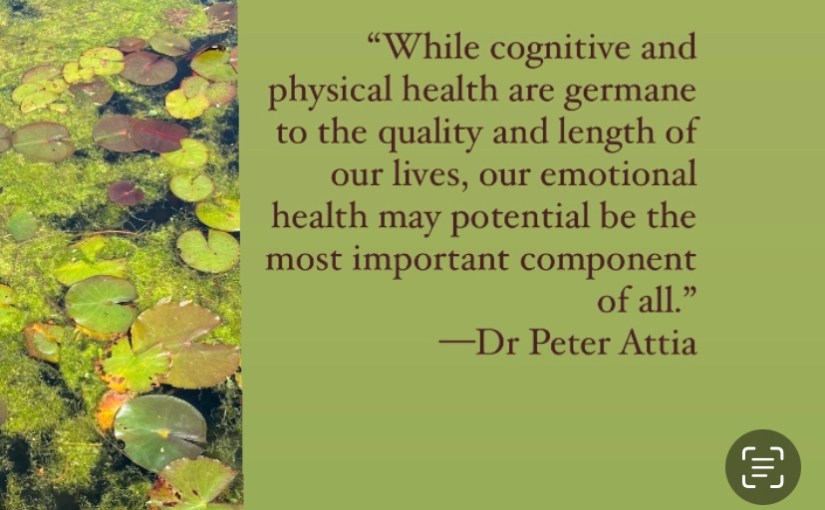
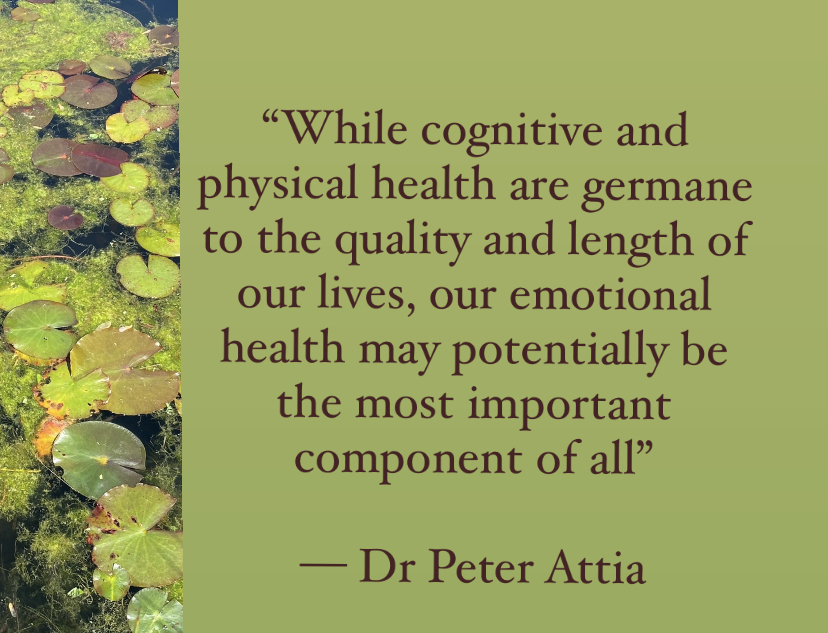
Dr. Peter Attia, host of the very popular podcast, The Drive, and author of “Outlive: The Science & Art of Longevity” emphasizes that while cognitive and physical health are germane to the quality and length of our lives, our emotional health may potentially be the most important component of all. “After all, what good is a long life if you are miserable?”

“Emotional health encompasses happiness, emotional resilience and distress tolerance, mindfulness, stillness and fulfillment, among others. It touches on our sense of individual purpose, as well as our ability to engage in meaningful and supportive relationships with those we love.” — From the Mental & Emotional Health Archives of Dr. Peter Attia (https://peterattiamd.com/category/mental-health/)

While listening to Dr. Attia discuss his new book Outlive with Dr. Andrew Huberman, I found myself completely captivated by the last 48 minutes of that podcast conversation. What he shared so openly about his own emotional health journey fit like a puzzle piece into my recent series of blog posts about the negative impacts of old parenting models. His personal story is so relatable on many levels – and proof positive that it behooves us all to take our emotional health as seriously as our exercise, nutrition and sleep.

From the outside, most of us would just assume that Dr. Peter Attia was living a happy, successful life. A Stanford/John Hopkins/NIH trained physical, he has built a thriving medical career focusing on the applied science of longevity. He has won prestigious awards, was the first person to make the round trip swim from Maui and Lanai, and has a huge following for his extremely popular podcast about longevity. He’s married and has three kids. Sure seems like he checked all the boxes for a good life.

Yet he shared both in his book and in the Huberman Lab podcast that he was driven to be a perfectionist and his inner critic was harsh and unrelenting. He also admits to becoming very skilled at drywall because he was prone to break a lot of things — both when he was younger and into his adult life. It took not one, but two, rock bottom moments in recent years to motivate him to get serious about his emotional health. The root causes of his core emotional issues were in his childhood — unprocessed trauma, lack of emotional language and lack of skillful emotional regulation.

Boom – there it is — the inescapable fact that what has happened in our childhood gets carried right into adulthood — and even when we work hard to build a successful life and check all the boxes, we still can get tripped up by our own unconscious obstacles.

In my recent blog post “Learning What We Need to Teach”, I shared that Dr. Dan Siegel recommends going back and examining our childhood so we can understand our relationship attachment style, how our parents influenced our development and how we made sense of what happened to us.

While Dr. Siegel readily acknowledges that most people are very resistant to revisiting a painful or dysfunctional childhood, it is a clear path to addressing the behavioral patterns and limiting beliefs that become our unconscious obstacles. Dr. Attia would likely frame this examination of our childhood an early intervention for our adult emotional health — and that framework comes from his personal experience and his scientific approach to longevity.

It was just a few years ago, as that second “rock bottom” was hitting hard for him, that Dr. Peter Attia’s good friend pulled him aside and told him he really needed this intervention. His good friend knew firsthand why unpacking family dysfunction and childhood trauma is of paramount importance for a good life. He is none other than Dr. Paul Conti, also a Stanford/Harvard grad, who is a psychiatrist and author of Trauma: The Invisible Epidemic; How Trauma Works and How We Can Heal From It.

The synchronicity of Dr. Paul Conti being a psychiatrist whose focus is on healing trauma and Dr. Attia being a medical doctor whose focus is on longevity and quality of life is not lost me. I have been witnessing the emerging integration of multiple disciplines and modalities for several years. So many significant neuroscience breakthroughs are deeply connected to the mind/body connection; the very integration of emotions with the lower and upper parts of developing brains for which Dr. Dan Siegel advocates the whole brain parenting approach.

We got emotions wrong for generations. Full stop. Emotions are the very first part of our human programming that needs to be installed. Emotions are how we learn to care for, and meet the needs of a precious baby. It is second nature for us to respond appropriately to an infant’s cries or their engaging laughter. How could we have been so blind to the obvious? The old parenting models actually had us overriding the most integral software component of being a human being. This is precisely why we have so many interpersonal difficulties, why our inner critic is so debilitating, and why we perpetuate problems from one generation to the next.

Peter Attia took Paul Conti’s sage advice. He did a deep-dive into this healing work in a 3 week program in Arizona, where he discovered a lot about his childhood that provided answers and insights. He learned tools and practices to help him pivot to the healthy end of his emotional health spectrum.

I was not at all surprised to learn that Dr. Attia was able to go back and look at blocked memories from childhood through the lens of an adult, who is now a parent himself, and discover deep compassion for a little boy who had no way of processing what he was experiencing; a little boy who strived to be “perfect” in order to feel safe and loved. His inner critic who was so hard on him when he missed the mark of “perfection” was parental message playing over and over….for 5 decades of his life.

This transformational experience was an enormous pivot for Dr. Peter Attia. He came to fully comprehend that all the work he was doing to help people live longer, without disease, chronic or major health issues, to ensure they stayed physically active and cognitively healthy was missing one compelling component — emotional health. In his mind, there could be nothing worse than living a very long life and being miserable, discontent and emotionally disregulated throughout it all.

As I listened to Dr. Attia convey all of this to his longtime friend and colleague, Dr. Andrew Huberman, I thought about a very familiar story that really brings this message home — Scrooge in the Christmas Carol. Past, present, future. See how our past influences our present….and where our present blindspots predict our future. We have instinctively known this for generations.

As he was going through what he calls his “rehab and recovery”, Dr. Attia was also deeply entrenched in writing his book, Outlive. There was no way he could not include his profound discovery about emotional health and it’s direct impacts on the quality of our lives — and although his editors and publisher thought it belonged in a separate book, he strongly disagreed. Integration of emotional health was essential to the pillars of longevity and quality of life.

This is so profoundly important, I am going to share it again:

Integration of emotional health is essential for our longevity, physical and cognitive health and the overall quality of our life.

Dr. Attia likes to create a dashboard for his patients as part of his comprehensive approach to mitigating health problems in the future. Not only does he seek to improve the length of their lifespan, he also wants to increase the length of their “healthspan” and shorten the length of “diseasespan.” He acknowledges that we have many ways to predict future possible health consequences by taking into account family history, genetics and using the wide array of medical tools (blood work, MRI’s, bone density, colonoscopy, mammograms, EKG, etc). There are many tools available for pre-screeening and preventive actions for our physical health; and a plethora of ways to measure and mitigate risk.

The same cannot be said for emotional health. There are no clearly defined ways of measuring it. As Dr. Andrew Huberman acknowledged, measuring emotional health is tricky — and language is our dissection tool. If we have a very limited emotional vocabulary and equally limited understanding of our inner emotional world, it would be like trying to do a biopsy with a blindfold on.

Not having a concise way to measure emotional health does not preclude Dr. Attia from adding it to the longevity dashboard for his patients however. He firmly believes that like cognitive and physical health issues, intervening early is key.

Can you imagine the positive and transforming impacts that are on the horizon for our mental health crises if there is a major pivot to include emotional health in comprehensive medical care? And it doesn’t stop there — we have growing evidence that stress and anxiety, unprocessed trauma, dysfunctional environments as well as generational trauma and addictions (epigenetics) contribute significantly to our physical health. Could it be that early intervention on our emotional health be the gateway to solving some of our most perplexing medical issues, including cancer, ALS, dementia and more. I firmly believe that it will.

For the record, Dr. Andrew Huberman was recently a guest on The Drive (Dr. Peter Attia’s podcast) and in that episode, Andrew really opened up about his own childhood, his parent’s contentious divorce and the debilitating impacts that it had on him for a great part of his adult life.

The candor and vulnerability that both of these dynamic, successful young men shared on each other’s podcasts is proof positive that we are witnessing a game-changing breakthrough that is long overdue. The skeletons are coming out of the closets! No more sweeping emotional health under the carpet.

Dr. Attia did not hesitate to point out that the top priority on his personal longevity dashboard is emotional health. He shared that “it is the easiest to get out of balance, the hardest to manage and the one that creates the most pain in his life.

When Dr. Andrew Huberman pressed his friend for a definition of emotional health, Peter told him that it’s hard to specifically define it, and perhaps more relevant to recognize the components that make up strong, positive emotional health. The following is excerpted from his conversation in the HubermanLab podcast:

Connectivity with others just seems to be an inescapable part of this (emotional health), so the ability to maintain healthy relationships and attachments to others; having a sense of purpose; being able to regulate your emotions; experiencing fulfillment; experiencing satisfaction — all of these things matter. And, if we take an honest appraisal of ourselves, we will notice that we have deficits is these areas.”

Being “present” — which may have been less of an issue a hundred years ago than it is today — Being present is very difficult; thoughts about the future, not being satisfied with what is happening in the moment. I have to work hard to overcome those things. When you are present, you generally are in a much better frame of mind.” –Dr. Peter Attia

Connecting the Dots:

When Brene Brown began her research on shame and vulnerability back in 2001, she was an instrumental part of the necessary paleontologist team to excavate our human emotions. There were so many fossilized clues embedded in the stratifications of unprocessed emotions and traumas passed from one generation to the next over centuries.

When Dr. Bruce Perry published his book Born for Love in 2010, he unearthed what happens to infants whose basic needs and emotional pleas are not addressed in calm, loving and supportive ways. He was helping us grasp that there was a serious problem and he sounded an alarm for our growing empathy poverty. It was even more than a disconnect from our shared humanity and empathy – it was a snowball rolling down the hill toward our individual and collective declining emotional health — because we were not fully installing our basic emotional programming.

Also in 2010, Dr. Dan Siegel introduce us to his developing concept of “mindsight”- the newest science of personal transformation made possible through integration of the various parts of brain and mind/body connection. For more than a decade, Dr. Siegel continues to expand on his research and has introduced the most profound contemporary parenting model – The Whole Brain Child. Dr. Siegel is leading the charge for this dynamic pivot that “integrates” our fundamental emotional GPS system with all the parts of a child’s brain, slowly over time, as the child’s brain develops along with their physical bodies. Future generations who are nurtured with a whole brain parenting approach will most certainly be more “emotionally healthy” as adults and in turn, more physical and cognitively healthy as well.

This single pivot will have dramatic and positive impacts on our epigenetics and has the potential to stop generational cycles of inherited health issues, addictions, trauma and dysfunction in its tracks.

Stealing a line from Hamilton – “Look around. Look around at how lucky we are to be alive right now.”

We can all be participating in this evolutionary pivot. We start by attending to our own emotional health and then we teach and model this integration for younger generations – for our children, grandchildren and our grandchildren’s babies.

Take advantage of all the resources that are integrating and cross-pollinating to help us live longer, live healthier both physically and cognitively — and most importantly to live a well-balanced, emotionally well-regulated, purpose-filled, satisfying, deeply rewarding life.

Recommended Resources:

Outlive – a well founded, strategic and tactical approach to extending lifespan while also improving our physical, cognitive and emotional health. Learn why ignoring emotional health could be the ultimate curse of all.

“I can say with certainty that this man saved my life. He. made life worth living. But most importantly, he empowered me to find and reclaim myself again.” Lady Gaga.

Do the work to heal yourself and find a path through trauma. Trauma is everywhere and so many of us are silently affected by it.
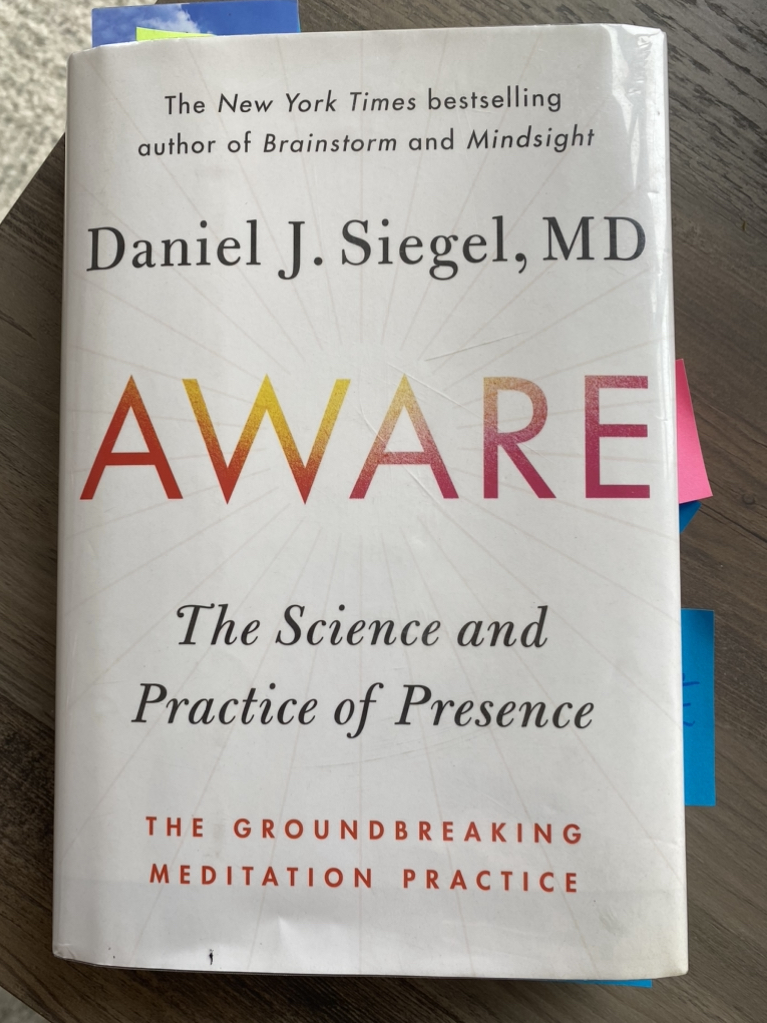
Practical instruction for mastering the “Wheel of Awareness”, a life-changing tool for cultivating more focus, presence and peace in one’s day to day life

March 20 Episode with Dr. Peter Attia: Improve Vitality, Emotional & Physical Health and Lifespan (Fast forward to the last 48 minutes of the podcast if you want to hear Dr. Peter Attia share his personal experiences with emotional health intervention and recovery) https://www.youtube.com/watch?v=ufsIA5NARIo&t=15s

Turning Personal Growth on Its Head..

From Iceberg to Mountain Range

When Brene Brown launched her newest book, Atlas of the Heart, she offered this beautiful, profound insight:

For me, this quote captures exactly what my personal growth and self discovery journey feels like. I had no idea where I was going when I started. Seven years ago, I was leaning pretty hard on the quote “all who wander are not lost” which makes me laugh out loud…because I was indeed “lost”. I used a lot of maps to find my way – and I still do. Some of those maps are weathered and worn, some are pristine and folded neatly into a well scored rectangle, some are digital and some have ink so fresh it washes over the paper like a watercolor.

Initially I wanted the “how to” maps. I scoured the self help sections of libraries, bookstores and the internet. Over time I came to realize the most transformational way to go about self discovery and personal growth is to approach it more like looking for clues on a hidden treasure map and being open to discovery.

If I were to break out a gigantic three-feet long piece of butcher block paper, I could whimsically draw with chunky crayons what that treasure map looked and felt like for me. There would be volcanos, broken bridges, tornados and swampland…and a few fairies, leprechauns, trampolines and bungee cords, rays of warm yellow sunshine and a deep reflecting pool. I’d add in some glittery neon-bright fireworks to spotlight my “aha” moments.

It is only with the clarity of my “hindsight googles” that I can now truly appreciate all the trash and treasures I discovered on my ongoing personal growth adventure. My experiences are much like the one my grandkids have with one of those “shine a light” flashlight books where the hidden pictures are revealed when a focused beam of illumination hits them.

It occurs to me that so often when we talk about personal growth and self-discovery, the emphasis is on how hard it is. The images of peeling off the layers of our emotional onion, dumpster diving into the baggage we’ve accumulated and breaking old habits seem more like punishment than an appealing invitation to become a better version of ourselves.

Rarely do we hear the upside of embarking on the personal growth journey, at least not in tangible, realistic ways. We hear all those fluffy, gauzy accolades about finding our “authentic” self but it all seems as fleeting and surreal as dressing up in a costume and pretending to be Cinderella or Spiderman. Looks good…but what does it really “feel” like?

The greatest gift of personal growth work is how freeing and empowering it feels — once you get to one of the pinnacles in the process. That becomes the motivation to reach the next pinnacle. Each one creates more space for what we really want in our lives. We often are completely unaware of just how much we get in our way, until we start looking at our patterns and blind spots. As we lighten the load, the journey becomes a lot more engaging in a very positive way.

One of the most insightful moments in any self-discovery journey is when we realize just how far we’ve come. This is a big boost to our motivation to keep going — when we look back and recognize that we have actually made a lot of forward progress; that we are showing up in improved ways in old familiar circumstances.

Recently I was re-taking a self-assessment test with a friend of mine and expressed to her that I would have answered the questions much differently a few years ago than I do today. The same was true for my friend and she expressed her gratitude that over the past several years, I have often reminded her of all her forward progress. Both of us were well aware that we now move through our daily lives with greater ease, having discarded old patterns for better skills.

From my personal perspective, personal growth doesn’t have to be the “hard work” of a paleontologist digging through stratifications and fossilizations we’ve amassed for decades. We can turn this concept on its head and treat it as the fascinating adventure it truly is. What if we had a whole new, enlightened approach to how we enter and maintain personal growth and self-discovery?

Picture this: — we often use the image of an iceberg to help us understand all the baggage, beliefs, narratives and personal history we are dragging under the surface.

If we flip this image, we now have an impactful — and inviting — new way to look at personal growth, self-discovery and self-improvement.

This is a powerful transformational image….

We will get stronger physically, mentally and emotionally as we scale and explore; we will need a backpack full of supplies, resources, tools (and maps), it’s a great idea to have a buddy system for a host of awesome reasons (safety, shared experiences, a boost or tether, meaning and memory making). We will get fresh air, fresh perspectives and see the bigger picture.

We can re-write the guidebook for living our best lives. What if personal growth became a “call to adventure”. What if we “preloaded” all the resources and practices we really need to meet life in a skillful way?

The truth is that we are now spending an incredible amount of our time and energy undoing all the damage caused by old paradigms, old parenting models, old stereotypes, outdated methodologies and therapies – not to mention a complete lack of understanding about the value of emotions, empathy, and meaningful connection with others.

We have a growing mental health crisis, too many distractions for our attention, and a deficit of awareness (our own as well as “other” awareness). We keep throwing ideas and challenges at the problems. The big PIVOT is to look at the root causes.

All throughout my exploration of a wide variety of resources and modalities for my own personal growth, there was one common thread.

Regardless of the resource, the compass always pointed back to childhood: childhood narratives about who we are, behavioral patterns and protective armor we developed in childhood, our childhood attachment styles, our beliefs and how we make meaning from our emotions and experiences. There is a lot to unpack from our childhood BEFORE we can even begin a successful and meaningful adult life journey.

Once I discovered this overarching theme, it dawned on me that we can do better. Our children are sponges for learning — and we can equip them for life in transformational ways by “resourcing” them in powerful new, healthier ways.

Neuroscience, psychology, neurobiology and epigenetics are all converging in astonishing ways to shine a light on so much of what we did not understand, or got wrong, and can do better.

In upcoming blog posts, I will be unpacking what we are learning about the old childhood framework that did not provide healthy scaffolding for life. Together we can learn about the importance of secure attachment styles, how a child’s brain develops and how adult brains can be rewired, teaching emotional literacy and healthy coping skills, how we can keep our brains “updated and upgraded” thanks to neuroplasticity, and the importance of integrating our nervous system with our executive functions.

In just one generation, we can break cycles of dysfunction, addiction, insecurity and inauthenticity. At this very moment in time, we have more substantive research, more accurate knowledge, and unbelievable access to meaningful resources than ever before. Significant changes in what were ground-breaking, Nobel prize-winning discoveries 15 or 30 years ago are happening at a very rapid pace. Children are learning faster and differently than they did when we were kids. Even us adults are learning faster and differently in some arenas than we ever have before.

When I began my personal growth journey in my early 60’s, I did not realize that it would lead me to children – and I am ecstatic that it did. So many of us enter parenthood with hopes and dreams of giving our kids a good life, possibly a better one that we had. With all the new research, enriched skill sets and tools we now have, we can equip our children for life as smartly as we equip them for their favorite hobbies and sports; have you noticed that we now put helmets on those little developing brains for good reason?

RECOMMENDED RESOURCES:
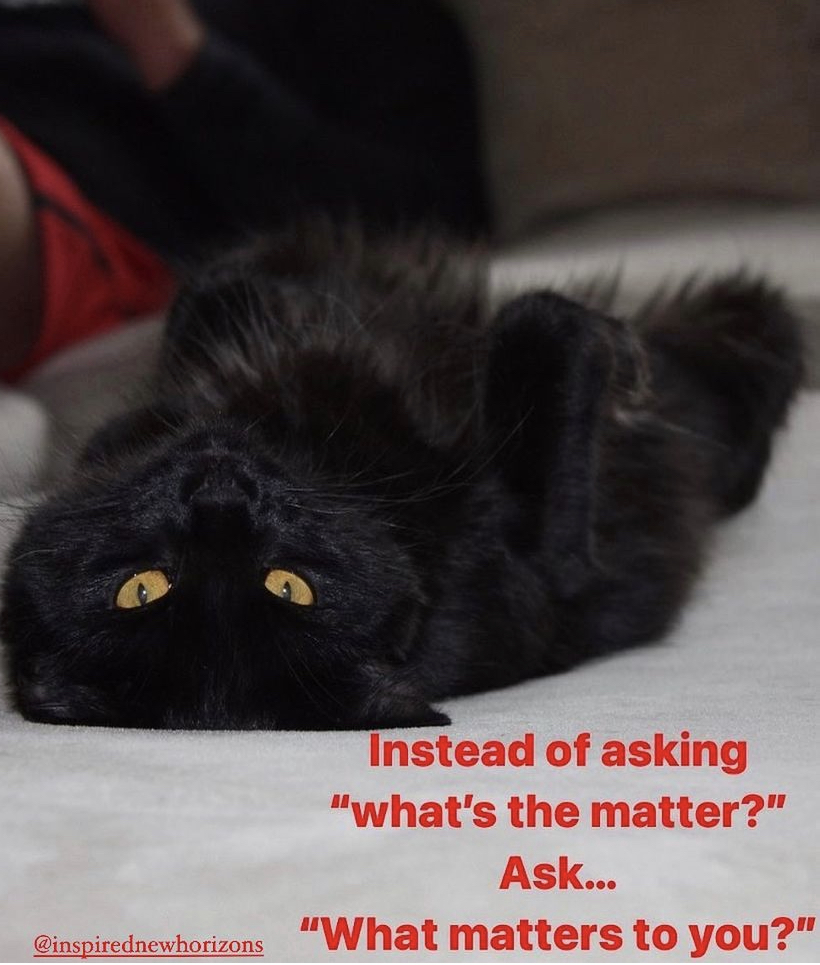
BEING WELL PODCAST: Listen to this relatable AND mind-expanding conversation with Dr. Rick Hanson and his son, Forrest, on the Keys to a Great Relationship. Rick has a brand new book out as well that offers fresh perspectives on his many decades of counseling and his own personal growth work.

https://www.rickhanson.net/being-well-podcast-the-keys-to-a-great-relationship/

Learn 50 simple practices for solving conflict, building connection and fostering love.. Read Dr. Rick Hanson’s newest book – Making Great Relationships.

The Missing Piece of the Personal Growth Puzzle

There are more than a few entry points for personal growth and just as many reasons why we get motivated to make some changes. Often the motivation comes from a painful experience or major adversity. But what if we could take an entirely different approach to personal growth? What if we reframed it as a part of the natural maturing process as we move through life?

Many of us begin our personal growth journey exploring the self-help section of the bookstore or library, discovering a podcast, participating in a support group, or seeking professional counseling. There is a tendency to keep our efforts under wraps even when we learn that many people struggle with the same issues we do.

In many instances, our personal growth work is cobbled together in a haphazard way. We migrate to teachings or tools that resonate with us. We are drawn to those whose stories are relatable and we strive to overcome our adversities just as they did. Our progress is often slow and some days it is hard to tell if we are actually making headway.

We hear that personal growth work is hard. It is.

We hear that personal growth work is worth it. It is.

Perhaps what has been missing in the personal growth field is a piece of the puzzle that would shift both the process and our motivation in a transformational way. The fundamental missing piece is neuroscience — discovering how our brains are working from childhood into adulthood.

Understanding the role our brains are playing as we navigate adulthood can become the catalyst for proactive personal growth work, enriching our wellbeing and improving the quality of our relationships. It would no longer be necessary to hide the fact that we need a little help to support our natural evolution. In fact, if we reframed personal growth as a foundational building block like exercise and nutrition, we would have a brand-new approachable and desirable entry point for investing in ourselves.

Think about this: Our brain is one of the most phenomenal devices we possess. Yet we know very little about all its capabilities and even less about how to care for and support its optimization. We take it for granted – yet it faithfully serves us through every single experience we have every day for our entire lifetime.

What if we changed our perspective about caring for and utilizing our brain’s full potential? What if we recognized the value of “upgrading” our internal operating systems as we go through life, building on what we have learned from our past experiences and proactively engaging in creating new neural pathways to meet our ever-changing goals.

Let’s see how that might be an optimum pathway for personal growth work by taking a closer look at a subject often discussed when we embark on self-help: how our childhood behavioral patterns and attachment styles often do not serve us well in adulthood.

In a February 2022 episode of the Huberman Lab Podcast, neurobiologist Andrew Huberman explained in great detail how our childhood attachment styles influence our adult attachment styles.

“How we attached, or did not attach, to our primary caregivers in our childhood has much to do with how we attach or fail to attach to romantic partners as adults because the same neural circuits (the neurons and their connections in the brain and body) that underlie attachment between infant and caregiver, between toddler and parent or other caregiver entering adolescence and in our teenager years are repurposed for adult romantic attachments. I know that might be a little eery to think about but indeed that is true.” Andrew Huberman, The Huberman Lab Podcast (2/14/2022)

Dr. Huberman’s insights here are astounding. Our brains “repurpose” attachment styles we developed as kids to help us create our attachment styles with our life partners. It doesn’t take a big stretch of one’s imagination to see how our repurposed adult attachment styles would also impact our friendships, relationships with co-workers and parenting.

The fortunate thing is that regardless of our childhood attachment styles and experiences, the neural circuits for desire, love and attachment are quite plastic — they are amenable to change in response to both what we think and what we feel, as well as what we do. However, all three aspects being discussed today desire, love and attachment — are also strongly biologically driven. (hormones, neurochemicals like dopamine, oxytocin, serotonin) and neural circuits (brain areas and areas of the body that interact with the brain). Andrew Huberman, The Huberman Lab Podcast (2/14/2022)

Dr. Huberman then delivers the “good news” about this phenomenon of “repurposing”. The neuroplasticity of our incredible brains opens up the vast potential to support this “repurposing” in a healthy, proactive, beneficial way. We can engage in this process in a very meaningful – and game-changing way.

We would be able to circumvent some of those awkward, cumbersome forays into adult relationships because we would have greater awareness and access to better tools. Regardless of the stability or chaotic nature of our childhoods, we need to be involved in this repurposing process. It is where we tap into our true nature and free ourselves from old narratives and limiting beliefs.

Imagine entering adulthood without constrictive adaptive childhood behavioral patterns. We all have them, regardless of our childhood experiences (even really good childhoods). Adaptive childhood behavioral patterns are how we made sense of our world as kids. Baked into those behavioral patterns are the armor we used to feel safe, the behaviors we relied on to get attention and feel loved, valued. These childhood behavioral patterns are inextricably linked to our childhood attachment styles.

I’ve written several posts on parenting and on the benefits of breaking generational chains of dysfunctional family patterns. Even when we are well intentioned about wanting to “do better” as parents for our own children, it is only natural that unconscious, residual adaptive patterns will seep into our own parenting. Our default childhood brain and body settings will make our best efforts more challenging than need be.

Dr. Dan Siegel, Clinical Professor of Psychiatry at UCLA, is a renowned resource for parents who desire to create and maintain secure attachments with their children. He emphasizes how important it is for parents to identify their own childhood attachment style first and foremost. He encourages parents to do their own healing and personal growth work as a fundamental part of parenting their own children with healthy, secure attachment styles.

Neuroscience has been exploding with game-changing breakthroughs for mental health, for personal growth, for the brain challenges that come with aging such as dementia and Alzheimer’s. Brain imaging is helping all of us see more clearly all the changes that our brains are subjected to — and are capable of. We have both an invested interest and a dynamic opportunity to actively participate in helping our brains stay healthy, stay upgraded and function with greater ease.

Maybe personal growth will become the new brain health. The more we know, the more we can participate in our healthy growth and evolution.

RECOMMENDED RESOURCES:

Dr. Dan Siegel YouTube Discussion:

The 4 S’s of Attachment-Based Parenting

https://www.youtube.com/watch?v=7zV2nLEeh0c&t=2780s

The Science of Love, Desire and Attachment
February 14, 2022
https://podcasts.apple.com/us/podcast/huberman-lab/id1545953110