Architects of our Experiences – Part 2

Are you fascinated by this new concept where we can actually become “architects of our emotions and experiences”? This new approach is much more “hands on” when it comes to navigating life and sets us up for greater success to meet its ever-changing challenges and opportunities. 

This is the 2nd in a three part series on becoming skillful architects of our experiences. Today we are going to learn about a multi-purpose diagnostic tool we can put into our architectural briefcase.  But before we dive into learning what this dynamic tool is and how to use it, let’s do a quick review of the basic foundational tool from part 1 — our body budget.

In my last post, I shared how our body budget significantly impacts how we experience life. When we are well resourced, things go more smoothly for us. When we are running on empty, we create a lot of emotional turbulence. Surely, this was both eye-opening and pretty obvious.

When we are getting consistent deep sleep, eating nutritious food, staying hydrated and getting regular exercise, our brains determine that we are “fuel efficient”. We have the necessary internal resources to meet the moments in our lives with clear heads and the ability to be emotionally balanced. All we really need to do is pay attention to our brains and bodies just like we do the battery charges and wifi connections on our phones.

Author Ryan Holiday recently shared the HALT acronym to help us remember that our first line of defense when it comes to dealing with emotional turbulence is to assess our human “check engine” lights. 

HALT stands for Hungry, Angry, Lonely or Tired. HALT is a simple and very effective tool to remind us that these four common conditions can derail our best efforts to stay in alignment with our values. When we are feeling emotional turbulence, a quick check in on our body budget can prevent us from getting in our own way.

For the record, this is also a great tool to share with children. When kids are acting out, we can pause to think about when they last ate, if they had a disrupted night of sleep or skipped a nap, or if they have been buzzing from one activity to the next without some quiet time or a brain break. Before we overreact to an unacceptable behavior, we can think about their “body budget” first and foremost. When we teach our kids to check in with themselves, we are equipping them with a foundational tool they can use for a lifetime. 

Now let’s add a versatile new tool to our architectural briefcase.  The multi-purpose tool that is a “must have” for skillful architects of experience is emotional granularity.  This term may seem a little foreign but it’s easier to grasp if we think of emotional granularity the same way we think about the fine-grained distinctions in wood, textiles and even sandpaper.

The reason that emotional granularity has such a strong impact on our emotional experiences is because the true essence of our experience is in the details. That’s right, details matter. 

We mistakenly believe that there is uniformity in common basic emotion such as happy, sad or mad. Nothing could be further from the truth — variation is the norm; not uniformity. 

Bear with me here for a minute — and think about your own varied experiences of mad. You can be mad at yourself, mad at a circumstance, mad at another. You might be really mad about running late one day and not care at all the next. Sometimes your body budget is in deficit and you get mad a lot during the course of a day; other days, you are well resourced and unflappable. Do I see your heading nodding in agreement that “variation is the norm?”

If we limit ourselves to the three most commonly identified emotions – happy, sad or mad, we also limit our deeper understanding of what we are really feeling in the moment. When we can tease apart the details that accompany happy, sad or mad — that is when we get to the heart of the matter. This is the gift of emotional granularity – the finely tailored emotions that best reveal the heart of our experience.

Emotional granularity is an exploratory multi-purpose tool. It’s actually easier to use than we might think. We just need more practice and a bigger emotional vocabulary.  

Start with why. Why are you mad? 

Is it because you are frustrated, anxious and annoyed? Now, dig a little deeper to get to the fine grains of greater detail. Are you frustrated that something you are attempting to accomplish is taking longer than expected? Are you anxious because it is the third time this week you tried to finish a project? Are you annoyed that others aren’t respecting your need for uninterrupted time to focus? 

Emotional granularity brings out the relevant details — in the accompanying emotions and the backstory of each.

The more finely-grained distinctions we can make, the more accurately we can parse what matters most, or recognize that there are multiple layers to one core issue. We may even be surprised to discover that we have competing emotions – and both are true. We can be happy for someone else and feel sad for ourselves; that’s paradox.

Emotional granularity moves us in the right direction for self awareness and effective problem solving with more clarity than we could ever access if we stop at “mad”. 

The reason emotional granularity is a dynamic multi-purpose tool is that it helps us accurately express our feelings and experiences — AND it makes it easier for others to support us in constructive, beneficial ways.

We often hear that emotional intelligence is a key component for building a good life and meaningful relationships. Emotional intelligence is defined as our capacity to be aware of and control our emotions; and to handle interpersonal relationships with empathy and non-judgment.  

Dr. Lisa Feldman Barrett emphasizes that the most invaluable asset for cultivating emotional intelligence is emotional granularity. The more finely tuned we can get about our emotions and experiences, the easier it is to regulate them and reframe our experiences. 

Not only does this support our efforts in achieving better emotional clarity and regulation in real time, it actually updates our internal database for the future. Remember that our brains are prediction machines. When we are able to reframe and reorganize our internal database by being more skillful with our emotional responses, we will vastly improve the accuracy of our future predictions. 

Yet another reason why emotional granularity is a dynamic, multi-purpose tool. It is a fast-tracked process of freeing us from old emotional triggers and outdated information from decades old past experiences. The better we get at using emotional granularity and becoming skillful architects of our experiences, the more traction we will have in building better habits and mature response patterns.

Emotional granularity helps us to level up. We get to know ourselves better through greater self-awareness. We become more skillful at unpacking multiple emotions that are interlaced with our current experiences. With this improved awareness and clarity, we don’t drain our body budget so quickly. We have greater access to self-compassion which turns on our parasympathetic nervous system which also positively supports our body budget. We get better at emotional regulation and it becomes easier to clearly express to others what we are experiencing and what we actually need in the moment. Not to mention the added bonus of automatically updating our brain’s complex interactive systems with invaluable, current and relevant data for future reference.

Have some fun with this new tool – explore the many emotions that you feel whenever you get that initial hit of a core emotion like mad, sad or happy. Become curious when you are with others when they are sad, mad or happy and ask questions to better understand all that they are feeling in the moment. Compare your findings with your friends and family. This is how we help ourselves and others super boost their emotional intelligence and become more skillful architects of their own experiences.

Quote from Dr. Lisa Feldman Barrett, author of How Emotions Are Made

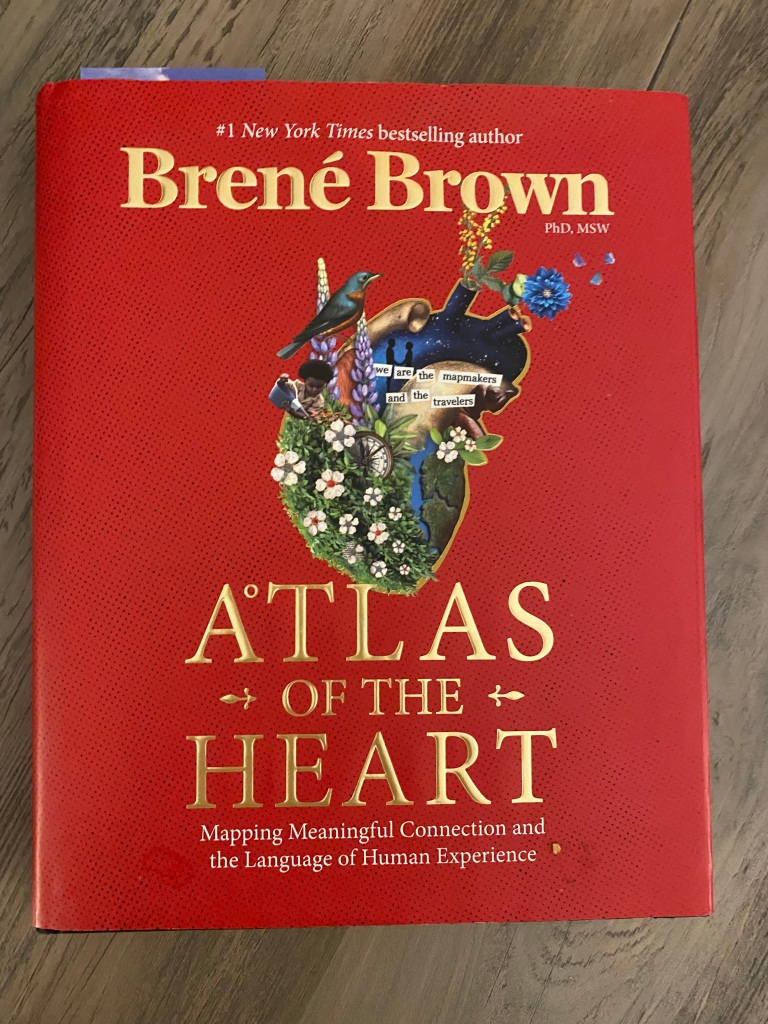
To help you expand your emotional vocabulary, read Brene Brown’s most recent book, Atlas of the Heart. Brene offers relatable stories and detailed definitions for 87 of our common emotions and experiences. Better yet, she has organized this invaluable resource by highlighting how we typically feel under certain circumstances. The chapters invite us step into “the places we go when….” When we compare, feel uncertain, when we are hurting or fall short.
Check out Dr. Marc Brackett’s newest app How We Feel. Dr. Brackett is the Director of the Yale Center for Emotional Intelligence and author of Permission to Feel. There are over 200 emotions to explore in the How We Feel app!

Click this link to go to the website https://howwefeel.org and learn more about the app and how you can use it to help you build your emotional awareness and vocabulary in real time.
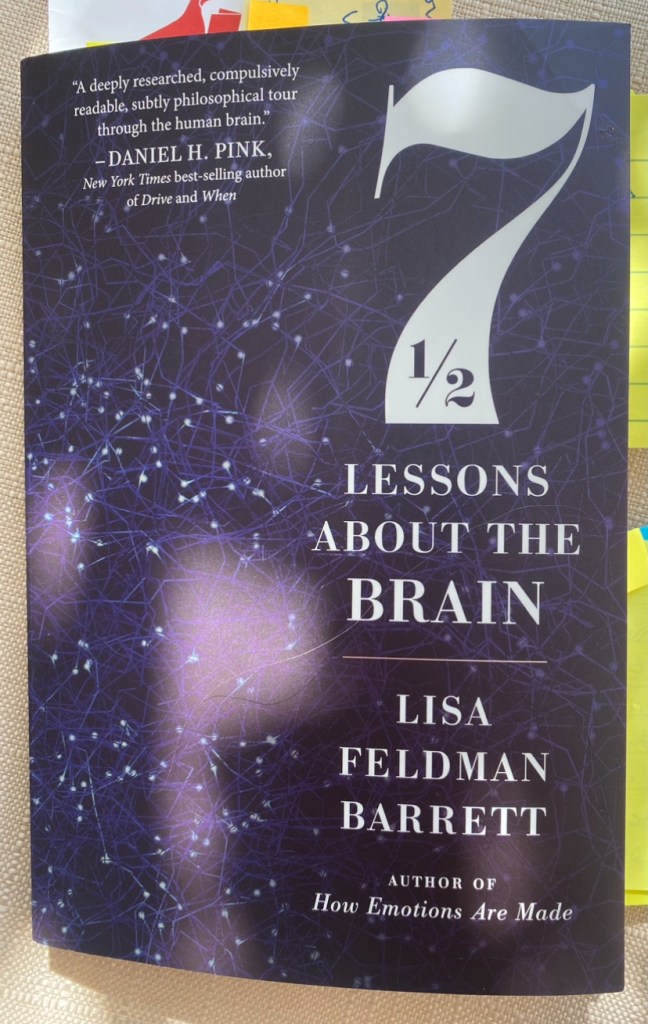
This quick, relatable read will stimulate your appetite to learn more about becoming an Architect of Your Experiences. Awesome insights into how our brains and bodies actually work.
If you are fascinated by neuroscience and love a deep dive into science and psychology, then treat yourself to How Emotions are Made. This book and Brene Brown’s Atlas of the Heart are reference books for our home libraries – the kind we will return to again and again!

Daily Gummies of Wisdom – Year End Insights

For those of you who follow my blog regularly, you may recall that I created a new feature during 2023 — occasional blog posts that featured a short collection of my Daily Gummies of Wisdom — with some expanded thoughts and reflections.

My Daily Gummies are nourishing food for thought to jumpstart your day and are intended as meaningful supplement for emotional health, self-awareness and self discovery. I launched the Daily Gummies of Wisdom email program in the spring of this year with the hope that the insight I shared might really resonate with every day life situations we all encounter.  

The biggest surprise for me personally was hearing back from so many people all across the country who found the gummies to be worthwhile, thought-provoking, motivating and inspirational. Sometimes the Daily Gummy was printed and stuck on the refrigerator for the family to see; some were forwarded to a friend dealing with the very issue that the gummy addressed; some were incorporated into sermons, support group discussions or a counseling session. A few people have shared with me that reading the Daily Gummy is now an integral part of their regular morning routine. I was deeply touched and overjoyed by the stories I’ve heard about the impacts of my Daily Gummies of Wisdom. What a gift for me — to be learning from others how they digested, metabolized and incorporated the insights into their own experiences. 

What I am learning is that real life examples do a lot to help us integrate better skills and tools in our daily lives. What could be more beneficial than hearing a true story about showing up differently changed an old relationship dynamic, solved a parenting problem, empowered others to become more true to themselves? That’s what I will be sharing more of in 2024 — the exciting changes that occur when personal growth and self discovery are visibly in action in our daily lives.

To jumpstart 2024, here is a recent Daily Gummy of Wisdom and the backstory that inspired it:

This gummy about our personal power was shared on December 11, 2023. It was inspired by two fascinating podcast conversations that unpacked “power” in a whole new way.  We hear a lot about “power” and we often have a negative association with it, such as power over, strong arming another or “disempowering” someone.

But what if we reframed it and saw power as our engine of change; how we shift from being stuck to making improvements?

The first podcast conversation that reframed my thinking about power was with Esther Perel, the renowned couples therapist and best selling author. Esther is such a compassionate. empathic and skillful couples counselor. She has a bedside manner that would be the envy of any medical professional. She possesses a rare, surgical precision to extract a couple’s key issue and open them up to seeing the deeper, loving relationship that is possible for them. Her ability to pull this out without inflicting more pain while simultaneously guiding a couple to healing, healthy connection is astounding. In a single couples session, she can remove a long-standing impediment and shift a couple from fighting WITH each other to fighting together FOR their partnership. 

Esther offers a unique perspective on power by reframing a common relationship power dynamic – the kind where one partner is strongly supported in pursuing their goals and the other partner makes a lot of sacrifice to accommodate them. Esther reminds the “accommodator” that he or she actually has tremendous power in the relationship.  If the “accommodator” stopped offering support, picking up the slack or doing more to keep the home life balanced, the other person would likely struggle to meet their goals or pursue their dreams. 

This reframing shifts the power dynamic perspective for both partners. Suddenly the accommodator clearly sees his or her own value, impact and contributions in a meaningful light. And the one who is the benefactor of all these accommodations gains a healthy awareness of all that is being offered on a daily basis to pursue a long term goal.  Esther gives the accommodator the gift of seeing his or her “agency” and the benefactor the gift of “gratitude” for the other’s contributions and sacrifices. 

Charisse Cooke, author and attachment-based psychotherapist, recently offered this tool for accommodators who are growing resentful: “match the behavior”. If you are hyper-functioning, overdoing and overextending but not getting anything in return, dial back on the energy, effort and contributions you are making to match the behavior and responses of your partner. This is a great way to correct an imbalance in the relationship dynamic.

We can restore a healthy balance in the “give and take” of our relationships when we recognize how we often give away our power and then feel unappreciated and resentful. 

I learned even more about power from a recent Huberman Lab podcast featuring Robert Greene, author of six international bestsellers. 

Robert Greene believes there is too much negative focus given to power, when in fact it has remarkable positive benefits. He shares that exercising self control is a SuperPower – especially when we are able to skillfully regulate our emotions and respond to life with calmness, clarity and objectivity. 

We give away our power unintentionally when we have knee jerk emotional reactions. We are well aware of this — often instantly regretting that we displayed such an immature response in front of our kids, friends, family or publicly. In a split second, we acted out of character and embarrassed ourselves. 

Think about a time when you witnessed an adult having a childlike meltdown and you lost a little respect for that person or it tarnished the image you once held for that person. This is how we diminish our power. 

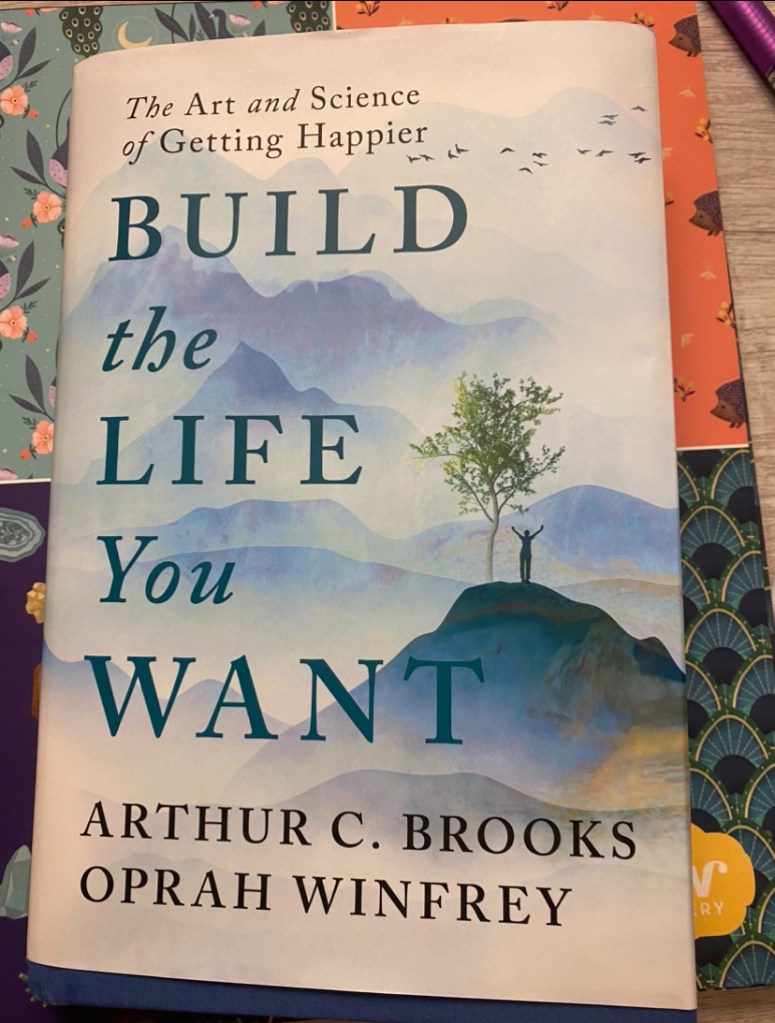
Arthur Brooks, happiness expert and another great author, recently revealed that our grandmothers gave us really good advice when they told us to “count to 10” when we were little and emotionally out of control. But now, we have science-based evidence that we really need to count to 30 – because that is how long it takes to move us from the limbic system in our brains to the pre-frontal cortex. In other words, the limbic system is where the strong emotional reactions come from — and using a 30 second pause moves us into our super-power of self-control and emotional regulation (the executive functions found in our pre-frontal cortex.)

Robert Greene urges us to not give away our personal power, but rather to own it as a super-power. Emotional self-control puts us in the driver’s seat and facilitates us showing up in life with our character, integrity and values intact. We actually have greater negotiation and strategy skills at our disposable when we show up cool, calm and collected.

FIND THE HUBERMAN LAB PODCAST on your favorite platform, including YouTube, and scroll through the episodes for the latest science on a topic that interests you.
FIND ESTHER PEREL’S PODCAST on your favorite platform — and listen in on counseling sessions to gain new insights on relationships

Nuggets of Wisdom – The Gifts of Awareness

I love those “aha moments” that show up in the midst of an ordinary day. Those “aha moments” grab our attention making us more aware of things we sometimes take for granted or are often too busy to notice. Catch an”aha moment” and put it in your pocket! Start a collection of “aha moments” and watch a little magic unfold in your daily life. This Nuggets of Wisdom in this post are about creating more “aha moments” by putting a little more awareness in each day — self-awareness, present moment awareness and other-awareness.

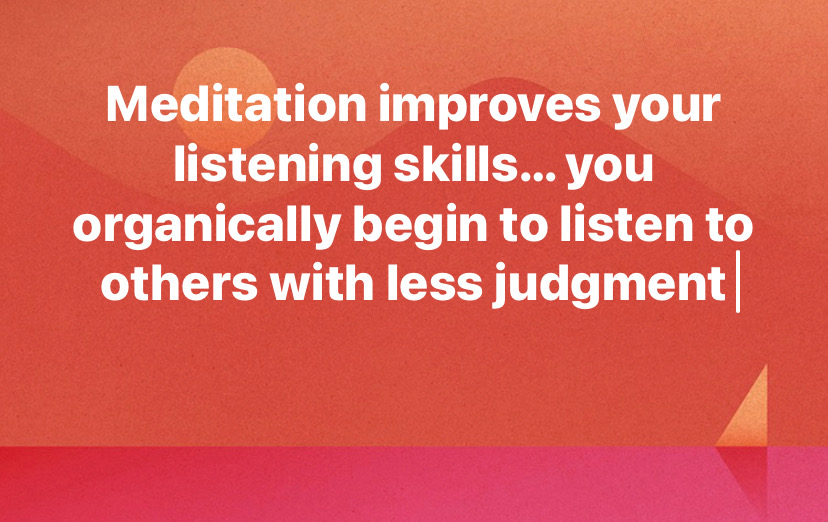
Meditation is one of those practices that begins to show up in your daily life in organic, meaningful ways. Take listening for example — when you meditate, you learn to be free from judging your own thoughts. You become more skilled at sifting out distracting thoughts. You become more attuned to listening to understand what you are truly feeling or experiencing.

When these skills sets begin to show up as you interact with others, you will smile knowing that you are taking your meditation practice from the “cushion to the real world.”

Improved communication and connection with others is a two way street — speaking AND listening. We can become better skilled at both! A skilled listener is non-judgmental and focused on understanding how another person is truly feeling.

Practice on yourself through meditation….then try it out IRL (in real life).

As we hone our skills to become more aware of our emotions, we might be surprised to discover that all too often we are giving those emotions much more control in the heat of the moment than we would prefer. It’s time to tell our emotions that they are always welcome, but they can’t do the driving.

During the course of a normal, busy, routine and occasionally chaotic day, we are going to experience a wide range of emotions. Sometimes when we are just being bombarded with too much to juggle, we inadvertently let our emotions run the show. Often it only makes a stressful situation worse.

Hit the reset button — take a deep, calming breath BEFORE you react/respond. That breath, that pause is often just enough to create awareness that it is your emotions taking over, not your integrity. And guess what? Your kids (and others) are watching…..and they’ll mimic your stealth skills if they see you doing this “reset” in times of stress, being calmer and more reasonable in your responses. That’s a win-win in the daily course of our busy lives.

In her newest book, Atlas of the Heart, Brene Brown dives deep into helping us understand how so many emotions can look similar — and all too often, we assume that we know exactly how someone else might be feeling. Then, we respond or react to others from that place — how those same emotions would feel to us. Is it any wonder that we can really make things confusing when this occurs? First of all, we are snagged on our own emotions and that will often pull our attention away from another person and inward on ourselves. Second, we may be putting the brakes on the emotions that another person is trying to process and understand.

Brene introduces a new concept for us to embrace — story stewardship. When we become trusted stewards of others’ stories, we listen with open hearts and open minds, without judgment and with an intention of getting to better understand what their personal experience and emotions truly are.

All of us have stories that are hidden under the tip of our iceberg. It would be impossible for others to know why certain things land so hard on our tender hearts. Not everyone needs to know, or can be expected to understand, these vulnerable parts of our story. It is healing for us to share our stories with someone who has earned the right to know the depths of our experiences. It is also helping others to gain bigger perspectives, to deepen their empathy and curiosity and to release habitual judgments when we have the courage to share our stories.

One of the greatest lessons to be learned from Brene when someone trusts us enough to share their stories, is to ask the question “What does support look like to you right now?” Ask that question and wait for the answer….take it in and really listen to what someone needs. Too often, we are so uncomfortable when others are hurting we rush to fix, to distract or even turn away. Meaningful story stewardship means holding space (even when we are uncomfortable) and asking others what they need.

We sometimes fail to see, or forget about, the best parts of ourselves. When we look in the mirror, we see reflected back whatever our inner critic or racing thoughts deem appropriate to share with us. If you have a trusted friend, a caring parter or a supportive parent who reminds you of your goodness, your grit and your unique gifts, then you are truly blessed. Those people are your best mirrors — the best sources of encouragement when life gets bumpy.

It is not surprising that we often bring the best versions of ourselves to the outside world — to our workplace, our community endeavors, even to strangers in the check out line. Yet we find it more challenging to tap into those attributes with the people we know the best — and often the ones we love the most. If you have a trust buddy that reminds you of this, thank them. If you have someone who has your best interests at heart and holds you accountable to the better version of yourself, you have a committed teammate in life.

We get to be these mirrors for others all throughout life. When you spend time on your own self-discovery, you often enhance your abilities to see the strengths and gifts that others possess too. Speak up — tell others all the goodness you see. The way they make you laugh, how generous they are, how resourceful they are, how they stand up for others…..there are so many ways that each of contribute our unique gifts to the world. Sometimes we all just need a really good mirror!

When the Students Become Teachers

I’m pulling a thread from my last blog post about “evolving” and how I witness personal growth blossoming from one generation to the next. My inspiration comes from my daughter and the book she recently gave me entitled Inward by Yung Pueblo as well as the most endearing “present moment” comments from my 3 year old grandson.

My 3 year old grandson, Tank, was in his happy place — a dirt filled construction site with a small mountain of freshly turned soil, a Tonka dump truck and a bright yellow excavator assessing the big job. I overhead his conversation to himself. “You can do this Tank. You’ve got this.” I turned to my daughter who was nearby and said “wow, that is great self-talk.” At that point he looked at me and said — “I am just telling my brain, Gigi.” Out of the mouth of babes, right? It seems so natural and so easy — assess a challenge and feed your brain the positive messages to tackle it.

One day he was playing in the same construction sight, his little leg outstretched in the cool dirt. He was busy digging away, filling a truck with soil, when he looked at me and said “I love the warm sun on my skin, Gigi.” “You know, buddy, that is one of my favorite feelings too,” I replied. That moment really touched my heart since I often share my little present moment delights with him — the happy chatter of the birds, a welcome cool breeze on a hot afternoon, the rich colors of the sky at sunset. Perhaps I have nurtured his awareness of his own little present moment treats. I hope so, because it is the moments when we are not distracted but fully steeped in the experience that enrich our memories. Children seem to learn so much by osmosis — which is really just observing us and where we focus our attention.

My daughter discovered Yung Pueblo a few months ago and read his book Inward while she and her family were on the road for a few months. When we reunited recently, she handed me her copy of the book saying I think you might like this, mom. She was right — I loved it. Yung Pueblo offers wisdom that comes from his own personal growth journey, his activism and life experiences. You’d think he was my age but this remarkable inspirationalist is only 32 years old! For young people like my daughter, he is relatable — and he leads by example. I am so delighted that she has found her very own resource for inspiration and learning. Here are just a few of his insights shared on his Twitter account in recent weeks:

Maturity is realizing there is a big difference between what you think you want and what you actually want. Your cravings can twist your mind and make elaborate fantasies that seem good but in real life they aren’t worth all the trouble. Align with your goals, not your cravings. –Yung Pueblo

Are you being yourself or are you being your past? Immediate reactions are often old patterns. Real authenticity is removing the power away from the immediate reaction and giving it to the intentional behavior that aligns with how you actually want to show up in the world. — Yung Pueblo

Find a partner who realizes how their emotional history impacts the way they show up in your relationship. They don’t need to know themselves perfectly or be fully healed, they just need enough self-awareness to see when their past is getting in the way of loving you right. –Yung Pueblo

A few days ago, my daughter came home from running an errand, eager to tell me about a podcast she had just listened to with Yung Pueblo on “radical authenticity.” Just like the moment with my grandson and his awareness of the warm sun on his skin, I found myself soaking up this moment. I often listen to podcasts while running errands or out walking — and I am usually excited to share some nugget of incredible insight when I return. Now here I was — the benefactor of something remarkable my daughter was discovering through her own resources.

Little does she know, but that brief conversation we had about radical authenticity was such a gift to me. As a parent, I’ve strived to foster all the goodness and potential I see in my children even though they themselves may not fully see it. My 33 year old daughter is now both my child and a mother of her own children. Through her own parenting lens, she is exploring more fully all that she wants to instill in her own children.

Some of my greatest growth spurts happened during my 30’s and 40’s and they were borne of the desire to be at my best for my children. I wish that I had discovered a “Brene Brown” to help me back then. What I know for sure is that I often was not my “authentic self” as I navigated my marriage, parenthood and my career. It took me til my 60’s to realize that people pleasing, conflict avoidance and pushing myself to the point of exhaustion were some of the roadblocks to being my authentic self.

I am elated that my daughter is embracing radical authenticity and allowing that big-hearted personality of hers to shine. She strives to bring her best self to her children every day — the real and honest version of herself. The conversations that she has with her young children touch my heart in a very deep way. They do not shy away from hard conversations and the realities of life. (This past year of pandemic and quarantine made this a necessary part of life.). They honor feelings, no matter what they are. They explore these emotions and how best to respond to them in healthy ways. They work out problems together with respect and understanding. Often when the kids are playing alone, they naturally use these whole-hearted skills to solve an issue with a dispute over a toy. My daughter stays out of it and allows them the space to put into practice what they are all learning through their interactions with her.

I marvel at the self-awareness that my young grandchildren already possess at the tender ages of 3 and 5. They can describe very accurately their body’s responses to emotions and situations. They are being taught to trust their intuition and make choices that are best for them. They recognize their individual differences and are learning to just accept that what causes a strong emotional response in one simply doesn’t hit the radar screen in the other.

When they offer an apology, they also explain what they wanted and how they were feeling. Just this morning I heard my grandson tell his sister that he was sorry for pouring water on her. He explained he was upset because he was excluded from her tea party. She accepted his apology and said very plainly “There are better ways to get an invitation, Tank.” What I love about this interaction is the framework my daughter has given them for a sincere apology. They acknowledge their actions, explain their frustrations and respect how that affected their sibling. It’s often just a matter of minutes til they’ve resolved their issue and are enjoying each other’s company.

In my generation’s childhood, we were often dismissed or even punished for expressing our emotions. As a result, we developed coping mechanisms that were more problematic than helpful. Brene Brown has taught us that all this armor we use to protect ourselves just gets in the way of being our beautiful authentic selves. My generation’s parenting style evolved where we often tried to soothe hurts with ice cream, and rescue our children which often meant they didn’t get a chance to solve their own problems. I don’t think we fully understood that though our intentions were good, we were still impeding the process of living authentically.

My generation did not have the tremendous influence and social pressures of social media to contend with either. Constant comparisons and a high demand to portray a “perfect life” on Facebook and Instagram just create more pressure and roadblocks to being present in the moment and being your authentic self. Brene reminds us that living authentically means embracing all of life — the messy, complicated stuff as well as the happy, lighthearted share-worthy moments.

It is a source of great comfort and inspiration to me and my friends to watch our adult children evolving in their own lives and in their parenting skills. They are doing a better job than we did in many cases and it gives me great hope that future generations will not be bogged down with baggage, armor and ineffective coping skills. Imagine harnessing all their energy in creative, resourceful, compassionate and respectful ways. The future we all hope for begins in the home, with our family and what we teach each other.

Recommended Resources:

Let Your Inner Truth Shine: How the Children in our Lives are also our teachers: click the link below for this Mindful Magazine’s Weekly Wakeup:

https://mailchi.mp/bce14a1eee4d/fww9ui8d7t-169078?e=7cfa105635
Inward is a collection of poetry, quotes, and prose that explores the movement from self love to unconditional love, the power of letting go, and the wisdom that comes when we truly try to know ourselves. It serves as a reminder to the reader that healing, transformation, and freedom are possible.

Every parent knows the importance of equipping children with the intellectual skills they need to succeed in school and life. But children also need to master their emotions. Raising an Emotionally Intelligent Child is a guide to teaching children to understand and regulate their emotional world. And as acclaimed psychologist and researcher John Gottman shows, once they master this important life skill, emotionally intelligent children will enjoy increased self-confidence, greater physical health, better performance in school, and healthier social relationships. Yung

A Meaningful Gardening Metaphor

Many who know me, know that I am an avid gardener. My love of gardening started early in life and has brought me so much joy over the years. One of my greatest pleasures is taking an overgrown jungle and turning it into a lush, textured and colorful retreat. Years ago, I nicknamed one of my shaded garden paths Nature’s Chapel for it was full of majestic Jack in the Pulpits and large-leafed variegated hostas that held raindrops like sparkling jewels. That graceful garden offered both calm and wonderment. Gardening has always been therapeutic for me. It brings me joy and a deep sense of satisfaction to transform an eyesore into a treasure for the senses.

Over the past few days, I have had to sit with some heavy emotions from my past. The images of my many gardens kept intertwining with my thoughts. Suddenly I realized that there was a meaningful metaphor emerging. I recalled a piece of raw land covered in thorny brambles and thick underbrush. At first sight, it looked like a daunting task to clear it all. But my vision of a lush garden with blushing pink bleeding hearts and emerald ferns spurred me on to tackle the clearing process. It took nearly a week of manual labor, blood (in spite of thick gloves), sweat and even a few exasperated tears. Eventually I was gazing at that thick rich composted soil, eager to plunge my fingers into it and inhale the promise of a dense flourishing garden.

I used this gardening metaphor as my anchoring point to revisit an old emotional wound. It has had a profound impact on my mindset to continue on — digging deep and clearing away thorny emotional brambles. I know that it will be hard work, but in the end I will have a clear, clean healthy space in my heart and life story.

Perhaps one of the most revelational transformations that happened during this clearing is that I am able to use tools I did not possess at the time of origination of the painful emotional trauma. It could have been one of many incidents in my childhood where a parent shred any hope of trust and protection through uncontrollable abusive responses. It could have been occasions when I was pleading for help for myself or my daughter and was completely ignored, even dismissed. It could be the innumerous times a former partner stripped me of self esteem and self-worth in spite of facts that proved otherwise. In those moments, I was not strong, lacked confidence and believed I was unworthy. Too young and insecure, too mired in dysfunctional circumstances others were unconsciously creating for me, for us.

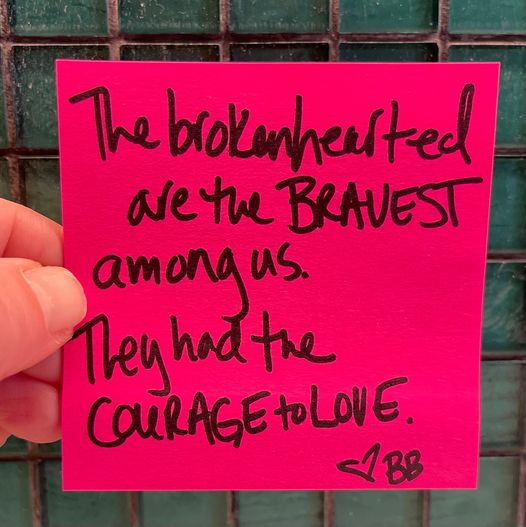
Today when I stand facing the thorny brambles of revisiting those old traumas, I am an older, wiser and more self-compassionate woman. My tools are knowing my own value and self-worth. I recognize that I have overcome some really painful, challenging life experiences and am still standing. I also know that in spite of mean, spiteful and deeply hurtful actions of others, my tender heart remains unchanged. My loving heart may be bruised, scarred and creviced, but it is capable of deep love and true warmth. In fact, I am certain that my brokenness is what allows more light and empathy into the deepest part of my very being. I have an innate understanding of the human condition precisely because of the pain I have endured.

In some ways, it is like having a crystal ball. I envision my crystal ball look as a snow globe. I can look at my young granddaughter as though she is in a delicate glass snowglobe, shake it and watch the fairy dust of snowy white sparkles drift over her. I can hear her laughter and I can wrap her in my arms when life hits her hard, offering comfort and assurance that she is loved, safe and protected. My wish for her, and all my grandchildren, is that this is their true foundation.

My improved self-awareness in my 60’s means that I am a better advocate for my innocent and vulnerable grandchildren. Of course, I will not be able to protect my grandchildren from life’s hardships, but I will hold space for them, I will honor their true feelings and I will be a source of comfort and strength. Awful things happen in life — how we show up for others in there hour of need is paramount. This is how we help our young people grow their character, their values and their resilience.

I am a crusader for my grandchildren. I will never watch silently as an adult carelessly and unconsciously strips a child of their worthiness or their need to feel safe and protected. While much of life’s challenges and heartbreaks cannot be changed, how we treat others is fully within our power. I have zero tolerance these days for adults who expect more from their young children than they do themselves. How can you expect a little one to have emotional regulation and patience if you are not role modeling that for them? Let’s face it, we are all imperfect and we will make mistakes but even then we have precious teaching moments and an opportunity to restore trust and worthiness. Our greatest tools in these moments are personal accountability and sincere apology.

These transformational tools must be used swiftly. I cannot stress this enough. We can circumvent serious emotional damage and development of unconscious protective behavioral patterns by owning our mistakes and hurtful actions and offering a sincere apology. Not just I am sorry, but a true commitment to change.

Imagine a fiesty preteen girl being told by her birth father that she’d be pregnant by the time she was 16. For three years she’d carry this in her heart like a heavy rock weighing her down. On what should be a very happy milestone 16th birthday, she bounds down the stairs and asks her mom if she should call him and tell him he was wrong — very wrong — about her on so many levels. It is caustic, toxic actions like this that plant the seeds of unworthiness in an innocent child. This young woman will carry this with her all her life – it is her emotional baggage packed and handed to her by a careless adult.

This is another example of a sliding door moment in life. That birth father could have realized what an awful thing he said to his daughter and he could have immediately apologized. Perhaps he was angry about something else and directed all that pain at his daughter. But years go by and he’s long forgotten he ever uttered those words to her. Yet she carries them buried in her heart and they will shape her through the years. She will always have a nagging inner voice telling her she is “less than” and there will be days she believes it. When people let her down, she will see it as proof of her own unworthiness. It will make recovery from life’s blows all the harder. When she becomes a mother, she will make every effort to ensure her own child feels completely loved and accepted, just as she is. It will take this woman years to undo the silent messaging that she is unworthy of love and belonging. And this is precisely why swift action is needed when we screw up.

I do believe that each generation becomes better at parenting in a healthy way by learning from our own parents what we do not want to repeat. This has been a guiding principle for me and many of my friends, and we are seeing that unfold with our adult children as they raise their own families now. I am also grateful for the work that Brene Brown has done to bring out into the wide open just how these very real life experiences impact us emotionally and psychologically throughout our lives. Which is precisely why we need to do our own “clearing and excavating” work. In my viewpoint, Brene has been a leading catalyst for making very public the critical need for all of us to dive into self-discovery and to support each other in a wholehearted way when we find the courage to do so.

It is my hope that my gardening metaphor will become a strong visual for consideration should someone ask you to help them as they are pulling weeds and emotional brambles from their own stories.

Almost a year ago, my lifelong friend, Judy Chesters, told me that we still had a lot of deep diving to do into our work of “emotional excavation”. Admittedly she caught. me by surprise because she and I have worked so hard for over 5 years supporting each other through a lot of processing of archived traumas and self-discovery. All I can say now is that she must have had a crystal ball of her own — for after a year of pandemic and unprecedented uncertainties she was so very right. Both she and I have gone much deeper into our own stories. The healing and empowerment that we have gained is almost hard to explain but how we both feel is much more grounded, expansive and light. I shared with her one day that I describe it as “rare air, deep water.”

When I am in that space of “rare air and deep water”, I let my imagination run free and wild. I envision my grandchildren traveling through their incredible lives without emotional baggage and scarred hearts — no limitations on their creativity, worthiness and ability to live authentic wholehearted, free-spirited lives. I imagine a world where we give to each other an enriching environment and nurturing support to be our best selves. Amy Davis

Helpful Resources:

RISING STRONG by Brene Brown.

Check out this overview: https://www.meaningfulhq.com/rising-strong.html

RADICAL ACCEPTANCE by Tara Brach

Read this summary by GoodReads: https://www.goodreads.com/book/show/173666.Radical_Acceptance

Check out this recent Typology Podcast with Ian Morgan Cron for some personal insights on the value of doing your own “shadow work” and the rewarding personal evolvement that grows from doing that self-discovery work. https://www.typologypodcast.com/podcast/2021/11/02/episode04-034/audreyassad