My “Starfish on the Beach” Moments

As many of you already know, I recently launched my Daily Gummy of Wisdom email program and it has been met with so much interest, encouragement and compelling conversations. I wanted to take this time today to highlight a few of the gummies that have really landed with people and the stories they have shared with me. This is exactly what I had hoped would come from the creation of my Daily Gummy of Wisdom. Together, we are all getting better at self awareness and “each other” awareness; we are finding new approaches to old, familiar problems; becoming more skillful in our own emotional regulation and in turn, we are supporting others with their own emotional health — especially children.

I launched the Daily Gummy email program to help those who were dialing back their social media consumption. The Gummy gets popped into your inbox at 6:45 a.m. each day. You can start your morning with this engaging food for thought and find that you just might tap into it for an interaction at home or work. Some are using the Daily Gummy as a mindful break mid-morning or mid-afternoon. A little pick me up and that “refresh” that music producer Rick Rubin says is so invaluable to keep us attentive and engaged with our daily life. Others find it a great way to wind down at day’s end. That’s the beauty of the Daily Gummy — you can use it when it best works for you. Our emotional health can benefit from a supplement morning, noon or night.

Think of the Daily Gummy that lands in your inbox as the physical health supplements you store in your bathroom or kitchen cabinet. It’s on the shelf, readily available, and you can take it when it best works for you. No need to wade through a barrage of social media content.

What has so pleasantly surprised me is how the Daily Gummy is being shared with others. Some of my subscribers have created their own expanded email list of family and friends — and they forward the day’s gummy with some thoughts of their own. A few like to print them out and discuss them with the family at dinner or over coffee with friends. Sometimes they get printed out, tucked in an envelope with a personal note and placed in a teen’s backpack or sent to a family member across the country. They are used to seal a yoga practice, as a prompt for writing classes, to open discussions in support groups, and even incorporated into a pastor’s Sunday sermons.

Sometimes I am the recipient of a Daily Gummy.

A subscriber will write to me and share how a certain gummy landed at just the right time to help them reflect on something that is weighing heavy on their heart. My friend, Diane Brandt, has often said that when we support others, the blessings go both ways and this is exactly how I feel when I hear the stories and learn more about what people are navigating. A mother reached out to me when one gummy was particularly helpful for her in supporting her 10 year old son and his emotional triggers. My photo really spoke to his heart; the image has become a touchstone for him.

When I was in my twenties, the starfish story really resonated with me; that image of a little boy walking on the beach tossing stranded, parched starfish back into the sea. An old man passed by him and questioned why he bothered. There was no way that he could possibly save them all. “Why does it matter?” he asked. The little boy responded, “It matters to this one.”

And that is exactly how I feel about my Daily Gummy of Wisdom. If just one person’s life is touched in a meaningful way by a photo and some insight, it matters. If, in turn, that person can reach out and support someone they love in a tender, compassionate and more skillful way, just imagine the impact it will have — the ripple effect.

Not every Daily Gummy lands at just the right time, but some will.

We are most definitely at the tipping point of remarkable breakthroughs for our emotional health. Quite a few of us are those proverbial stranded, dehydrating starfish on the beach. The more we know, the more we notice. This is how attending to our own emotional health not only helps us improve our quality of life, it raises our awareness of how we can support others in truly beneficial, impactful positive ways.

Here are a few of the Daily Gummies that have landed in recent weeks:
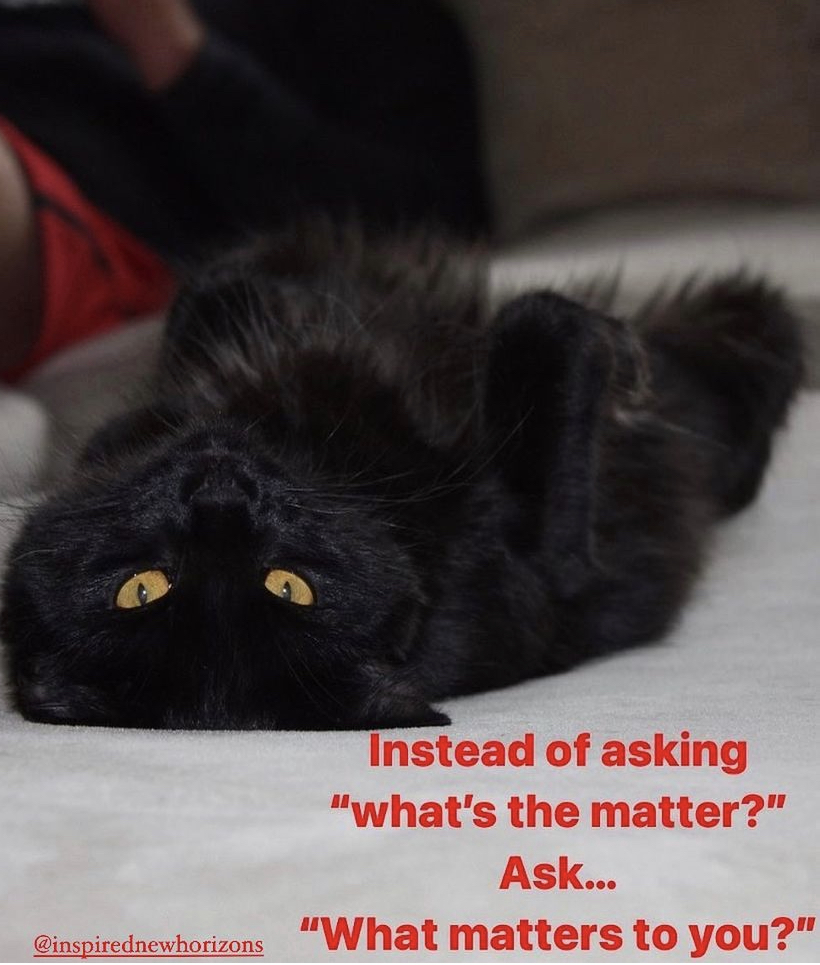
Asking “what the matter” limits our ability to gain real understanding of what another person is feeling — and it often ignites a strong desire in us to fix things right away.

Let’s be honest, how often do we utter “What’s the matter?” with a tone of voice that feels judgmental? Yes — a lot.

Think of asking “what matters to you?” as a much more skillful diagnostic tool. A way to probe a little deeper into discovery and be truly helpful in a meaningful way.

So often, we stay on the surface level of an issue, stating frustration or disappointment, but the real problem causing those emotions is tangled up in misunderstandings, miscommunication, differing opinions or scales of importance. Real problem solving is only possible when we drill down into core issues.

If you want to discover how powerful this diagnostic skill really is, try it for yourself. Next time you are feeling frustrated or annoyed – ask yourself “What matters to me?” Your honest answer will reveal a lot.

One of my close friends reached out to me about this Daily Gummy. She is very active in her community as a leader, a volunteer and a musician. Like me, she is a born helper. She confessed that she often rushes in to fix things, clean up a mess or solve a problem — and quite often without even asking out loud “what’s the matter.” She can see what’s the matter very clearly. (She just described me to a “T”). It dawned on her that quite often she was jumping in before she really understood what was really going on. She often found herself overcommitted, slightly resentful and puzzled why nothing was really changing.

My friend shared that re-arranging words and asking an important question differently, shifted everything. When she enters a situation now, she asks “What matters to you” and listens to learn. As a result, she is accomplishing a few things on her personal growth to do list. She is catching herself before she rescues others; she is becoming a good story steward and listening without judgment and pre-conceived ideas; she is able to set healthy boundaries for her time, energy and interests. And most importantly, those people she loves to help are feeling a deeper and more supported connection with her. Just look at how much positive emotional and relational change occurred by one dynamic question: “What matters most to you?”

Have you noticed how your mood changes throughout the day? It is truly astonishing how much our mood swings around and how little we pay attention to it. Why does it matter? Because our mood influences everything.

When we are in a good mood, we tap into our best natural resources. We are resilient, flexible, creative problem solvers. It’s like sporting a Teflon jacket — nothing negative sticks — not the traffic jam, the spilled milk or someone’s snarky comments. In fact, most events seem less like “problems” and more like “opportunities”.

But a bad mood — yikes! We trade the Teflon jacket for a magnetic catcher’s mitt. Our brain’s default negativity bias looks for — and finds — everything that’s going wrong. That same traffic jam was created just to make us late; the spilled milk is evidence we are doomed for a bad day; the snarky comment sets off a chain reaction critical self talk.

Mood swings can take us on a wild ride. And our mood impacts others. We rarely get the response and support we want when we are surly.

A new subscriber sent me an email with some adorable emojis to thank me for this image and the gummy which she is using in her conversations with her kids. She is helping them to see how a bad mood in one child can take the joy out of something her other child is having in the moment. Evidently they have had some hilarious discussions about being on the “mood swing”. She is so grateful for this image which really resonated for her young children; and how it gave them a way to openly express what they are feeling in the moment with both levity and honesty.

We are in a continuous flow of emotions throughout the day. Just like a whitewater rafting adventure, we never know what lies ahead in our emotional river.

As if it isn’t enough to navigate our own emotional flow, we are often in the same boat with others — each having their own unique experience. It’s a miracle that we can stay afloat!

That is why it’s so important to not “rock the boat” with unnecessary drama and out of control emotions. Every person’s experience is unique. Someone may be lamenting the adventure is coming to an end; and another relieved that it is over. One may be in awe of the expansive view; and another is reading a troubling text. One is tense, another is so relaxed.

The guide plays a key role. He is grounded, calm and has a deep rudder (i.e. skillful emotional navigation). Can you be that guide for others when emotions run high? Staying calm, being skillful with your own emotional flow and helping others with theirs — now that’s earning your emotional fitness badge.

This Daily Gummy reminded me of my life in my mid-40’s, when I was juggling a career change, two teenagers and a five year old, health issues and life in general. Bills to pay, meals to make, vacations to plan, holidays, boo-boos and the many overlapping needs of family members. I used to tell my friends that I was in the white water rapids of life without a paddle. I didn’t know much about emotional health at that time, so I would push through a lot of hard stuff without processing it. I made everyone else my priority firmly believing that if I took care of them, I too would be just fine. But I began to notice a pattern. I could push through for about three months and then I would be in a state of exhaustion that would land me in bed for a few days trying to recover from bronchitis or the flu. I’d recover and jump right back into the white water rapids, powering through and making up for that lost time by overcommitting. A few months later, I’d be tossed out of the raft into the level 5 white water rapids and I’d be sick again. My own version of rinse, repeat.

Besser van der Kolk tells us that the “body keeps the score” – and that is just one of the big lessons I learned the hard way. My body was trying to tell me that I could not stay afloat if I did not attend to myself. A big pivot for me was taking this to heart — both physically and emotionally. Busy parents can struggle a lot with self-care, emotional regulation and work-life balance.

The metaphor for me is that we cannot be skillful guides if we aren’t taking care of ourselves. We are not only better for our partners and children when we take care of our own needs, we are role modeling for our children and grandchildren the importance of physical, cognitive and emotional health for their own.

The white water rapids of life will be ever present. The change occurs when we become skillful life guides, with a bouyant flexible raft and a deep rudder.

I hope you have enjoyed discovering a few new things about my Daily Gummy of Wisdom and that you will sign up for the email program. Click this link to be added to the growing group of folks who are making their emotional fitness an integral part of their well being:

https://inspired-new-horizons.ck.page/3381cf137f
RECOMMENDED RESOURCES:
Pop a Daily Gummy of Wisdom Supplement

I am so excited to announce the launch of a brand new initiative to support our emotional health and overall wellbeing. My Daily Gummy of Wisdom is intended to be an awareness supplement to help us all maintain our emotional fitness.

We take vitamins and supplements to support our physical and cognitive health, so why not have a little daily boost for our emotional health and overall quality of life?

If you are a regular follower of my blog, Inspired New Horizons, then you might really enjoy getting these small, and potent, daily supplements to help you stay in shape as you develop better life skills and emotional regulation.

My Daily Gummies of Wisdom incorporate my love of photography with my passion for sharing information about personal growth, awareness, parenting, life skills and emotional health.

Here’s a sample of today’s Daily Gummy of Wisdom:

Daily Gummy of Wisdom – Monday, May 8, 2023

Create a little buffer zone between you and your different roles and varied experiences throughout your day. It is a simple little practice that can make a big difference.

Think about all the hats your wear in a day – parent, spouse, child, co-worker, friend, customer, neighbor — the list is endless.

We often just jump from one role to the other without a reset or refresh. When this happens, we drag some residue from each role or experience into the new one. That residue might be sticky — like a strong unsettling emotion that adheres to everyone and everything we touch.

We wouldn’t let our child run around the house, into the car or out into the neighborhood with sticky hands. We’d take a minute or two to wash those little hands that are capable of leaving gooey fingerprints all over the place.

This is what a brief buffer zone can do for you — it’s a little hand washing for your emotional and experiential residue as you transition from one role to another, or from one task to a new one.

It doesn’t take much time to do this — and the benefits are enormous.

Before you leave the house in the morning, as you close the front door, take a deep breath and let go. You’ve done as much as you could and how you are off to work, taking the kids to school, or heading to an appointment. Let go and look forward. Howe do you want to enter the new experience and greet those you meet there?

When you return home, as you close your car door and make your way to the front door, repeat that process. Let go. You’ve done all you could out and about today. You are home now. You may have pressing things you want to share with your family, but pause before barging in. You have no idea how their own day unfolded. Mentally wash your sticky residue so can listen with good intention and focus when you are reunited with your family.

If your emotional or experiential residue hacks some of your attention, you. may miss the smallest yet most rewarding moments of your day. That absolute delight on your child’s face to see you, that “there’s no place like home” feeling that washes over you.

When we give ourselves a little transition “hand washing”, we are more attentive and less reactionary. We treat ourselves to being more fully present and organically take in more of the good we often miss in life.

HERE’S THE CALL TO ACTION: Sign up below to get my Daily Gummy of Wisdom popped right into your inbox each morning. It only takes a minute or two to read….is great food for thought and has a lovely slow release factor all day long. The Daily Gummy will increase your awareness, help you stay in alignment with your core values and foster all those better life skills you are honing.

We read a lot of worthless brain junk food in our social media feeds throughout the day. Why not trade a little of that mindless scrolling for one high quality daily supplement for your emotional fitness and overall wellbeing?

Sign up right here: Click this link: https://inspired-nehorizons.ck.page/3381cf137f

We Are the Change Agents

I’d like to give an enormous hat tip to Dr. Peter Attia for championing the integral role our emotional health plays in the overall quality and length of our life. He is shining a beacon on the many ways that our emotional health impacts our physical and cognitive health, our most treasured personal relationships and maybe most importantly — how well we actually know ourselves.

From the outside looking in, Dr. Peter Attia certainly seems to be a shining example of living the good life. He has a hugely successful career in medicine, is a renowned authority on the subject of longevity and good health, is in great physical and cognitive shape, and is married with three children. He practices what he preaches. In other words, he has checked all the boxes for a successful, happy life.

Yet in recent years, while writing his newest book, Outlive, Dr. Peter Attia became acutely aware that there was a gaping hole in the complete picture of longevity and quality of life — emotional health. What good is checking all the boxes that outwardly give the impression of success and happiness, if in fact inwardly we are miserable?

Yes, we can be physically and cognitively very healthy; we can be proactive with preventive measures and early detection to ensure we live longer — and possibly longer without illness, disease or cognitive decline. But if we are unhappy, discontent and lack emotional regulation, we will continue to be miserable no matter how physically fit or mentally sharp we are; no matter how many measurements of success we seem to have achieved.

This is a true fact for so many of us. We have a very big blind spot about how our emotional health has taken its toll on us and our families, all while we have been actively checking off the boxes.

We can be so unaware of the impacts of our emotional health that we will unconsciously sabotage ourselves over and over again. Dr. Peter Attia uses the metaphor of Formula One racing to help us grasp the magnitude of ignoring our emotional health:

Just a few short decades ago, Formula One racing had a very high rate of death among its drivers because of the risk factors. The cars were engineered for performance not safety. Today that risk factor for death and serious injury has been dramatically reduced. What changed? The cars are now engineered for safety first and performance second. Minimize risk.

As Dr. Attia points out, we use risk factors all the time to help us minimize the risk to our physical and cognitive health. We intervene early to prevent infection, illness and disease. Yet we have been ignoring emotional health all the while.

No one asks the questions — “What is your risk for poor emotional health and what are we doing about it?

It has become very clear over the past decade or two that it behooves us all to reflect on how the old parenting models impacted us — and especially our emotional health. The risk factors for our emotional health are imbedded in those old parenting paradigms that disconnected us from understanding and effectively utilizing our emotions. Our emotions are an integral part of our brain/body connection and we are long overdue for a major upgrade to our human operating system.

Just look at all the advances that we have made in modern medicine to fight genetically inheritable diseases. We have been blind to the generational inheritances of poor emotional health. And now our eyes have been opened – we have a brand new pathway to addressing the quality of our emotional health.

Not only are we able to intervene early for our own emotional health, we can begin to ensure that our children get a head start on a lifetime of good emotional health.

We are the change agents; the ones that will break the cycles of dysfunction that got passed unconsciously from one generation to the next. We will advance human evolution by proactively integrating our emotions with our complex, developing brains.

Dr. Peter Attia shared with Dr. Andrew Huberman in a recent podcast that for most of his life he got really good at drywall repair – because he was dealing with an unconscious inner rage from trauma in his childhood – and that anger often had him punching a hole in the wall. In fact, it was that same anger and strong urge to punch a guy in a parking lot that made him realize he had to get help for his emotional disregulation. He realized in that moment that he could have lost everything he had spent his whole life building — his reputation, his career, his marriage and family – because of unchecked emotional health.

I just have to say that Dr. Attia still packs a punch — a positive and very healthy one. He punched a big hole in our blindspots when it comes to emotional health and the integral role it plays in the overall quality of our life.

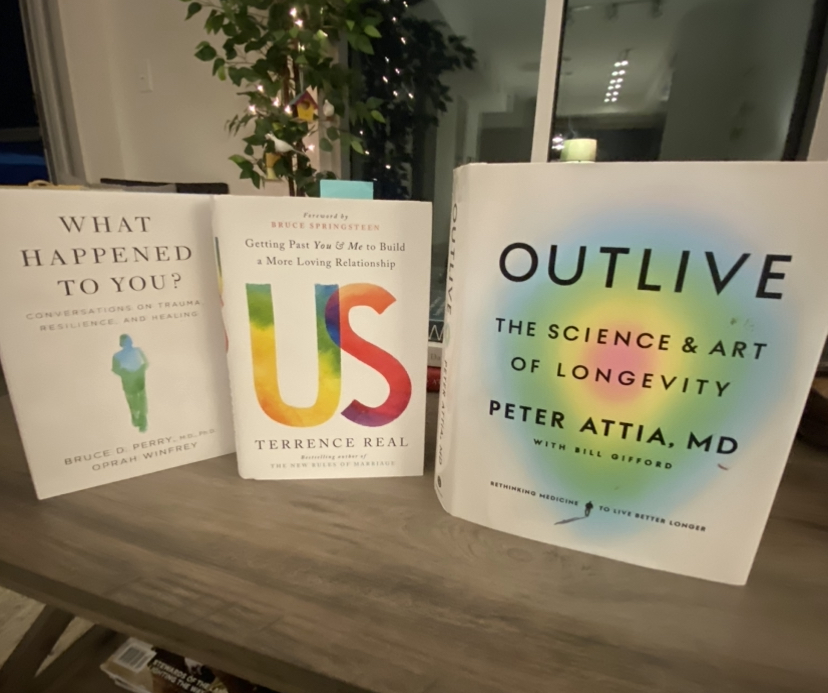
As I was reading Dr. Attia’s book, Outlive, I was delightfully surprised to discover that he had turned to two of my favorite resources to help him in his search and recovery process for emotional health — Esther Perel and Terry Real. I have long followed their work, participated in their seminars and read their books. It was Terry Real’s relationship summit in May, 2022 that prompted my blog post “Whatever He Has, I Want It” featuring Hugh Jackman’s journey with personal growth and emotional awareness.

Little holes have been being poked into our need to focus on emotional health from a diverse array of sources for several decades. Neuroscience has been paving the way as we make tremendous breakthroughs in understanding how our brains, bodies and emotions need integration in order to function optimally.

Changes are happening at a very fast pace now. Old methods once used for parenting, for treating trauma and mental health issues are being tossed out and replaced with protocols that focus on integration of emotions. Dr. Bessel van der Kolk even emphasizes that it is not necessary to go back and revisit all the re-traumatizing details of a childhood event. Instead, the focus and therapy becomes on how a person is feeling today, what they are experiencing in the present moment – and integrating that into more manageable responses to current experiences.

Dr. Attia explains that we can reframe this work as an “invitation to view our own young experiences through the eyes of our own child”. I wouldn’t be surprised if he learned that from Terry Real, who often says that the best motivation in the world for personal change is our children. Terry says that we might not change for our partners or ourselves, but we rarely resist change if we know it will help our kids.

Our emotional health is rooted in our childhoods. There is no doubt about that. It is crystal clear that we will be the change agents for breaking generational patterns of poor coping skills, unhealthy attachment styles, maladaptive patterns of behavior and lifelong poor emotional health.

Dr. Attia would encourage each of us to view our emotional health and its risk factors the same way that we view our physical and cognitive health. Dig into our family history, intervene early, develop healthier approaches and incorporate a daily maintenance program to support an ongoing healthy trajectory.

RECOMMENDED RESOURCES:

Develop a list of podcasts that become your “go to” playlist to support your emotional health. Here are a few of my favorites:

Learning What We Want to Teach

My last three blog posts have been dedicated to helping us understand how a child’s young brain develops. Understanding both the present limitations and the future potential of these incredible developing child brains is not only transformational for parenting — it is equally transformational for us adults. In fact, it may be the gateway we need to help us understand ourselves better.

If we overlay this new whole brain parenting template on our own childhood, it will become very evident that few of us got what was needed to provide integration between our young nervous systems and our future upper brain processing. The old parenting models did not have the benefit of the recent neuroscience and neurobiology breakthroughs; nor did these models address the invaluable role our emotions play in our mind/body connection.

This is precisely why Dr. Dan Siegel is such a strong proponent of adult personal growth work. We can’t teach what we don’t know. And in all likelihood, we were not taught emotional awareness and regulation, mind/body connection, and core relationship skills. I know that I never heard about co-regulation, attunement or attachment styles when I was growing up; and I didn’t read about them in my dog-earned copy of Dr. Spock’s child care book and no pediatrician ever explained brain development to me.

I had no idea that my own personal growth journey, started eight years ago, would lead me back to my childhood. It’s taken me a long time to excavate, unravel and detangle myself from the pitfalls of that old parenting model.

So many times throughout my eight years of self-discovery work, my friends and I would lament, “I wish I knew this stuff when I was younger.” That’s the gift embedded in hindsight. We truly can look back –with the insight and knowledge we now have — and see much more clearly how complicated our lives and experiences were because we were using coping strategies instead of meaningful life skills.

This is precisely why I feel so “connected” now when I’m interacting with my grandchildren — especially when they are overcome with big emotions. I intimately know how it feels to be little and overwhelmed; and I now have much better knowledge and tools for responding to them. I am playing an active role in teaching what “I wish I knew then.”

Looking Back Through the Lens of Hindsight:

I grew up in a very unpredictable and dysfunctional Petri dish. Like most in similar environments (very commonplace for my generation I have discovered), my coping strategies became my “super powers”. Just like Brene Brown, I too became hyper vigilant for the inevitable volcanic eruption of big emotional clashes between my parents and siblings. I became a first responder – calm under pressure; assessing both the situation and the damage quickly; applying first aid where needed and cleaning up the broken pieces. But my Nurse Nancy crisis tool kit had only “aftermath” tools in it. I can’t tell you how many times as a little girl I longed to live in an environment where first responders were not the order of the day.

I went out into the adult world wanting calm stability more than anything. I naively believed that I could somehow “create and maintain” that stable calm; possibly avoid unnecessary drama and routine chaos and crises.

Hindsight is the crystal clear rear view mirror that reminds us that life is as unpredictable as the ocean. We can’t avoid stormy seas, bad weather and engine troubles with our boat. All I brought with me from childhood was a tattered Nurse Nancy first aid kit and emergency responder capabilities (i..e. poor coping strategies and childlike behavioral patterns). What I have come to appreciate is the value embedded in Whole Brain Parenting — of being raised to be the “captain of our ships”, to trust our internal GPS system (emotions), and to have a fully integrated operating system (all parts of our complex brains).

Imagine the confidence and empowerment that would come when stepping into the adult world better pre-loaded and prepared for all the elements. Eighteen years of real life experiences, in meaningful, daily apprenticeship with our skillful parents, learning how to successfully navigate good times, adversity, obstacles and necessary course adjustments. This just takes my breath away — it is so exhilarating.

That Sticky Emotional Undertow:

Regardless of the entry point for self-discovery and personal growth, sooner or later we will come to realize that what happened in our childhoods did have some long lasting impacts on how we view ourselves and how we are showing up in the world as adults. That has surely been my personal experience. As I began to peel the layers off my own life onion, I discovered blind spots and behavioral patterns that had their origins in my childhood.

In my last blog post, I shared that my number one goal as a parent was to “calm” a distressing situation as quickly as possible. That was my childhood conditioning taking charge of what I was feeling coursing through me – even though it was now my own child who needed my attention first and foremost. (Just a little relevant reminder here — I stepped into adulthood craving calm). I did not have any bandwidth left at that time to cope with what I perceived as unnecessary hardships and drama.

My poorly functioning emotional system had a faulty modulator. My own emotional discomfort at witnessing my child in distress hijacked my logical brain. I needed things to be calm; I wanted my kids to be calm again — but all along it was me who needed to be the calm. The emotional undertow from my childhood was strong; like a rip tide.

I grabbed my first responder kit and leaned hard on what got me through my childhood, with a heaping dose of good intentioned consoling in the form of special activities, cookies or fun distractions — after all, I had the agency now as a grown up to offer these comforts to my child. (See the pattern? See how I was not able to “pre-load” and “teach” what I didn’t know?). My instinct was “get to calm” quickly and my “go-to’s” to achieve this was consoling (not connecting); tangible comforts with a short shelf life (not teaching emotional awareness, regulation and resilience). It was the old paradigm of dismiss those feelings, get back to happy, have a treat.

The flip side of this double-edged conditioning was that in my adult relationships, I’d stuff my emotions to give the appearance of being calm, reliable, self sufficient. I had a black belt in this coping strategy from childhood. I was the compliant child, the one my parents could count on to never make a scene or cause embarrassment. What I didn’t know was that stuffed emotions become the tempest in the tea pot.

These exiled emotions don’t go away and they don’t go silent. In fact, they will just keep pounding on the door trying to get our attention for the things that do matter most to us. When my emotions demanded that I let them out of storage, I would have an uncharacteristic, unreasonable blow up over something minor — which would cause me both shame and embarrassment. Or….I’d be engulfed in the mire of resentment on the inside while I gave the appearance of being the happy, efficient, dependable “helper” on the outside.

Stuffed emotions will most assuredly not ensure calmness. Stuffed emotions rock the boat.

Both of these scenarios — of me as a parent and of me as a partner – show how taking those childhood blueprints into the adult world become a “doubling down” of the very things we are trying to prevent. I’d ask myself over and over (for decades) why my well-intentioned parental lessons weren’t sticking; and why I was often cleaning up other people’s consequences of their own actions. I could not see the neon yellow post it note on my forehead that said “First Responder”.

Learning What We Wish to Teach:

I am no longer swooping in to stressful situations unconsciously trying to soothe and comfort my own younger self. Yes, I now have awareness that so often throughout my life, I was often doing just that — unconsciously trying to comfort myself at the same time I was attempting to care for others. I could literally feel my emotions (both old and new) swirling all through my body and I did not have the awareness or tools to attend to myself first — and then turn my full attention and skills to another.

As parents and grandparents, we have to put our own oxygen mask on first.

Being swept away in our emotional and somatic vortex will not help us attend to the basic human needs of our children in the calm and grounded foundational ways needed to be effective “teachers.” It will also not help us in being healthy, flexible, supportive partners.

This is precisely why Dr. Dan Siegel believes that the key to becoming a better parent, partner or grandparent is to begin by examining our own childhood:

How you make sense of your own past is the best predictor of how your child will get along with you. So, try out that work first. It’s amazing how often people then find unbelievable liberation — by just that knowledge…..that it isn’t what happened to you, it’s how you made sense of what happened to you.”Dr. Dan Siegel (on Becoming a Better Parent)

Dr. Siegel suggests we begin with our childhood attachment style. Discovering that our childhood attachment style may have been avoidant, ambivalent (anxious or preoccupied), dismissive or disorganized can shine a lot of light on our present day issues in life and our relationships. As he reveals, it can even help us discover why we may be having trouble relating to our own kids (in spite of our best intentions).

Start exploring who you were as a kid, who were your parents and how they influenced your development. It is not what happened to you as a child, it is how you made sense of what happened to you. People often freak out and are very resistant to going back to examine their dysfunctional or painful childhood. Yet if you focus on your own history — and in a methodical way — go through your memory systems, go through your narrative system, you can actually liberate yourself from the prisons of the past. This is supported by brain plasticity studies.” — Dr. Dan Siegel (on Becoming a Better Parent)

For the record, the prisons of the past are limiting beliefs we have about ourselves, emotional triggers that hijack us from staying calm and present in the moment, poor emotional regulation, our default (outgrown) behavioral patterns, and our inner critic. Clinical psychologist, Becky Kennedy shares that “our voice to our kids becomes their voice to themselves.”

I can attest to the liberation that Dr. Siegel says is possible. Going back through both memory and narrative was well worth my time and effort. I’ve often shared with friends that I opened up a lot of “real estate” for new and better ways of being. This inner work serves as a really good indicator light when I am faced with a familiar situation, but can catch myself before stepping into an old unhealthy pattern or reaction.

If we don’t cultivate our self-awareness and replace outdated reactions with better life skills and tools, we will inadvertently be teaching our kids the very patterns and coping styles we adopted in childhood. Good intentions alone are not the path forward. We need to be working on the same emotional regulation skills and relationship tools that we wish to teach.

I found the enneagram to be a very helpful accompaniment for this methodical work that Dr. Siegel proposes — and for teasing apart all the ways that childhood attachment styles contribute to our emotional armor and adaptive behavioral patterns. Even if you don’t determine what your own enneagram type might be, reading through all nine types descriptions and typical behavioral patterns is incredibly helpful for understanding ourselves and others.

The enneagram can be a window into the inner world of others and what may be submerged in their childhood. I found that it really helped me to recognize that how others were “showing up” in life was driven more by their core needs than by the relationship dynamic we’d created. This fresh perspective was enough to help me shift how I could show up in better ways for others; and it helped me not to take things so personally.

This is a meaningful link between attachment style and our behavioral patterns. We are often using those old childhood blueprints to get our adult needs met only to discover things are backfiring. We push away what we want the most; we make it hard for people to support us; we aren’t clear in our needs or boundaries.

The enneagram helps us understand just how those developing little brains of ours lacked the integration of what we were feeling in our young bodies with an upper brain that could help us make sense in a logical, more mature way. If our parents were disregulated, we learned to navigate disregulation. If there was a lot of chaos and uncertainty, we learned to silence our needs. Maybe we became compliant or defiant, peacemakers or troublemakers.

These childhood strategies worked because we came to count on the predictability of the unpredictably of our internal family systems. As children, we grew to know our parents and siblings patterns of behavior very well. So even if it was a Petri dish of uncertainty, confusion or volatility, we had our own “go to” patterns — all formed out of reactivity not inner resources.

Once we go into adulthood and start building our own lives and relationships, the Petri dish changes. The once familiar predictability of our family unit is replaced with new people bringing their own internal family systems with them into new relationships. Now we are in a whole new environment and we are fish out of familiar water.

I once saw an Australian TV show where a new love interest shows up for the main character, with an entire room full of suitcases, roller bags and totes — with a shoulder shrug and an impish smile, he announces “this is my emotional baggage.” Talk about a powerful image to drive home the point about all that we bring with us into our relationship dynamics and parents. The tap roots of our coping methods and behavioral traits can be traced back to childhood.

Here’s where things get even more interesting. In Atlas of the Heart, Brene Brown shares with us that a lot of emotions show up looking very similar to each other but in fact can be quite different. So, if we operate on only on sparse emotional knowledge, we may mistake a partner’s or child’s emotion for anger when it is really fear or confusion.

Brene’s research for Atlas of the Heart revealed that most of us have a very limited emotional vocabulary — happy, sad or angry. How can we possibly be teaching our children the invaluable gifts of our emotions if we possess such a limited understanding ourselves?

The relatable personal stories woven into Brene’s book will help shed even more light on how our childhood impacts our adult relationships and parenting. Atlas of the Heart is yet another remarkable resource for becoming better “teachers”. Brene Brown expands our emotional vocabulary and granularity from three to 87 familiar emotions and lived experiences.

Cultivating Self Awareness and Honing Our Teaching Skills:

Just look how much we have changed with each generation in order to protect our kids and learn from our past experiences. To be honest, a lot of the things we take for granted today were met with a lot of resistance early on. Just listen to Malcolm Gladwell share how reluctant we were to use seat belts in our cars! Can you imagine any new parent not putting their newborn in an infant car seat, in the backseat, for the drive home from the hospital? Can you imagine teaching a young child to ride a bike without a protective helmet?

All that we are learning from neuroscience, neurobiology, epigenetics, psychology and the social sciences are making very clear where we can do better — for ourselves and our children. As I have shared before, in just one generation, we can make the giant pivot in the right direction for present and future generations; for quality of life, the ability to successfully navigate the uncertainties of life, for strong inner resources, flexible relationship skills, emotional literacy, empathy and a grounded confidence in their own self worth.

The first step is learning what we need to teach. That requires being amenable to looking back at our own childhood with self-compassion, with honesty and clear eyes. Dr. Dan Siegel says that people are resistant to this because they don’t want to revisit painful memories. As Shrek would say “better out than in.”

“Better out than in” – one of Shrek’s most notable lines – means that rather than stuffing things (emotions, events, waste and irritants) into your being, it’s far better to have them processed, integrated, and/or released.

I believe in this process of looking back at our childhood and learning from our experiences through the lens of hindsight and new research. It is liberating and it feels expansive to be unburdened from old self imposed limitations.

I strongly believe that reframing parenthood as an “18 year apprenticeship for life” will lead to great teaching moments with our kids that we otherwise may have missed.

RECOMMENDED RESOURCES:

Listen to this converation about parenting with Adam Grant and Clinical Psychologist, Becky Kennedy:
Bringing Out the Good in Kids — and Parents
https://podcasts.apple.com/us/podcast/bringing-out-the-good-in-kids-and-parents-with-becky-kennedy/id1554567118?i=1000597939810
What a timely episode of Being Well. This one is chock full of invaluable insights about the body/brain connection and somatic psychology
Using the Body to Heal the Mind with Elizabeth Ferreria (2/27/2023)
https://podcasts.apple.com/us/podcast/being-well-with-forrest-hanson-and-dr-rick-hanson/id1120885936?i=1000601823501

You’ll want to listen to this podcast on Attachment Styles – Dealing with Common Symptoms and Becoming More Securely Attached (2/20/2023)
https://podcasts.apple.com/us/podcast/being-well-with-forrest-hanson-and-dr-rick-hanson/id1120885936?i=1000600561917
Please visit Dr. Dan Siegel’s Website to access all his incredible content and tools for Whole Brain Parenting, for his groundbreaking development of Mindsight and for greater insights into the impact of childhood attachment styles.
https://drdansiegel.com